
Catalogue Search | MBRL


Are you sure you want to remove the book from the shelf?

{{itemTitle}}
477
result(s) for
"Papal courts."
Sort by:

Diplomacy in Renaissance Rome : the rise of the resident ambassador
\"Diplomacy in Renaissance Rome is an investigation of Renaissance diplomacy in practice. Presenting the first book-length study of this subject for sixty years, Catherine Fletcher substantially enhances our understanding of the envoy's role during this pivotal period for the development of diplomacy. Uniting rich but hitherto unexploited archival sources with recent insights from social and cultural history, Fletcher argues for the centrality of the papal court -- and the city of Rome -- in the formation of the modern European diplomatic system. Part I introduces the political context from the return of the popes to Rome, the 1454 Peace of Lodi and after 1494 the Italian Wars; the assimilation of ambassadors into the ceremonial world; the prescriptive literature; and trends in the personnel of diplomacy. Part II takes a thematic approach, exploring travel and communication practices; the city of Rome as a space for diplomacy; and the world of gift-giving\"-- Provided by publisher.
Book
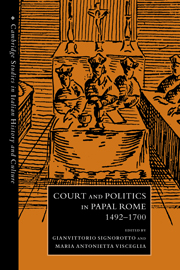
Court and Politics in Papal Rome, 1492–1700
This 2002 book attempts to overcome the traditional historiographical approach to the role of the early modern papacy by focusing on the actual mechanisms of power in the papal court. The period covered extends from the Renaissance to the aftermath of the peace of Westphalia in 1648 - after which the papacy was reduced to a mainly spiritual role. Based on research in Italian and other European archives, the book concentrates on the factions at the Roman court and in the college of cardinals. The sacred college came under great international pressure during the election of a new pope, and consequently such figures as foreign ambassadors and foreign cardinals are examined, as well as political liaisons and social contacts at court. Finally, the book includes an analysis of the ambiguous nature of Roman ceremonial, which was both religious and secular: a reflection of the power struggle both in Rome and in Europe.
eBook


Papal Justice
Examines the motley shape of the pope's territorial domain, the institutions found there, and the relationships between Rome and its outlying cities. Microhistories of how things worked form a clear picture of relations between the sovereign and his subjects.
eBook

Marriage on Trial
This work vividly describes many of the individual cases and offers new insight into the social and legal pressures on marriage in the Middle Ages.
eBook
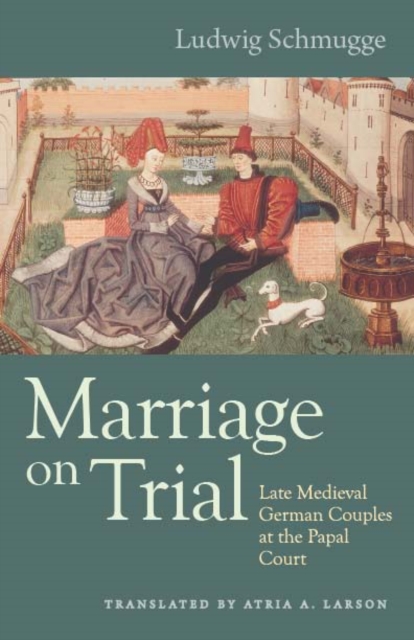
Marriage on trial : late medieval German couples at the papal court
This work vividly describes many of the individual cases and offers new insight into the social and legal pressures on marriage in the Middle Ages.
eBook

Twilight of the Renaissance
Diplomat, courtier, and heretic, Juan de Valdés (c.1500-1541) was one of the most famous humanist writers in Renaissance Spain. In this biography, Daniel A. Crews paints a lively portrait of a complex and fascinating figure by focusing on Valdés's service as an imperial courtier and how his employments in Italy - after brushes with the Spanish Inquisition - influenced both Spanish diplomacy and his own religious thought. Twilight of the Renaissance focuses on Valdés's political activities in Charles V's Italian alliance system and negotiations with the papacy, while painting a lively portrait of an intriguing and complex Renaissance figure.
Crews examines how Valdés, who was praised by two popes and, the emperor, was also branded a heretic almost immediately after his death. By considering Valdés's spirituality, as well as egotism, this incisive work reveals how the libertine atmosphere of the late Renaissance challenges the saintly Socratic image Valdés fashioned for himself in his writings.
eBook

Thirteenth Century England XI
Editors: Janet Burton, Björn Weiler, Philipp Schofield, Karen Stöber. The thirteenth century brought the British Isles into ever closer contact with one another, and with medieval Europe as a whole. This international dimension forms a dominant theme of this collection: it features essays on England's relations with the papal court; the adoption of European cultural norms in Scotland; Welsh society and crusading; English landholding in Ireland; and dealings between the kings of England and Navarre. Other papers, on ritual crucifixion, concepts of office and ethcis, and the English royal itinerary, show that the thirteenth century was also a period of profound political and cultural change, witnessing the transformation of legal and economic structures [represented here by case studies of noblewomen and their burial customs; and a prolonged inheritance dispute in Laxton]. This volume testifies to the continuing vitality and [with contributors from three continents and six countries] international nature of scholarship on medieval Britain; and moves beyond the Channel to make an important contribution to the history of medieval Europes. Contributors: ROBERT STACEY, FRÉDÉRIQUE LACHAUD, STEPHEN CHURCH, CHRISTIAN HILLEN, JESSICA NELSON, MATTHEW HAMMOND, KATHRYN HURLOCK, NICHOLAS VINCENT, ADAM DAVIES, HUI LIU, EMMA CAVELL, DAVID CROOK, BETH HARTLAND.
eBook
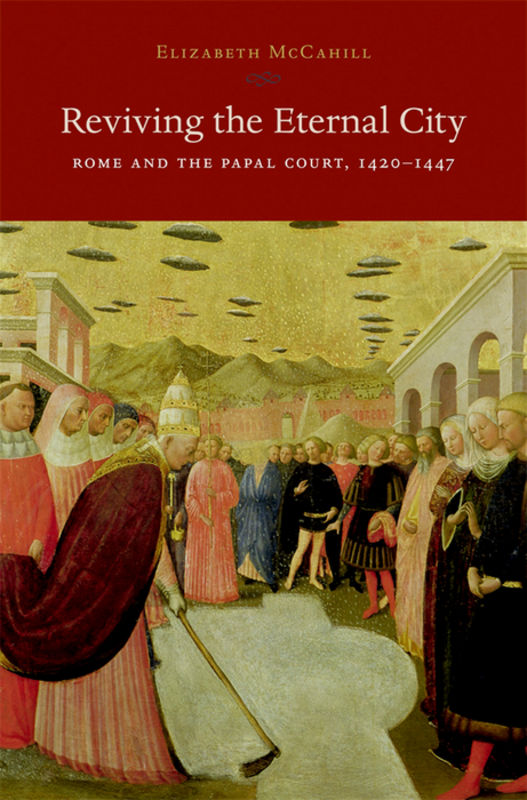
Reviving the eternal city : Rome and the Papal Court, 1420-1447
In 1420, after more than one hundred years of the Avignon Exile and the Western Schism, the papal court returned to Rome, which had become depopulated, dangerous, and impoverished in the papacy's absence.
eBook
Professional Canon Lawyers: Advocates and Proctors
By the beginning of the fourteenth century, lawyers turn up everywhere in contemporary documents. This is no doubt partly an artifact of the records, since activities that involved advocates, proctors, judges, and notaries produced enormous masses of written matter. The great majority of all surviving medieval records are in fact legal documents of one sort or another. While their prominence in the records may give an exaggerated impression of their ubiquity, professional lawyers, judges, and notaries constituted a substantial and prosperous element within most late medieval towns and cities whose population records have been studied. Papal courts and tribunals required the services of substantial numbers of trained lawyers, as did administrative offices, where they were commonly deemed more flexible and tactful than theologians.
Book Chapter