
Catalogue Search | MBRL


Are you sure you want to remove the book from the shelf?

{{itemTitle}}
993
result(s) for
"Paradise in art"
Sort by:
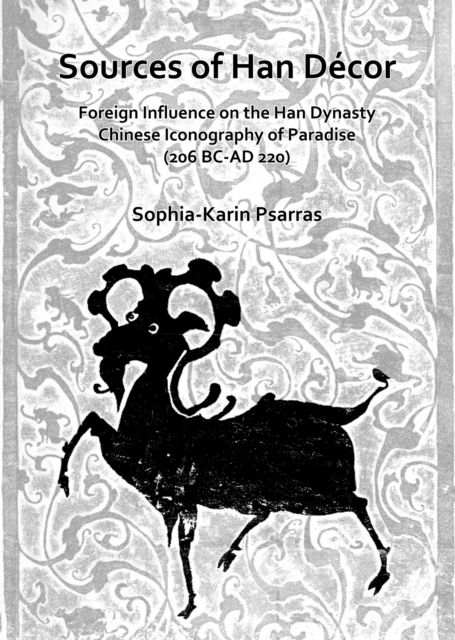
Sources of Han Décor
Using archaeological data to examine the development of Han dynasty Chinese art (206 BC-AD 220), Sources of Han Décor focusses on three major iconographies (the animal master, the tree of life, and animal predation), together with a series of minor motifs (particularly the griffin and a number of vegetal forms). All of these are combined in what may be considered the most important iconographic creation of the Han: images of paradise. While influence from the Chinese Bronze Age (especially, c. the 14th-3rd centuries BC) on Han art is expected, a surprisingly profound debt to Greece, the Near East, and the steppe is evident not only in the art of the Han era, but in that of the preceding Eastern Zhou (c. 771-221 BC). Initial Eastern Zhou incorporation of this largely-Western influence appears concentrated in chronological parallel to the Orientalization of Greek art (c. the 7th century BC) and the eastern spread of Hellenism (c. the 4th century BC), followed by repeated introduction of foreign motifs during the Han, when these influences were fully integrated into Chinese art.
eBook

Imagining Gay Paradise
Mages of Manhood asks the question: How have gay/queer men in Southeast Asia used images of paradise to construct homes for themselves and for the different ideas of manhood they represent? The book examines how three gay men in Bali, Bangkok, and Singapore have deployed different ideas of “paradise” over the past century to create a sense of refuge and to dissent from typical notions of manhood and masculinity. For the disciplines of queer studies, gender studies, communication, and Southeast Asian studies, it provides (1) a “queer reading” of Walter Spies, a gay German painter who in the 1930s helped turned Bali into an island imagined as an ideal male aesthetic state; (2) a historical account of the absorption of Western notions of romantic heterosexual monogamy in Thailand during the reign of King Rama VI, providing an analysis of his plays, and the subsequent resistance to those notions expressed through an erotic, architectural paradise called Babylon created by a post-World War II Thai named Khun Toc; and (3) an account and analysis of the “cyber-paradise” created by a young Singaporean named Stuart Koe. The book examines their pursuit of sexual justice, the ideologies of manhood they challenged, the different types of gay spaces they created (geographic, architectural, online), and the political obstacles they have encountered. Because of its historical sweep and its focus on the relationship between gay men and ideas of Edenic space, it makes an important contribution to understanding gay/queer life in Southeast Asia.
eBook

Milton on Film
In January 2012, shooting was set to begin in Sydney, Australia, on the Hollywood-backed production of Milton's Paradise Lost, with Oscar nominee Bradley Cooper cast as Satan. Yet just two weeks before the start of production, Legendary Pictures delayed the project, reportedly due to budgetary concerns, and soon the company had suspended the film indefinitely. Milton scholar Eric C. Brown, who was then serving as a script consultant for the studio, sees his experience with that project as part of a long and perplexing story of Milton on film. Indeed, as Brown details in this comprehensive study, Milton's place in the popular imagination—and his extensive influence upon the cinema, in particular—has been both pervasive and persistent.
eBook

The satanic epic
The Satan of Paradise Lost has fascinated generations of readers. This book attempts to explain how and why Milton’s Satan is so seductive. It reasserts the importance of Satan against those who would minimize the poem’s sympathy for the devil and thereby make Milton orthodox. Neil Forsyth argues that William Blake got it right when he called Milton a true poet because he was \"of the Devils party\" even though he set out \"to justify the ways of God to men.\" In seeking to learn why Satan is so alluring, Forsyth ranges over diverse topics--from the origins of evil and the relevance of witchcraft to the status of the poetic narrator, the epic tradition, the nature of love between the sexes, and seventeenth-century astronomy. He considers each of these as Milton introduces them: as Satanic subjects.
eBook

Contrapasso, Violence, and Madness in Dante’s The Divine Comedy and Westworld
The medieval epic poem, The Divine Comedy, and Jonathan Nolan and Lisa Joy’s prestige drama, Westworld, have more in common than at first meets the eye. Both represent hellish and purgatorial geographies, both physical and psychological. And both share the view that what is regularly considered “perfect liberty”, or the liberty to indulge in any and every desire one wishes to with impunity, is in fact a form of slavery, as argued by Aristotle. Both the denizens in Dante’s Inferno and the guests in Westworld’s park, therefore, are ensnared by their own desires. This article will consider the structure of Dante Alighieri’s The Divine Comedy and Jonathan Nolan and Lisa Joy’s hit HBO show Westworld, which I will argue takes parts of its structure consciously from Dante’s The Divine Comedy. And though at the outset, the two works of art appear dissimilar, the theologically and philosophically infused medieval Catholic-Italian poetry of Dante and the sensuous, nihilistic, and provocative story-telling of Jonathan Nolan’s recent work on the generation and expression of consciousness, ultimately what they share is similarity in structure and an agreement on the connection between activity, suffering, madness, perfection, consciousness, and freedom of the will from sin.
Journal Article

The Creator and the Creative Process in Milton’s Paradise Lost: A Lyrical Analysis
This book is an in-depth lyrical and structural analysis of Milton's epic poem Paradise Lost and his representation of the biblical creation story of the Book of Genesis. It combines approaches of critical biblical exegesis and literary comparative methods to analyze Milton's concept of creation and his depiction of creative processes and productive elements in his narrative, particularly with regard to style, imagery, structure, meaning and mythological origin. The central part of the book involves an analysis of Milton's portrayal of the role and identity of the creator and that of his creatures and explores Milton's interpretation and symbiosis of Christian and Classical concepts. Furthermore, the relationship between the creator and his creations and the occurring conflict between them is going to be examined together with the subsequent deconstruction and reconstruction of God's creation. The book also discusses Milton's own role as a poet, author and creator and puts it in relation to his work, life, and narrative style.
eBook

Rose, Tulip and Peony: The Image of Paradise and the “Localized” Islam in China
Al-Janna—Paradise—is the most important image of the afterworld in Islam. The Qur’an describes paradise as an oasis. Along with the spread of Islam, the image of paradise has gradually transformed into a garden with blooming flowers, where different Muslim groups chose their favorite flower based on their local knowledge and custom. Thus, the Persian, Turkish, and Hui peoples of China chose the rose, tulip, and peony as their respective flowers symbolizing paradise. We argue from these cases that as a world religion, Islam is locally practiced and understood, with many different variations.
Journal Article

BOOK REVIEW; Renegades in the sun: '60s art in L.A.; People, places and moments from the era are sketched out in anecdotes and details
More Vanity Fair than standard art history, it's an affectionate, deliciously gossipy account of the decade when a convergence of renegade artists, entrepreneurs, curators, collectors and writers put Los Angeles on the art world's map.
Book Review

Personal is political: the alchemy of happiness in Arundhati Roy’s The Ministry of Utmost Happiness
From the title to the text, happiness matters in The Ministry of Utmost Happiness. However, happiness has garnered less critical attention than the text’s political, cultural, social, gendered, and realist readings, implicating the impossibility of achieving ‘utmost happiness’ in the post-9/11 world rife with political chaos. Alternatively, this paper claims that by defying the limitations of a political vision, oppressing gendered norms, and social structures that ensnare individuals in unhappy states, the drab graveyard where, Anjum- the Muslim transgender first takes up residence after failing to find happiness in Duniya and Khawabgah, and later sets up ‘a People’s Pool, a People’s Zoo and a People’s School’, the personal becomes a space where everyone, irrespective of gender, class, caste, and religion, can live together happily. Based on this counter reading of the text, this study divulges Roy’s optimistic invocation of the connection between the personal and political as an imaginative manifestation of the alchemy of happiness, which was theorised by Muslim philosopher Ghazali–whereby the divine contemplation experienced at the personal level contributes to communal happiness at the broader scale. Thus, the text philosophizes happiness as a transcendental experience that enables the individual to rise above base material concerns and drives him to the love of God, self, and humanity. This recognition of happiness as a spiritual reality holds the power to turn even a graveyard into paradise.
Journal Article