
Catalogue Search | MBRL


Are you sure you want to remove the book from the shelf?

{{itemTitle}}
168
result(s) for
"Paramount"
Sort by:

Polskojęzyczne remaki filmów z Hollywood. Powrót do Joinville
Artykuł jest próbą opisania kulis realizacji, a następnie recepcji pięciu polskojęzycznych filmów dźwiękowych wyprodukowanych w studiu Joinville pod Paryżem. Wcześniejsze publikacje utrwaliły negatywny, a nawet nieco satyryczny obraz współpracy polskich filmowców z Paramountem. Autor sprawdza, czy czarna legenda Wytwórni Babel z Joinville, gdzie realizowano remaki w kilkunastu wersjach językowych, znajduje potwierdzenie w ustaleniach historyków kina oraz tekstach publicystycznych z epoki. Stara się również odpowiedzieć na pytanie, dlaczego żaden polski „talkie” nie odniósł sukcesu komercyjnego, a inicjatywa Adolpha Zukora zakończyła się porażką.
Journal Article

Phenomenology, \Pokémon Go\, and Other Augmented Reality Games: A Study of a Life Among Digital Objects
The aim of this paper is to analyse the effects on the everyday world of actual Augmented Reality games which introduce digital objects in our surroundings from a phenomenological point of view. Augmented Reality is a new technology aiming to merge digital and real objects, and it is becoming pervasively used thanks to the application for mobile devices Pokémon Go by Niantic. We will study this game and other similar applications to shed light on their possible effects on our lives and on our everyday world from a phenomenological perspective. In the first part, we will show how these digital objects are visualised as merged in the surroundings. We will point out that even if they are visualised as part of the everyday world, they are not part of it because they are still related to the fictional world generated by the game. In the second part, we will show how the existence of these objects in their fictional world has effects on the everyday world where everybody lives. The goal of Augmented Reality is not reached yet because these objects are not part of the everyday world, but it already makes our lives embedded with digital elements. We will show if these new objects have effects on our world and on how we live our lives.
Journal Article

The examination of the Tofā Māmāo cultural concept and repositioning it as a theoretical approach to guide Pacific research
While the emergence of Pacific scholars has contributed to the development of Pacific methodologies, they have not fully addressed the broader academic context in New Zealand. Appreciating the importance of diverse cultural values and beliefs among Pacific peoples, doing research with them must be honoured and acknowledged for its uniqueness. The Samoan cultural concept named Tofā Māmāo (in-depth knowledge) is a potential theoretical approach to guide Pacific research. This study explored Tofā Māmāo from the perspective of paramount chiefs and its theoretical position within academia. The talanoa (dialogue) approach was employed during the one-on-one interviews to collect the data. The findings revealed that the Tofā Māmāo is defined metaphorically as a Pearl of Wisdom and a principal philosophical element in the fa'a-Samoa (Samoan culture). Its principles are suitable for Pacific research and enrich the whole process. It symbolises the ability to unlock an archive of knowledge that has existed for generations. It defines truth through oral traditions which justifies its positioning when doing research. While Pacific metaphors and proverbs are elements of interpreting the meaning of the Pacific people's worldview, the significance of the Tofā Māmāo has a primary potential to inform the theoretical stance of the research.
Journal Article
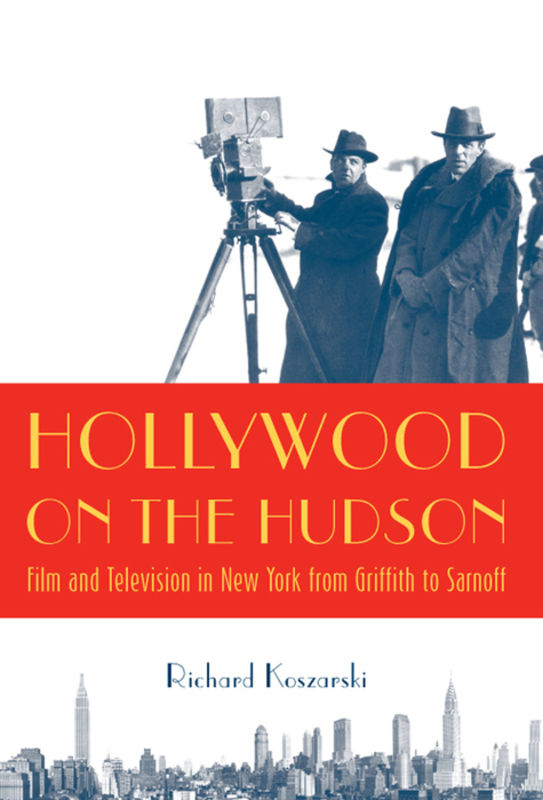
Hollywood on the Hudson
In Hollywood on the Hudson, Richard Koszarski rewrites an important part of the history of American cinema. During the 1920s and 1930s, film industry executives had centralized the mass production of feature pictures in a series of gigantic film factories scattered across Southern California, while maintaining New York as the economic and administrative center. But as Koszarski reveals, many writers, producers, and directors also continued to work here, especially if their independent vision was too big for the Hollywood production line.
eBook

Selling Science Fiction Cinema
How science fiction films in the 1950s were marketed and
helped create the broader genre itself. For Hollywood, the
golden age of science fiction was also an age of anxiety. Amid
rising competition, fluid audience habits, and increasing
government regulation, studios of the 1950s struggled to make and
sell the kinds of films that once were surefire winners. These
conditions, the leading media scholar J. P. Telotte argues,
catalyzed the incredible rise of science fiction.
Though science fiction films had existed since the earliest days
of cinema, the SF genre as a whole continued to resist easy
definition through the 1950s. In grappling with this developing
genre, the industry began to consider new marketing approaches that
viewed films as fluid texts and audiences as ever-changing. Drawing
on trade reports, film reviews, pressbooks, trailers, and other
archival materials, Selling Science Fiction Cinema
reconstructs studio efforts to market a promising new genre and, in
the process, shows how salesmanship influenced what that genre
would become. Telotte uses such films as The Thing from Another
World , Forbidden Planet , and The Blob , as
well as the influx of Japanese monster movies, to explore the
shifting ways in which the industry reframed the SF genre to market
to no-longer static audience expectations. Science fiction
transformed the way Hollywood does business, just as Hollywood
transformed the meaning of science fiction.
eBook

One-Party Government in the Ivory Coast
Professor Zolberg brings the factual material about the Ivory Coast's social, economic, and political development since 1961-1962. Originally published in 1964. The Princeton Legacy Library uses the latest print-on-demand technology to again make available previously out-of-print books from the distinguished backlist of Princeton University Press. These editions preserve the original texts of these important books while presenting them in durable paperback and hardcover editions. The goal of the Princeton Legacy Library is to vastly increase access to the rich scholarly heritage found in the thousands of books published by Princeton University Press since its founding in 1905.
eBook

Motion-Picture Mappaemundi: On Location Cartography in California
This paper examines the phenomenon of film location maps in California. These unusual maps, popular in the 1930s and associated with Paramount Studios, presented those locations within California that could plausibly substitute for another world location onscreen (e.g., the Sierra Nevada mountain range could stand in for the Alps as a background in a film). In this article, I analyze a sequence of these maps, arguing that the global juxtapositions and cinematic superimpositions that they create were only possible within a specific historical context, namely (1) the formalization of the role of the location manager as that profession evolved within the studio system and location shooting in California; (2) a particular form of place-based tourist marketing for California that claimed a global variety of geographies within the state; (3) the importance of the idea of place to Paramount Studios in these years, and how this related to a contemporaneous boom in California place-naming; and (4) the simultaneous rise of pictorial maps, a kind of cartography that joined illustration and caricature.
Journal Article

Engulfed : the death of Paramount Pictures and the birth of corporate Hollywood
From Double Indemnity (1944) to The Godfather (1972), the stories behind some of the greatest films ever made pale beside the story of the studio that made them.In the golden age of Hollywood, Paramount was one of the Big Five studios.
eBook

The Most Famous Costume Designer: Reviewing Edith Head's Career through a Contractual Lens
Edith Head, possibly Hollywood's most iconic costume designer, won a record eight Oscar statuettes for Best Costume Design. Despite her popularity, Head has also sparked controversy; many detractors question her talent as a designer by arguing that her success rested merely on her self-promotional efforts rather than her work inside the wardrobe department. This article explores Head's career vis-a-vis the discourses surrounding her public persona to understand how she constructed her image as Hollywood's most famous costume designer, survivingfor over five decades in an industryfraught with constant economic and political turmoil. In doing so, this article will shed light on the activities assigned to her as head of costume during and after the studio era.
Journal Article
“Multiple Realities” Revisited: James and Schutz
Although James and Schutz provide us with the most insightful investigations of multiple realities that we come across in philosophical, psychological and sociological literature, hardly any critical studies have addressed James’s and Schutz’s conceptions of multiple realities alongside each other. This paper fills this gap. The paper demonstrates that James and Schutz were concerned with the same set of issues in their respective accounts of multiple realities. It further shows the different ways in which James and Schutz understood multiple realities and how they conceptualized the fundamental levels of reality’s constitution. It also provides a critical analysis of Schutz’s allegation that James’s analysis is psychologistic, arguing that this accusation is ungrounded and that Schutz’s
epoche
of the natural attitude in fact bolsters James’s analysis of belief. The paper concludes with a set of reflections on the heterogenous nature of paramount reality, bringing into question James’s and Schutz’s assumption that each reality is inwardly coherent, although incompatible with each other.
Journal Article