
Catalogue Search | MBRL


Are you sure you want to remove the book from the shelf?

{{itemTitle}}
151
result(s) for
"Paratexte"
Sort by:

Zwischen Anmerkungslust und Reflexionszwang. Poetologische Paratexte in aktuellen Lyrikbänden
Für die poetologische Wende der Gegenwartslyrik spielen Paratexte eine zentrale Rolle. In aktuellen Lyrikbänden werden Gedichten nicht nur gelehrte Anmerkungen (Marion Poschmann) und poetologische Nachworte (Franz Josef Czernin) beigefügt. Es gibt zudem neuartige multiple
Paratext-Konzepte, mit denen Dichter aus dem scheinbar Beigeordneten den substantiellen Dichtungs-Nährboden überhaupt erst gewinnen und diesen Generierungsprozess ostentativ ausstellen (Ulrike Draesner, Steffen Popp).
Journal Article

La lexicografía en el siglo XVIII: estudio del paratexto en diccionarios monolingües franceses sobre agronomía
Tout au long du XVIIIème siècle et en raison des nouveaux progrès scientifiques, l’on assiste dans toute l’Europe à une véritable éclosion de dictionnaires, d’encyclopédies et de répertoires lexicaux qui prétendent compiler et classer le nouveau flot de vocabulaire. L’apparition du dictionnaire monolingue donne un élan décisif à la publication d’ouvrages à classement alphabétique qui facilitaient au lecteur une consultation plus aisée et plus rapide. Nous nous intéressons plus particulièrement aux parties communes à tous ces ouvrages lexicographiques telles que l’Avis au lecteur, l’Avant-Propos, la Préface et autres: elles éclairent profondément tout ce qui a trait tant à la composition qu’à la publication et la diffusion de l’ouvrage. Dans cet article, nous analysons le paratexte dans un corpus composé de quatre dictionnaires monolingues français de termes agricoles: ces ouvrages contribuèrent à la diffusion et à la vulgarisation de la nouvelle terminologie agricole liée aux récents progrès réalisés dans ce domaine.
Journal Article

Pourquoi et comment étudier l’histoire de l’enseignement des mathématiques dans les sociétés islamiques entre 750 et 1500
Pourquoi et comment étudier l’histoire de l’enseignement des mathématiques dans les sociétés islamiques entre 750 et 1500Dans cet article, je cherche à poser un certain nombre de questions sur la manière de traiter l’énorme quantité de textes mathématiques élémentaires en arabe, en persan et en turc conservés dans différents types de bibliothèques au cours de nombreux siècles et à travers plusieurs pays. Je propose de les traiter principalement comme les témoins d’un système éducatif étendu qui a commencé à inclure les sciences mathématiques à partir du xiie siècle et à s’étendre à de nombreuses régions, même en dehors du monde islamique classique et des grands centres urbains. Je propose un certain nombre de réflexions sur les raisons pour lesquelles ces textes ont été ignorés par les historiens des sciences dans les sociétés islamiques pendant environ un demi-siècle et sur la façon dont les objectifs et les méthodes de recherche appliqués par les plus grands historiens nous ont empêchés d’étudier un corpus aussi important ainsi que leur cadre institutionnel. Je prolonge ces questions historiographiques avec une série de propositions sur la manière de compléter l’étude des textes mathématiques afin de trouver des réponses à la question de savoir comment l’enseignement des sciences mathématiques était organisé dans un contexte principalement informel, comment sont apparus les canons d’ouvrages pédagogiques et quelles pratiques pédagogiques se sont développées au contact des disciplines religieuses qui dominaient les milieux éducatifs.
Journal Article

Show Sold Separately
Highlights the trailers, merchandising and cultural
conversations that shape our experiences of film and
television It is virtually impossible to watch a movie or
TV show without preconceived notions because of the hype that
precedes them, while a host of media extensions guarantees them a
life long past their air dates. An onslaught of information from
print media, trailers, internet discussion, merchandising,
podcasts, and guerilla marketing, we generally know something about
upcoming movies and TV shows well before they are even released or
aired. The extras, or \"paratexts,\" that surround viewing
experiences are far from peripheral, shaping our understanding of
them and informing our decisions about what to watch or not watch
and even how to watch before we even sit down for a show. Show
Sold Separately gives critical attention to this ubiquitous
but often overlooked phenomenon, examining paratexts like DVD bonus
materials for The Lord of the Rings , spoilers for
Lost , the opening credits of The Simpsons ,
Star Wars actions figures, press reviews for Friday Night
Lights, the framing of Batman Begins , the videogame of
The Thing , and the trailers for The Sweet
Hereafter . Plucking these extra materials from the wings and
giving them the spotlight they deserve, Jonathan Gray examines the
world of film and television that exists before and after the
show.
eBook

Text, paratext and Spanish vocabulary in Voyage d’Espagne (1736) by Guillaume Manier
The French pilgrim Guillaume Manier travelled to Spain in 1726, where he mainly visited Santiago de Compostela and Madrid. Ten years later, he wrote two texts about that experience: a story called Voyage d’Espagne and a glossary of Spanish words with their French translation. The aim of this article is to show the relationship between these two written works and assess their transcendence. The fact that both of them share abundant Spanish words proves they are closely related. Our starting point is that a story can be identified as a text and a glossary as a paratext. Both complement and enrich each other and were conceived of as a single unity in order to provide useful information for future readers and travelers to Spain.
Journal Article
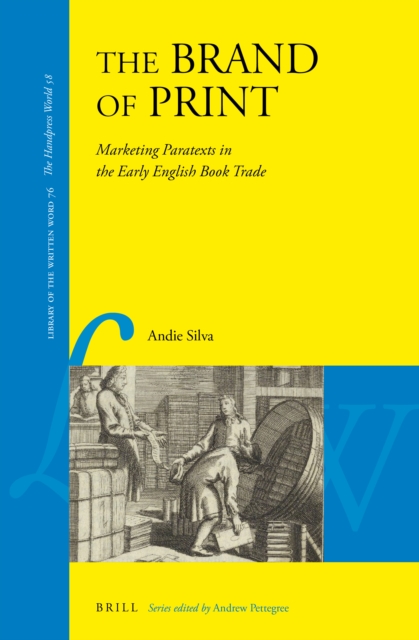
The Brand of Print
The Brand of Print uses contemporary marketing theory to analyze prefaces, dedications, and other paratexts authored by early English printers, publishers, and booksellers as a unique genre, showcasing how these \"print agents\" developed niche markets by building relationships with readers.
eBook

Traduire et retraduire le vernaculaire et l'érotisme de Lady Chatterley's Lover
Mots-clés Lady Chatterley's Lover, L'Amant de Lady Chatterley, traduction, paratexte, érotisme, dialecte, oralité Pour explorer l'époque tragique qui s'ouvre après la Première guerre mondiale, D.H. Lawrence écrit et ré-écrit trois fois Lady Chatterley's Lover (1929), texte donc très travaillé pour aboutir au style unique et complexe qui est la marque de l'auteur1 . Et nous ne parlons ici que de la troisième et dernière version du roman, considérée comme une sorte de testament de Lawrence, qui décèdera deux ans après y avoir mis le point final. Son appareillage savant la rend néanmoins intéressante puisqu'elle s'adresse visiblement, cinquante ans après la première traduction, à un public averti, cultivé et capable de passer outre aux interprétations scabreuses du roman, capable au final d'admettre que L'Amant de Lady Chatterley « n'est pas un roman de sexe » selon la lettre de Lawrence à Curtis Brown du 15 mars 1928 mentionnée dans l'« Introduction » (Révision, 7). Leur traduction à deux mains n'est, du reste, pas mentionnée dans les pages web les concernant, alors que Fleutiaux est une auteure consacrée par le Prix Femina entre autres pour Nous sommes éternels4 tandis que Vernière est connue pour son œuvre picturale et photographique5 .
Journal Article

Textual Agency
Gómez-Bravo also explores how authorial and textual agency were competing forces in the midst of an era marked by the institution of the Inquisition, the advent of the absolutist state, the growth of cities, and the constitution of the Spanish nation.
eBook

The dynamics of text and framing phenomena : historical approaches to paratext and metadiscourse in English
This volume explores the complex relations of texts and their contextualising elements, drawing particularly on the notions of paratext, metadiscourse and framing. It aims at developing a more comprehensive historical understanding of these phenomena, covering a wide time span, from Old English to the 20th century, in a range of historical genres and contexts of text production, mediation and consumption. However, more fundamentally, it also seeks to expand our conception of text and the communicative 'spaces' surrounding them, and probe the explanatory potential of the concepts under investigation. Though essentially rooted in historical linguistics and philology, the twelve contributions of this volume also are open to insights from other disciplines (such as medieval manuscript studies and bibliography, but also information studies, marketing studies, and even digital electronics), and thus tackle opportunities and challenges in researching the dynamics of text and framing phenomena in a historical perspective.
eBook

Les Héroïdes à la fin du Moyen Âge : pour une définition élargie de l’acte traducteur
Cet article a pour objectif d’exposer certaines lacunes dans le vocabulaire discursif concernant la translatio studii et imperii à la fin du Moyen Âge. L’étude de cas, en l’occurrence Les XXI Epistres d’Ovide, traduction des Héroïdes faite par Octovien de Saint-Gelais au xve siècle, montre comment un texte classique s’est transformé en s’inscrivant dans certaines formulations artistiques et culturelles de l’époque. En d’autres termes, grâce à mon analyse, se révèlera comment le mot « traduction » délimite non seulement une transformation textuelle de l’œuvre d’Ovide, mais également une ré-contextualisation, un ré-encadrement, et, enfin, une réception distincte du texte source.
Journal Article