
Catalogue Search | MBRL


Are you sure you want to remove the book from the shelf?

{{itemTitle}}
31
result(s) for
"Paris (France) -- Social life and customs -- 20th century"
Sort by:

And the show went on : cultural life in Nazi-occupied Paris
Throughout this penetrating and unsettling account, Riding keeps alive the quandaries facing many of these artists. Were they \"saving\" French culture by working? Were they betraying France if they performed before German soldiers or made movies with Nazi approval? Was it the intellectual's duty to take up arms against the occupier? Then, after Paris was liberated, what was deserving punishment for artists who had committed \"intelligence with the enemy\"? By throwing light on this critical moment of twentieth-century European cultural history, And the Show Went On focuses anew on whether artists and writers have a special duty to show moral leadership in moments of national trauma.
Book

When Paris Sizzled
When Paris Sizzled vividly portrays the City of Light during the fabulous 1920s, when art and architecture, music, literature, fashion, entertainment, transportation, and behavior all took dramatically new forms. Through rich illustrations and evocative narrative, Mary McAuliffe brings this vibrant era to life.
eBook

When Paris sizzled : the 1920s Paris of Hemingway, Chanel, Cocteau, Cole Porter, Josephine Baker, and their friends
\"With rich illustrations and evocative narrative, McAuliffe portrays Paris during the fabulous 1920s, when art and architecture, music, literature, fashion, entertainment, transportation, and behavior all took dramatically new forms\"--Provided by publisher.
Book

Paris-Edinburgh
By the end of the nineteenth century, Paris was widely acknowledged as the cultural capital of the world, the home of avant-garde music and art, symbolist literature and bohemian culture. Edinburgh, by contrast, may still be thought of as a rather staid city of lawyers and Presbyterian ministers, academics and doctors. While its great days as a centre for the European Enlightenment may have been behind it, however, late Victorian Edinburgh was becoming the location for a new set of cultural institutions, with its own avant-garde, that corresponded with a renewed Scottish national consciousness. While Morningside was never going to be Montparnasse, the period known as the Belle Epoque was a time in both French and Scottish society when there were stirrings of non-conformity, which often clashed with a still powerful establishment. And in this respect, French bourgeois society could be as resistant to change as the suburbs of Edinburgh. With travel and communication becoming ever easier, a growing number of international contacts developed that allowed such new and radical cultural ideas to flourish. In a series of linked essays, based on research into contemporary archives, documents and publications in both countries, as well as on new developments in cultural research, this book explores an unexpected dimension of Scottish history, while also revealing the Scottish contribution to French history. In a broader sense, and particularly as regards gender, it considers what is meant by 'modern' or 'radical' in this period, without imposing any single model. In so doing, it seeks not to treat Paris-Edinburgh links in isolation, or to exaggerate them, but to use them to provide a fresh perspective on the internationalism of the Belle Epoque.
eBook

Europeanising spaces in Paris, c. 1947-1962
\"In the wake of the Second World War, ideas of Europe abounded. What did Europe mean as a concept, and what did it mean to be European? Europeanising Spaces in Paris, c. 1947-1962 makes the case that Paris was both a leading and distinctive forum for the expression of these ideas in the post-war period. It examines spaces in the French capital in which ideas about Europe were formulated, articulated, exchanged, circulated, and contested during this post-war period, roughly between the escalation of the Cold War and the end of France's war of decolonisation in Algeria. Such processes of making sense of Europe are elucidated in urban, political and cultural spaces in the French capital. Specifically, the Parisian cafâe, home and street are each examined in terms of how they were implicated in ideas about Europe. Then, the Paris-based Mouvement socialiste des âetats unis d'Europe (The Socialist Movement for the United States of Europe) and the far-right wing Fâedâeration des âetudiants nationalistes (The Federation of Nationalist Students) are examined as examples of political movements that mobilised around--very different--concepts of Europe. The final section on cultural Europeanising spaces draws attention to the specificities of the Europeanism of exiles from Franco's Spain in Paris; the work of the great scholar of the Arab world, Jacques Berque, in the context of his understanding of the Mediterranean world and his understanding of faith; and finally, the work of the legendary photographer, Henri Cartier-Bresson, by looking at the capacities and limitations of the photographic medium for the representation of Europe, and how these corresponded with Cartier-Bresson's political, social, and aesthetic commitments\"--Publisher description.
Book

Bricktop's Paris
2015 CHOICE Outstanding Academic Title Longlisted
for the 2015 American Library in Paris Book Award During
the Jazz Age, France became a place where an African American woman
could realize personal freedom and creativity, in narrative or in
performance, in clay or on canvas, in life and in love. These women
were participants in the life of the American expatriate colony,
which included F. Scott Fitzgerald, Gertrude Stein, and Cole
Porter, and they commingled with bohemian avant-garde writers and
artists like Picasso, Breton, Colette, and Matisse. Bricktop's
Paris introduces the reader to twenty-five of these women and
the city they encountered. Following this nonfiction account, T.
Denean Sharpley-Whiting provides a fictionalized autobiography of
Ada \"Bricktop\" Smith, which brings the players from the world of
nonfiction into a Paris whose elegance masks a thriving underworld.
eBook

A moveable feast : the restored edition
Published posthumously in 1964, A Moveable Feast remains one of Ernest Hemingway's most beloved works. It is his classic memoir of Paris in the 1920s, filled with irreverent portraits of other expatriate luminaries such as F. Scott Fitzgerald and Gertrude Stein; tender memories of his first wife, Hadley; and insightful recollections of his own early experiments with his craft. It is a literary feast, brilliantly evoking the exuberant mood of Paris after World War I and the youthful spirit, unbridled creativity, and unquenchable enthusiasm that Hemingway himself epitomized.
BOOK
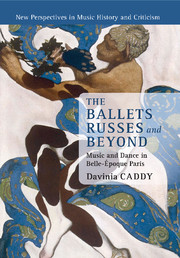
The Ballets Russes and Beyond
Belle-époque Paris witnessed the emergence of a vibrant and diverse dance scene, one that crystallized around the Ballets Russes, the Russian dance company formed by impresario Sergey Diaghilev. The company has long served as a convenient turning point in the history of dance, celebrated for its revolutionary choreography and innovative productions. This book presents a fresh slant on this much-told history. Focusing on the relation between music and dance, Davinia Caddy approaches the Ballets Russes with a wide-angled lens that embraces not just the choreographic, but also the cultural, political, theatrical and aesthetic contexts in which the company made its name. In addition, Caddy examines and interprets contemporary French dance practices, throwing new light on some of the most important debates and discourses of the day.
eBook

Bricktop's Paris : African American women in Paris between the two World Wars
T. Denean Sharpley-Whiting tells the fascinating story of African American women who travelled to France between the two World Wars to seek freedom of expression.
Book
