Catalogue Search | MBRL


Are you sure you want to remove the book from the shelf?

{{itemTitle}}
13
result(s) for
"Paris (France) Social conditions 19th century."
Sort by:

Public city/public sex : homosexuality, prostitution, and urban culture in nineteenth-century Paris
\"In the nineteenth century, Paris was redesigned in ways intended to exercise social control over its citizens. This effort to control certain kinds of interactions, however, created new spaces that female prostitutes and men who sought sex with other men could use for public sex\"-- Provided by publisher.
Book

Pederasts and Others
Examine how a community of support in Nineteenth-Century Paris became a blueprint for modern sexual identity!
A unique social history, Pederasts and Others: Urban Culture and Sexual Identity in Nineteenth-Century Paris is a valuable addition to the growing field of gay and lesbian studies. The book examines the interaction between the city's male homosexual subculture and Parisian authority figures who attempted to maintain political and social order during the early years of the French Third Republic by using laws against public indecency and sexual assault to treat same-sex sexuality as a crime. Faced with a constant cycle of surveillance, harassment, and arrest, the city's gay men survived the hostile urban environment by forming a community of support that had a widespread and lasting influence on the development of modern sexual identities.
Pederasts and Others: Urban Culture and Sexual Identity in Nineteenth-Century Paris is based on a statistical analysis of more than 800 working-class and middle-class men who were arrested or investigated by Parisian police between 1873 and 1879. Their stories, presented through long and short case studies, represent nearly 2,000 names recorded by police in 'Pederasts and Others,' a ledger detailing the arrests of male homosexuals for public offenses against decency and other minor offenses. (The term 'pederast' identified those suspected of same-sex sexual activity, not the modern definition that indicates homosexual relations with a minor.) The ledger entries reveal specific habits, attitudes, values, and characteristics about these men that set them apart-the same traits that identified them as part of a community based on their behavior and relationships.
Pederasts and Others: Urban Culture and Sexual Identity in Nineteenth-Century Paris examines:
the forces of authority
the laws regarding same-sex sexual behavior
the role of the police
the rol
eBook

Massacre : the life and death of the Paris Commune
\"The Paris Commune lasted for only 64 days in 1871, but during that short time it gave rise to some of the grandest political dreams of the nineteenth century--before culminating in horrific violence. Following the disastrous French defeat in the Franco-Prussian War, hungry and politically disenchanted Parisians took up arms against their government in the name of a more just society. They expelled loyalists and soldiers and erected barricades in the streets. In Massacre, John Merriman introduces a cast of inimitable Communards--from les petroleuses (female incendiaries) to the painter Gustave Courbet--whose idealism fueled a revolution. And he vividly recreates the Commune's chaotic and bloody end when 30,000 troops stormed the city, burning half of Paris and executing captured Communards en masse. A stirring evocation of the spring when Paris was ablaze with cannon fire and its citizens were their own masters, Massacre reveals how the indomitable spirit of the Commune shook the very foundations of Europe\"-- Provided by publisher.
Book

Human Remains:Medicine, Death, and Desire in Nineteenth-Century Paris
The living and the dead cohabited Paris until the late eighteenth century, when, in the name of public health, measures were taken to drive the latter from the city. Cemeteries were removed from urban space, and corpses started to be viewed as terrifyingly noxious substances.The dead had fallen victim to a sustained new reflection on the notions of life and death that emerged from the two new medical fields of biology and hygiene. In large part, the Paris of the nineteenth century-the Paris of modernity-arose, both theoretically and physically, out of this concern over the relations between the animate and the inanimate.As the dead became a source of pervasive and intense anxiousness, they also became an object of fascination that at once exceeded and guided the medical imagination attempting to control them. Human Remains examines that exuberant anxiety to discover the irrational, indeed erotic, forces motivating the medicalization of death.Working across a broad range of disciplines, including history, literature, the visual arts, philosophy, and psychoanalysis, the book seeks to understand the meaning of the dead and their role in creating one of the most important cities of the contemporary world.
eBook

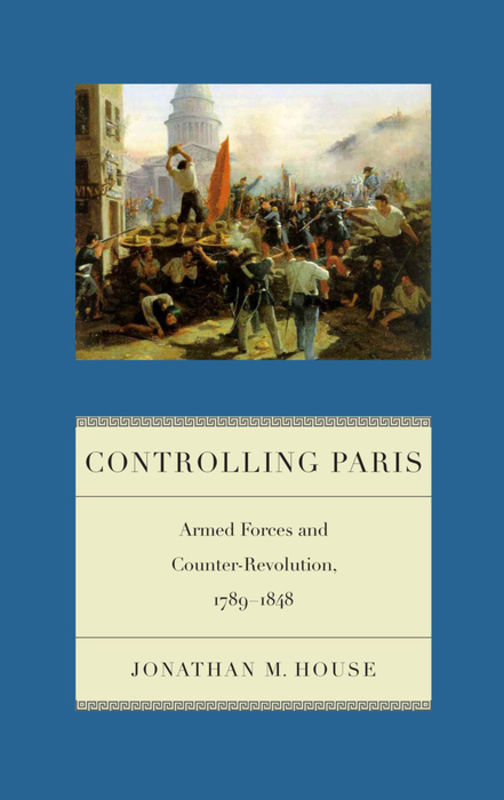
Controlling Paris : armed forces and counter-revolution, 1789-1848
\"When not at war, armies are often used to control civil disorders, especially in eras of rapid social change and unrest. But in nineteenth century Europe, without the technological advances of modern armies and police forces, an army's only advantages were discipline and organization--and in the face of popular opposition to the regime in power, both could rapidly deteriorate. Such was the case in France after the Napoleonic Wars, where a cumulative recent history of failure weakened an already fragile army's ability to keep the peace. After the February 1848 overthrow of the last king of France, the new republican government proved remarkably resilient, retaining power while pursuing moderate social policies despite the concerted efforts of a variety of radical and socialist groups. These efforts took numerous forms, ranging from demonstrations to attempted coups to full-scale urban combat, and culminated in the crisis of the June Days. At stake was the future of French government and the social and economic policy of France at large. In Controlling Paris, Jonathan M. House offers us a study of revolution from the viewpoint of the government rather than the revolutionary. It is not focused on military tactics so much as on the broader issues involved in controlling civil disorders: relations between the government and its military leaders, causes and social issues of public disorder, political loyalty of troops in crisis, and excessive use of force to control civil disorders. Yet somehow, despite all these disadvantages, the French police and armed forces prevented regime change far more often than they failed to do so. Jonathan M. House is the William A. Stofft Professor of Military History at the U.S. Army Command & General Staff College. His previous books include Combined Arms Warfare in the 20th Century; A Military History of the Cold War, 1944-1962; and, with David M. Glantz, When Titans Clashed : How the Red Army Stopped Hitler\"-- Provided by publisher.
Book

Controlling Paris
When not at war, armies are often used to control civil disorders, especially in eras of rapid social change and unrest. But in nineteenth century Europe, without the technological advances of modern armies and police forces, an army's only advantages were discipline and organization - and in the face of popular opposition to the regime in power, both could rapidly deteriorate. Such was the case in France after the Napoleonic Wars, where a cumulative recent history of failure weakened an already fragile army's ability to keep the peace.After the February 1848 overthrow of the last king of France, the new republican government proved remarkably resilient, retaining power while pursuing moderate social policies despite the concerted efforts of a variety of radical and socialist groups. These efforts took numerous forms, ranging from demonstrations to attempted coups to full-scale urban combat, and culminated in the crisis of the June Days. At stake was the future of French government and the social and economic policy of France at large.InControlling Paris, Jonathan M. House offers us a study of revolution from the viewpoint of the government rather than the revolutionary. It is not focused on military tactics so much as on the broader issues involved in controlling civil disorders: relations between the government and its military leaders, causes and social issues of public disorder, political loyalty of troops in crisis, and excessive use of force to control civil disorders. Yet somehow, despite all these disadvantages, the French police and armed forces prevented regime change far more often than they failed to do so.Jonathan M. Houseis the William A. Stofft Professor of Military History at the U.S. Army Command and General Staff College. His previous books includeCombined Arms Warfare in the 20th Century;A Military History of the Cold War, 1944-1962; and, with David M. Glantz,When Titans Clashed: How the Red Army Stopped Hitler.
eBook

Massacre
The Paris Commune lasted for only 64 days in 1871, but during that short time it gave rise to some of the grandest political dreams of the nineteenth century-before culminating in horrific violence. Following the disastrous French defeat in the Franco-Prussian War, hungry and politically disenchanted Parisians took up arms against their government in the name of a more just society. They expelled loyalists and soldiers and erected barricades in the streets. In Massacre, John Merriman introduces a cast of inimitable Communards-from les pétroleuses (female incendiaries) to the painter Gustave Courbet-whose idealism fueled a revolution. And he vividly recreates the Commune's chaotic and bloody end when 30,000 troops stormed the city, burning half of Paris and executing captured Communards en masse. A stirring evocation of the spring when Paris was ablaze with cannon fire and its citizens were their own masters, Massacre reveals how the indomitable spirit of the Commune shook the very foundations of Europe.
eBook

Gender and justice : violence, intimacy and community in fin-de siècle Paris
Historian Eliza Earle Ferguson's meticulously researched study of domestic violence among the working class in France uncovers the intimate details of daily life and the complex workings of court proceedings in fin-de-siècle Paris. With detective-like methods, Ferguson pores through hundreds of court records to understand why so many perpetrators of violent crime were fully acquitted. She finds that court verdicts depended on community standards for violence between couples. Her search uncovers voluminous testimony from witnesses, defendants, and victims documenting the conflicts and connections among men and women who struggled to balance love, desire, and economic need in their relationships. Ferguson's detailed analysis of these cases enables her to reconstruct the social, cultural, and legal conditions in which they took place. Her ethnographic approach offers unprecedented insight into the daily lives of nineteenth-century Parisians, revealing how they chose their partners, what they fought about, and what drove them to violence. In their battles over money and sex, couples were in effect testing, stretching, and enforcing gender roles. Gender and Justice will interest social and legal historians for its explanation of how the working class of fin-de-siècle Paris went about their lives and navigated the judicial system. Gender studies scholars will find Ferguson's analysis of the construction of gender particularly trenchant.
eBook

The Notion of Housing Need in France: From Norms to Negotiations (19th–21st Centuries)
This article aims to show how the concept of “housing need” has circulated between the social sciences and architectural design fields in France since the second half of the 19th century up until today. France is a particularly rich example for developing this sociohistorical overview over a long span of time, through three time periods: the beginning of housing policy which, during the hygienist period and in legal devices and statistics, defined “good housing” as opposed to inadequate housing; the debate surrounding the notion of need illustrated through an examination of mass construction since the beginning of the 1950s, in particular, that of large social housing estates which developed in response to the housing crisis and the increase of slums; and the contemporary period, that raises many questions faced by architects and urban planners concerning the persistence of forms of inadequate housing and the development of individual aspirations for well-being.
Journal Article