
Catalogue Search | MBRL


Are you sure you want to remove the book from the shelf?

{{itemTitle}}
573
result(s) for
"Paris World"
Sort by:


HPV infection and P16 expression in oral and oropharyngeal cancer in Kazakhstan
Background
Human papillomavirus (HPV) is an important etiologic factor in different cancers of anogenital region and also in a fraction of head and neck cancers (HNC) particularly oropharyngeal tumors. The HPV16 genotype associated with the majority of HPV-related head and neck carcinomas. Th incidence of oropharyngeal cancer is increasing in many countries, and the rate of HPV positive tumors is about 70% in Europe and North America. Little known about the prevalence of HPV in HNC in Central Asia.
Methods
It’s a prospective analysis of patients with verified oral or oropharyngeal cancer. Sociodemographic and clinical data obtained on admission to treatment. The diagnosis of HPV positivity assessed by both the P16 expression on immunohistochemistry(IHC) and polymerase chain reaction (PCR)with HPV DNA detection and HR HPV type determination.
Results
Seventy six patients with oral and oropharyngeal cancer tested for HPV. Forteen cases were positive for HPV by PCR and 15 cases by P16 IHC. Of the 35 oropharyngeal tumors, nine were HPV DNA and p16 IHC positive, giving the rate of 25.7%. Of the 41 oral tumors, five were HPV DNA and six p16 IHC positive, giving the rate of 12.2%.
Conclusion
It is the first study mapping prevalence of HPV positivity in oral and oropharyngeal cancer in the Central Asian region. The rate of HPV positivity was higher in oropharyngeal than in oral cancer, the nonsmokers were significantly more frequent in the HPV positive group and HPV 16 was the most frequent type. However, the HPV positivity rates are lower than referred in the western world.
Journal Article

Paris in turmoil : a city between past and future
\"Since the disastrous Pompidou years, working-class Paris has been steadily nibbled away, either by destruction or more insidiously by a kind of internal colonization. Take for example a small outlying district populated by Arabs, blacks and poor whites twenty years ago, the L'Olive neighbourhood north of La Chapelle The area is noted as pleasant, people frequent it and explore it, and as the rents are low some settle there. Others follow, first friends and then anyone else. Rents go up, buildings are renovated, bars open, then an organic food shop, a vegan restaurant ... The earlier indigenous inhabitants are driven out by the rising rents and settle further away, in Saint-Denis if they are lucky, or else in Garges-lès-Gonesse, Goussainville or God knows where. But new neighbourhoods are emerging, for example the Chinese quarter of Bas Belleville, which has grown since the 1970s to the point that in some streets, such as Rue Civiale or Rue Rampal, the restaurants and shops are all Chinese, with many Chinese sex workers on Boulevard de la Villette. These Chinese almost all come from Wenzhou, a large province south of Shanghai, whose inhabitants are reputedly known for their commercial skills. Paris is constantly changing as a living organism, both for better and for worse. This book is an incitement to open our eyes and lend an ear to the tumult of this incomparable capital, from the Périphérique to Place Vendôme, its markets of Aligre and Belleville, its cafés and tabacs, its history from Balzac to Sartre. In some thirty succinct vignettes, from bookshops to beggars, Art Nouveau to street sounds, Parisian writers to urban warts, Jacobins to Surrealism, Hazan offers a host of invaluable aperçus, illuminated by a matchless knowledge of his native city.\" --Publisher's website.
Book

The rise and fall of American hegemony from Wilson to Trump
A century ago, Woodrow Wilson changed America’s place in the world when he sent two million men to fight in Europe, but America withdrew into isolationism in the 1930s. After the Second World War, Harry Truman and others created a framework of permanent alliances and multilateral institutions that became known as the ‘liberal international order’ or ‘Pax Americana’. Those terms have become obsolete as descriptions of the US place in the world, but the need for the largest countries to provide public goods remains. An open international order covers political–military affairs; economic relations; ecological relations; and human rights. It remains to be seen to what degree these depend on each other and what will remain as the 1945 package is unpacked. Wilson’s legacy of developing international institutions continues to make sense. Leadership is not the same as domination, and it will need to be shared. There have always been degrees of leadership and degrees of influence during the seven decades of American pre-eminence after 1945. Now with less preponderance and a more complex world, American exceptionalism in terms of its economic and military power should focus on sharing the provision of global public goods, particularly those that require ‘power with’ others. Wilson’s century old insights about international institutions and a rules-based order will remain crucial, but America’s place in that world may be threatened more by the rise of populist politics at home than the rise of other powers abroad.
Journal Article

Paris 1944 : occupation, resistance, liberation
\"The fall of Paris to the Nazis on June 14th, 1940, was one of the darkest days of World War II. And the liberation of the city on August 25th, 1944, felt like the brightest. The liberation was also the biggest party of the century: champagne flowed freely, total strangers embraced--it was a celebration of life renewed against the backdrop of the world's favorite city, as experienced by the likes of Ernest Hemingway, J. D. Salinger, Pablo Picasso, and Robert Capa. But there was nothing preordained about this happy ending. Had things transpired differently, Paris might have gone down as a ghastly monument to Nazi nihilism. Paris 1944--timed for the eightieth anniversary of the liberation of Paris--tells the story of those iridescent days in a startling new way. Cutting through decades of myth-making, the reader watches the city's fate hanging in the balance against the drama, heroism, joy, and suspense of one of the most explosive moments of the twentieth century.\" --Publisher's description.
Book
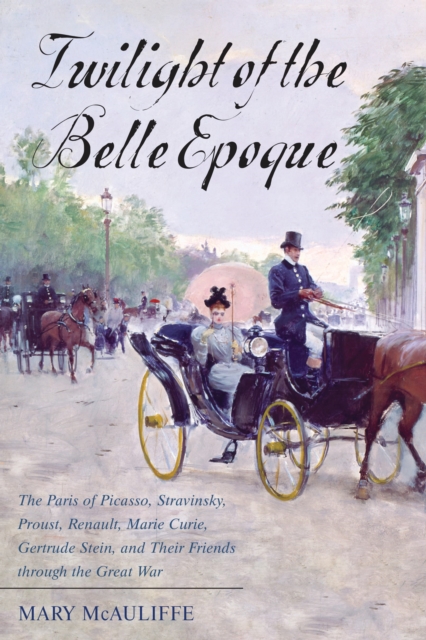
Twilight of the Belle Epoque
Mary McAuliffe’s Dawn of the Belle Epoque took the reader from the multiple disasters of 1870–1871 through the extraordinary re-emergence of Paris as the cultural center of the Western world. Now, in Twilight of the Belle Epoque, McAuliffe portrays Paris in full flower at the turn of the twentieth century, where creative dynamos such as Picasso, Matisse, Stravinsky, Debussy, Ravel, Proust, Marie Curie, Gertrude Stein, Jean Cocteau, and Isadora Duncan set their respective circles on fire with a barrage of revolutionary visions and discoveries. Such dramatic breakthroughs were not limited to the arts or sciences, as innovators and entrepreneurs such as Louis Renault, André Citroën, Paul Poiret, François Coty, and so many others—including those magnificent men and women in their flying machines—emphatically demonstrated. But all was not well in this world, remembered in hindsight as a golden age, and wrenching struggles between Church and state as well as between haves and have-nots shadowed these years, underscored by the ever-more-ominous drumbeat of the approaching Great War—a cataclysm that would test the mettle of the City of Light, even as it brutally brought the Belle Epoque to its close. Through rich illustrations and evocative narrative, McAuliffe brings this remarkable era from 1900 through World War I to vibrant life.
eBook


The Parisian Police and the Holocaust: Control, Round-ups, Hunt, 1940–4
Slightly more than half of the 74,150 Jews deported from France between 1942 and 1944 were arrested in Paris and its close suburbs. For the large majority of these 38,500 men, women, and children, their arrest was carried out by ordinary policemen belonging to the Paris Police Prefecture. The objective of this article is to propose a complete and synthetic analysis of the role of this institution and its agents in the Holocaust. In Paris, unlike anywhere else in Europe, the implementation of the ‘final solution’ was entrusted to the traditional administration. These police officers were competent and knew perfectly the environment of the persecution. But, generally speaking, they were not anti-Semite activists, they did not like the Germans, and, more importantly, they acted according to their own institutional logic. So, the French's repressive system did not automatically feed the Nazi machine of destruction. It is this complexity of the machine of persecution in occupied France which explains, in many respects, the toll of the Holocaust in France, and, more specifically, in the Paris region.
Journal Article

Power as prestige in world politics
Power is shifting from the West to the East. Asia is experiencing the initial throes of this shift, where the key protagonists are the United States, the established power or hegemon, and China, the rising challenger and peer competitor. This article argues that the ongoing geopolitical competition between the United States and China is best viewed as a competition over the hierarchy of prestige, with China seeking to replace the US as the most prestigious state in the international system within the next thirty years. Although the competition is a global one, with China having made significant economic–political inroads into Africa, Latin America and even Europe, Asia is where China must establish its prestige or ‘reputation for power’ in the first instance. China seeks the top seat in the hierarchy of prestige, and the US will do everything in its power to maintain its pole position, because the state with the greatest reputation for power gets to govern the region: it will attract more followers, regional powers will defer to and accommodate it, and it will play a decisive role in shaping the rules and institutions of international relations. In a word, the state at the top of the prestige hierarchy gets to translate its power into the political outcomes it desires with minimal resistance and maximum flexibility. Power is shifting from the West to the East. Asia is experiencing the initial throes of this shift, where the key protagonists are the United States, the established power or hegemon, and China, the rising challenger and peer competitor. This article argues that the ongoing geopolitical competition between the United States and China is best viewed as a competition over the hierarchy of prestige, with China seeking to replace the US as the most prestigious state in the international system within the next thirty years. Although the competition is a global one, with China having made significant economic–political inroads into Africa, Latin America and even Europe, Asia is where China must establish its prestige or ‘reputation for power’ in the first instance. China seeks the top seat in the hierarchy of prestige, and the US will do everything in its power to maintain its pole position, because the state with the greatest reputation for power gets to govern the region: it will attract more followers, regional powers will defer to and accommodate it, and it will play a decisive role in shaping the rules and institutions of international relations. In a word, the state at the top of the prestige hierarchy gets to translate its power into the political outcomes it desires with minimal resistance and maximum flexibility.
Journal Article