
Catalogue Search | MBRL


Are you sure you want to remove the book from the shelf?

{{itemTitle}}
1,620
result(s) for
"Parlement"
Sort by:

France after 2012
\"In May 2012, French voters rejected the liberalizing policies of Nicholas Sarkozy and elected his opponent, the Socialist Franًcois Hollande, president. In June 2012, the incumbent president's center-right UMP party was swept out of government in the ensuing parliamentary elections, giving way to a new center-left majority in the National Assembly. This book analyzes the contexts and results of the 2012 presidential and parliamentary elections in France. It assesses the legacies of the Sarkozy presidency that informed the 2012 electoral campaigns, scrutinizing his domestic social and economic policies on the one hand and European and foreign policies on the other. In turn, the elections' outcomes are also analyzed from the standpoint of various political parties and other institutional interests in France, and the results are situated within the broader run of French political history. Finally, the book examines the principal challenges facing the Hollande administration and new government of Prime Minister Jean-Marc Ayrault, and assesses how effectively these have been met during their first year in office\"--Provided by publisher.
Book
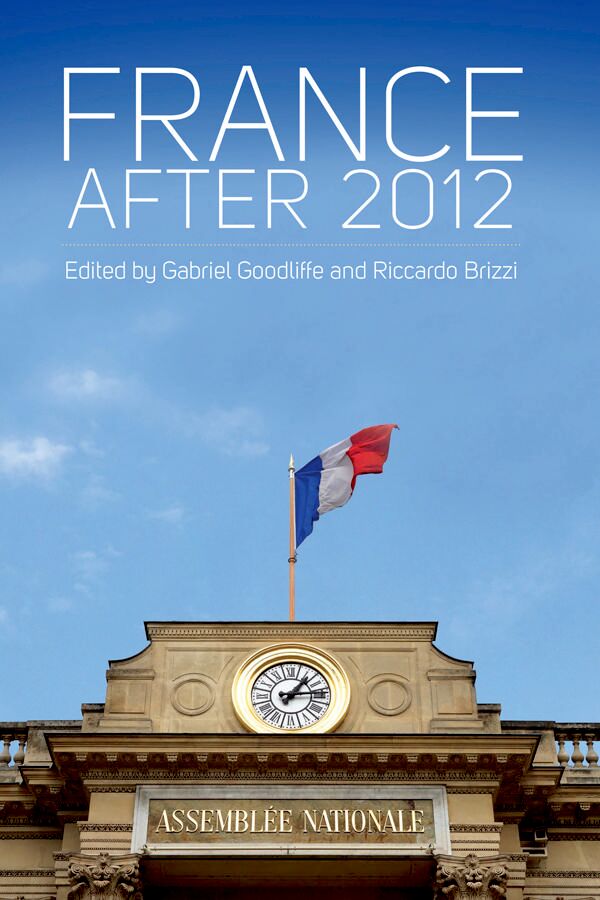
France after 2012
In May 2012, French voters rejected the liberalizing policies of Nicolas Sarkozy and elected his opponent, the Socialist Francois Hollande, president. In June 2012, the incumbent president's center-right UMP party was swept out of government in the ensuing parliamentary elections, giving way to a new center-left majority in the National Assembly. This book analyzes the contexts and results of the 2012 presidential and parliamentary elections in France. It assesses the legacies of the Sarkozy presidency that informed the 2012 electoral campaigns, scrutinizing his domestic social and economic policies on the one hand and European and foreign policies on the other. In turn, the elections' outcomes are also analyzed from the standpoint of various political parties and other institutional interests in France, and the results are situated within the broader run of French political history. Finally, the book examines the principal challenges facing the Hollande administration and new government of Prime Minister Jean-Marc Ayrault, and assesses how effectively these have been met during their first year in office.
eBook

Across the aisle : opposition in Canadian politics
\"How do parties with official opposition status influence Canadian politics? Across the Aisle is an innovative examination of the theory and practice of opposition in Canada, both in Parliament and in provincial legislatures. Extending from the pre-Confederation era to the present day, it focuses on whether Canada has developed a coherent tradition of parliamentary opposition.
Book
Power and Politics in Old Regime France, 1720-1745
First Published in 2004. Routledge is an imprint of Taylor & Francis, an informa company.
'Dr Peter Campbell is to be congratulated on a bold, important and learned work' – Literary Review '[Peter Campbell] has given a valuable synthesis of recent work on seventeenth-century France' – Times Literary Supplement 'Bulges with stimulating insights and bright ideas.' – French History 'A rare snapshot of how high politics actually worked ... With this manual in hand the reader could survive at the court of Louis XV - and probably score.' – History Today
eBook

Duffy : stardom to Senate to scandal
\"Mike Duffy made his name as a political reporter, and in the process became one of Prince Edward Island's most famous exports. He cast himself as the ultimate insider, Parliament Hill's man in the know. It made him a household name and one of the Canada's best-paid journalists. But Duffy wanted to get even closer and lobbied his way into the Canadian Senate, with dire results. Veteran journalist Dan Leger tells the story of Duffy's rise to the top in Canadian media, his entanglement with the Harper Conservatives, and the scandal that made him one of the most controversial figures in contemporary politics.\"-- Provided by publisher.
Book

The European Parliament's Committees
This book analyzes the development of the European Parliament's (EP) committees and their relationship with national political parties in the light of the EP's increased legislative role over the last three decades.
The book argues that national parties have a greater incentive to care about what goes on in the EP given the growth in its legislative power. Because most of the EP's detailed legislative work takes place in its committees, national parties should be concerned about their involvement with the EP's committee system. Based on extensive original research, this book shows how the EP's committees have changed over time in response to legislative empowerment and analyzes how national parties and individual MEPs use the committee system to further their policy goals. The book makes a theoretical contribution by providing an explanation for the variation in powers of committees between separated and fused systems of government and by adapting theories of legislative organization developed in the context of the US Congress, to the EP.
The European Parliament's Committees will be of interest to students and scholars studying the European Parliament, EU institutions, policy-making, and the development of legislatures and political parties.
eBook

Delegation and accountability in parliamentary democracies
Parliamentary democracy is the most common way of organizing delegation and accountability in contemporary democracies. Yet knowledge of this type of regime has been incomplete and often unsystematic. Delegation and Accountability in Parliamentary Democracies offers new conceptual clarity on the topic. Taking principal-agent theory as its framework, the work illustrates how a variety of apparently unrelated representation issues can now be understood. This procedure allows scholarship to move well beyond what have previously been cloudy and confusing debates aimed at defining the virtues and perils of parliamentarism. This new empirical investigation includes all 17 West European parliamentary democracies. These countries are compared in a series of cross-national tables and figures, and 17 country chapters provide a wealth of information on four discrete stages in the delegation process: delegation from voters to parliamentary representatives, delegation from parliament to the prime minister and cabinet, delegation within the cabinet, and delegation from cabinet ministers to civil servants. Each chapter illustrates how political parties serve as bonding instruments, which align incentives and permit citizen control of the policy process. This is complemented by a consideration of external constraints, such as courts, central banks, corporatism, and the European Union, which can impinge on national-level democratic delegation. The concluding chapters go on to consider how well the problems of delegation and accountability are solved in these countries. Delegation and Accountability in Parliamentary Democracies provides an unprecedented guide to contemporary European parliamentary democracies. As democratic governance is transformed at the dawn of the twenty-first century, it illustrates the important challenges faced by the parliamentary democracies of Western Europe.
eBook

The Royal Financial Administration and the prosecution of crime in France, 1670-1789
The Royal Financial Administration and the Prosecution of Crime in France, 1670–1789 explores the French monarchy’s role in financing criminal prosecutions in the royal courts of the realm—the payment of criminal frais de justice in the vocabulary of the ancien régime—between 1670 and 1789 (that is, from the codification of criminal judicial procedure in the early period of Louis XIV’s personal rule to the outbreak of the French Revolution). The subject brings together three areas of scholarly inquiry—criminal justice, royal administration, and the management of the crown’s finances. A central goal of the study is to provide factual information and interpretive insights on each of these topics and to explain the relationship of each to the others over a long time period. The book contributes to existing scholarship in four ways. First, although each of the major dimensions of the inquiry—the operation of the criminal justice system, the conduct of the royal administration, and the management of the monarchy’s finances—has a large and increasingly sophisticated historical literature, this is the first study to combine them in a systematic way. Second, the long time period covered in the book not only enables the historian to distinguish gradual from rapid change, but it also allows the reader to view how the system functioned in different historical contexts. Third, the study is based on archival sources throughout France. This comprehensive approach permits the identification of elements of a common experience without sacrificing attention to important aspects of regional diversity. Finally, with respect to the sources themselves, the range is broad, encompassing regulatory acts and decisions of the king’s councils; administrative correspondence at the central, regional, and in some cases local levels; financial accounts and related papers; and court records from the major appellate courts and from several lower courts as well. An appendix of 33 tables lists figures of annual expenditure and other pertinent financial operations for each of the major financial districts of the kingdom.
eBook

René-Nicolas de Maupeou (1714–1792). Ostatni kanclerz nowożytnej Francji i jego reforma parlamentów
René-Nicolas de Maupeou was the last Chancellor of France before the French Revolution. At the end of the reign of Louis XV, in 1771, he carried out a judicial reform that weakened the political importance of parlements and temporarily strengthened the king’s position. However, this led to the radicalisation of social moods and, in the long run, may have accelerated the fall of the monarchy. Maupeou was a controversial figure, hated by many, but he was also a great politician, hard-working, energetic and strong-willed.
Journal Article