
Catalogue Search | MBRL


Are you sure you want to remove the book from the shelf?

{{itemTitle}}
177
result(s) for
"Parsing (Computer grammar)"
Sort by:


Reading Machines
Besides familiar and now-commonplace tasks that computers do all the time, what else are they capable of? Stephen Ramsay's intriguing study of computational text analysis examines how computers can be used as \"reading machines\" to open up entirely new possibilities for literary critics. Computer-based text analysis has been employed for the past several decades as a way of searching, collating, and indexing texts. Despite this, the digital revolution has not penetrated the core activity of literary studies: interpretive analysis of written texts._x000B__x000B_Computers can handle vast amounts of data, allowing for the comparison of texts in ways that were previously too overwhelming for individuals, but they may also assist in enhancing the entirely necessary role of subjectivity in critical interpretation. Reading Machines discusses the importance of this new form of text analysis conducted with the assistance of computers. Ramsay suggests that the rigidity of computation can be enlisted by intuition, subjectivity, and play.
eBook

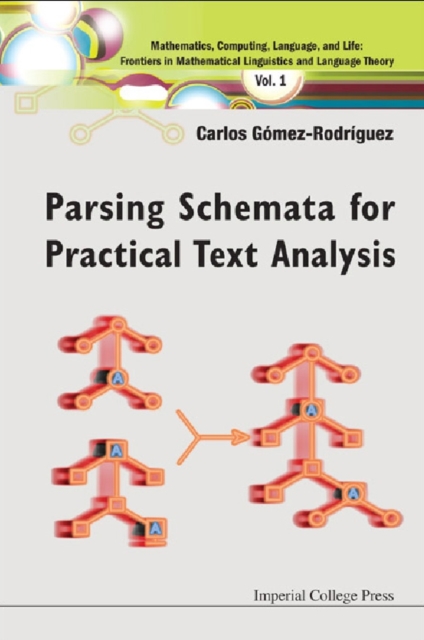
Parsing schemata for practical text analysis
The book presents a wide range of recent research results about parsing schemata, introducing formal frameworks and theoretical results while keeping a constant focus on applicability to practical parsing problems. The first part includes a general introduction to the parsing schemata formalism that contains the basic notions needed to understand the rest of the parts. Thus, this compendium can be used as an introduction to natural language parsing, allowing postgraduate students not only to get a solid grasp of the fundamental concepts underlying parsing algorithms, but also an understanding of the latest developments and challenges in the field.Researchers in computational linguistics will find novel results where parsing schemata are applied to current problems that are being actively researched in the computational linguistics community (like dependency parsing, robust parsing, or the treatment of non-projective linguistics phenomena). This book not only explains these results in a more detailed, comprehensive and self-contained way, and highlights the relations between them, but also includes new contributions that have not been presented.
eBook
Microsoft Log Parser Toolkit
Written by Microsoft's Log Parser developer, this is the first book available on Microsoft's popular yet undocumented log parser tool. The book and accompanying Web site contain hundreds of customized, working scripts and templates that system administrators will find invaluable for analyzing the log files from Windows Server, Snort IDS, ISA Server, IIS Server, Exchange Server, and other products.System administrators running Windows, Unix, and Linux networks manage anywhere from 1 to thousands of operating systems (Windows, Unix, etc.), Applications (Exchange, Snort, IIS, etc.), and hardware devices (firewalls, routers, etc.) that generate incredibly long and detailed log files of all activity on the particular application or device. This book will teach administrators how to use Microsoft's Log Parser to data mine all of the information available within these countless logs. The book teaches readers how all queries within Log Parser work (for example: a Log Parser query to an Exchange log may provide information on the origin of spam, viruses, etc.). Also, Log Parser is completely scriptable and customizable so the book will provide the reader with hundreds of original, working scripts that will automate these tasks and provide formatted charts and reports detailing the results of the queries.Written by Microsoft's sole developer of Log Parser, this is the first book available on the powerful yet completely undocumented product that ships with Microsoft's IIS, Windows Advanced Server 2003, and is available as a free download from the Microsoft Web siteThis book and accompanying scripts will save system administrators countless hours by scripting and automating the most common to the most complex log analysis tasks
eBook
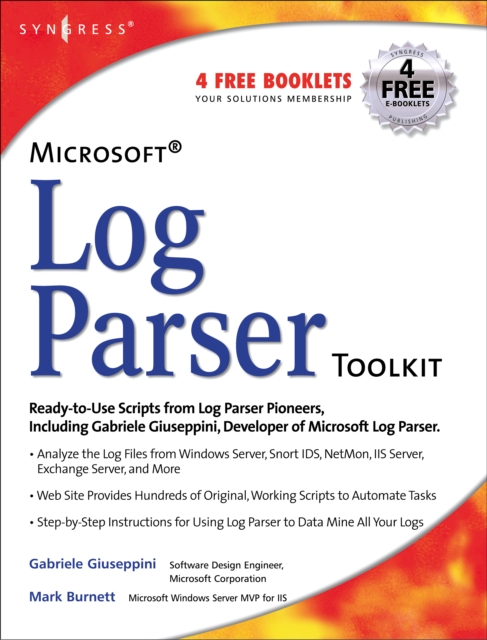
Microsoft Log Parser Toolkit
Written by Microsoft's Log Parser developer, this is the first book available on Microsoft's popular yet undocumented log parser tool.The book and accompanying Web site contain hundreds of customized, working scripts and templates that system administrators will find invaluable for analyzing the log files from Windows Server, Snort IDS, ISA.
eBook
Comparison of text preprocessing methods
Text preprocessing is not only an essential step to prepare the corpus for modeling but also a key area that directly affects the natural language processing (NLP) application results. For instance, precise tokenization increases the accuracy of part-of-speech (POS) tagging, and retaining multiword expressions improves reasoning and machine translation. The text corpus needs to be appropriately preprocessed before it is ready to serve as the input to computer models. The preprocessing requirements depend on both the nature of the corpus and the NLP application itself, that is, what researchers would like to achieve from analyzing the data. Conventional text preprocessing practices generally suffice, but there exist situations where the text preprocessing needs to be customized for better analysis results. Hence, we discuss the pros and cons of several common text preprocessing methods: removing formatting, tokenization, text normalization, handling punctuation, removing stopwords, stemming and lemmatization, n-gramming, and identifying multiword expressions. Then, we provide examples of text datasets which require special preprocessing and how previous researchers handled the challenge. We expect this article to be a starting guideline on how to select and fine-tune text preprocessing methods.
Journal Article

Difficult diagnoses in breast pathology
Breast cancer is the second leading cause of cancer death in women in the United States. For the pathologist, almost any breast lesion may produce diagnostic difficulty, especially due to frequently small samples (core biopsy specimens) and a variety of mimics and variants seen in specific types of lesions. Additionally, the difficulty of breast lesion diagnosis has risen dramatically in recent years due to the increased emphasis on stratifying patients for appropriate therapy on an individual basis; the wider range of both local and systemic therapeutic options, and the potential for earlier diagnosis through increased mammographic breast screening leading to a higher likelihood of a favorable outcome. \"Difficult Diagnoses in Breast Pathology\" will have a special focus on the difficult diagnostic problems in breast disease for the surgical pathologist: needle core biopsy interpretation, diagnosis of precursor lesions and early stage disease, recognition of neoplastic mimics and other misleading variants, and other particularly difficult areas including appropriate use of newer immunohistochemical markers, where appropriate. Prognostic questions and early staging are of special importance in the pathologist's collaboration with oncology clinicians and, increasingly, in informing patients and participating in ongoing management assessment. Throughout, the emphasis will be on a visual presentation with high-quality images on the more difficult problems and questions that the pathologist is likely to have in evaluation of breast disease. In this book, each chapter is authored by recognized expert in the area. It features: hundreds of high-quality images; tables and key points in each chapter that summarize the most important findings; and offers coverage based on addressing in detail the real-world diagnostic problems the pathologist will face in daily practice.
eBook

Learning Grammars for Architecture-Specific Facade Parsing
Parsing facade images requires optimal handcrafted grammar for a given class of buildings. Such a handcrafted grammar is often designed manually by experts. In this paper, we present a novel framework to learn a compact grammar from a set of ground-truth images. To this end, parse trees of ground-truth annotated images are obtained running existing inference algorithms with a simple, very general grammar. From these parse trees, repeated subtrees are sought and merged together to share derivations and produce a grammar with fewer rules. Furthermore, unsupervised clustering is performed on these rules, so that, rules corresponding to the same complex pattern are grouped together leading to a rich compact grammar. Experimental validation and comparison with the state-of-the-art grammar-based methods on four different datasets show that the learned grammar helps in much faster convergence while producing equal or more accurate parsing results compared to handcrafted grammars as well as grammars learned by other methods. Besides, we release a new dataset of facade images following the Art-deco style and demonstrate the general applicability and extreme potential of the proposed framework.
Journal Article