
Catalogue Search | MBRL


Are you sure you want to remove the book from the shelf?

{{itemTitle}}
1,390
result(s) for
"Parson, J"
Sort by:

Revisiting the Topia Road: Walking in the Footsteps of West and Parsons
In 1940, Berkeley graduate-student geographers Robert West and James Parsons traveled to Mexico's Sierra Madre Occidental to retrace the Topia Road, colonial Mexico's main trans-Sierran trail linking isolated mountain mining hamlets with the Pacific Coast and the world beyond, a journey chronicled in a 1941 Geographical Review article. Almost sixty years later, we document an attempt to retrace West and Parsons's route. Based on field observations, interviews with local informants, replication of Parsons's photographs, and his field notes, we evaluate landscape alteration in what West and Parsons referred to as some of the most isolated settlements in Mexico. We assess changes in the still-remote communities along the route in terms of three influences: mining, migration, and drug trafficking.
Journal Article

Plus ça change
Revisiting approaches to historical geography is an activity favored by many, and this essay provides a journey through space and time. After an introduction, I shift to look at seven separate if succinct examples, with illustrations looming large as a reminder of just how significantly historical geography differs from straight-up academic history, whether in an approach to fact or in its historiography. Presented are scenes and circumstances that matter to me, each incorporating a moment or two of memoir. Themes include movement (conveyances); extraction (mining); management (working landscapes); routes (byways); vernaculars (licit and illicit); edibles and farmways; and, finally, cooperation—the last a look at whom we learn from in the field. The overall message is a plea for researching a past that reminds us that the more things change, the more they stay the same.
Journal Article

L’anthropologie et le concept de “parentalité” chez Elsie Clews Parsons
Les travaux actuels sur la parentalité s’accordent pour penser la famille à partir de l’enfant, et non plus à partir de la filiation et de l’alliance (matrimoniale). Cette idée, on la retrouve déjà chez l’anthropologue Elsie Clews Parsons, et ce, dès le début du xxe siècle. Elle a développé, par le biais de sa proposition de contrat parental, une théorie de la responsabilité parentale laissant l’homme et la femme libres (ou non) de coopérer au sein de la famille, de définir les rôles par eux-mêmes et pour eux-mêmes, pour peu que les enfants soient élevés selon des exigences minimales normalisées par l’État. Ses textes avant-gardistes sont, hélas, tombés dans l’oubli. Ils restent cependant d’une grande actualité et nous permettent de repenser avec un siècle de recul les avancées, mais également les récurrences des débats contemporains sur la famille. Outre ses idées sur la parentalité, cet article vise à présenter Elsie Clews Parsons elle-même, ainsi que le rôle qu’elle a joué dans l’histoire de l’anthropologie américaine et dans celle des études féministes.
Journal Article

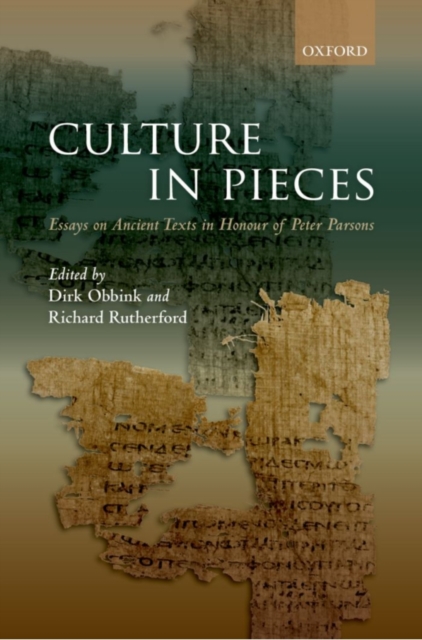
Culture in pieces : essays on ancient texts in honour of Peter Parsons
This volume of essays is chiefly concerned with the problems of interpretation raised by fragmentary evidence, especially by the partial or imperfect survival of texts from the classical world. The essays consider a variety of problems, addressing questions of literary history, source-criticism, editorial method, and scholarly technique.
eBook