
Catalogue Search | MBRL


Are you sure you want to remove the book from the shelf?

{{itemTitle}}
1,300
result(s) for
"Participation, Jewish"
Sort by:


Jewish Partisans of the Soviet Union During World War II
Jewish Partisans of the Soviet Union is a classic compilation of original Russian and Jewish sources on the anti-Nazi resistance in Eastern Europe. It is rooted in decades of research motivated by a desire to set the record straight on Jewish participation in resistance movements, a phenomenon often overlooked when not actively concealed. As the son of Jewish partisans in Nazi-occupied Eastern Europe, Jack Porter presents here the result of his decades-long research: first-hand accounts and interviews with survivors and partisans, as well as some of their original work, and a seminal English translation of Partisan Brotherhood, a historical document gathered by Russian-Jewish intellectuals in 1948 at the height of anti-Semitic hysteria, written mainly by non-Jewish Soviet partisan commanders recounting the deeds of the Jewish fighters in their units.
eBook


German Jewish Soldiers and the Celebration of Yom Kippur in Wartime: Patriotic Images and Jewish Aspirations
One of the enduring themes in German Jewish history has been the deep-seated desire of Jews to be fully accepted as equals by other Germans, including the right to worship freely. Their conscription and voluntary service in the military during both the Franco-Prussian War (1870–1871) and World War I (1914–1918), provided an opportunity for Jews to demonstrate their fealty to the nation. Moreover, their requests for Jewish military chaplains were granted, enabling them to celebrate their traditional High Holy Days services. This article tells the story of Jewish religious worship on Yom Kippur during both wars as depicted by German artists. We examine contemporaneous accounts of the scenes depicted, and find that while some were accurate with respect to venue and mood, the most popular images of throngs of Jewish soldiers worshiping on open-air battlefields were fictionalized images of events that never took place. These pictorial images, exaggerated, romanticized, and idealized, portrayed Jews as patriotic Germans, fully engaged with the wartime goals of the German government while practicing their unique forms of worship. German Jews and Jews throughout the diaspora clung to these images which became widely available on postcards, lithographs, and cloth wall hangings. They continued to be proudly displayed in Jewish homes as symbols of Jewish patriotism, until the end of World War I when blatant antisemitism falsely blamed the Jews for Germany’s defeat.
Journal Article

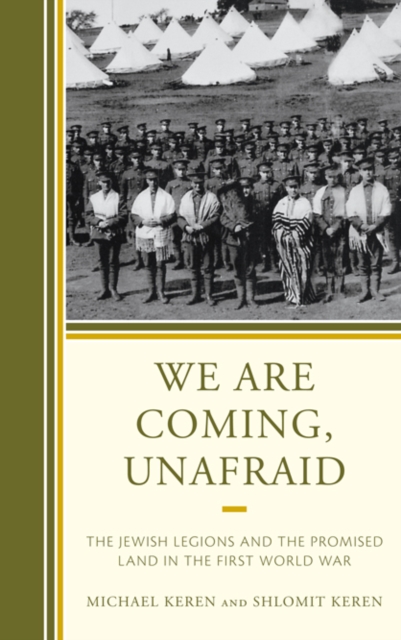
We Are Coming, Unafraid
This book tells the little-known stories of three all-Jewish battalions formed in the British army as part of the Allies' Middle East campaign, recruiting soldiers from the United States, Canada, England, and Argentina. Many of the soldiers, ranging widely in education level, social class, and combat experience, were displaced immigrants or children of such immigrants. Together, they coalesced into the all-Jewish battalions: \"the liberators of the Promised Land.\" The ranks of the Jewish Legions included some who would become prominent leaders, such as David Ben-Gurion, Israel's first prime minister, and Yitzhak Ben-Zvi, Israel's second president; however, this book focuses on the experiences of ordinary soldiers who served alongside them. Drawing on diaries, memoirs, and letters, the book follows their journey at sea through unrestricted submarine warfare; by trains and trucks through Europe, Egypt, and Palestine; and their battlefield experiences. The authors show how these Yiddish-speaking young men forged a new kind of soldier identity with unique Jewish features, as well as an evolving sense of nationalism.
eBook

Jewish Integration in the German Army in the First World War
The peer-reviewed series seeks to provide an international platform for new approaches to the study of modern Jewish history. Covering the period from the Enlightenment to the 21st century, the series focuses on cutting-edge work in social, cultural, economic, and political history. It seeks to explore new avenues in the understanding of modern Jewries in their historical contexts, encouraging a multi-layered exploration of topics which transcend the analytical boundaries of ethnicity, nation, and religion. The series embraces monographs and challenging research-oriented anthologies dedicated to a deeper understanding of essential themes in the main fields of Jewish studies, such as Jewish thought, migration, biography, Israel and the Middle East, Holocaust studies, the history of memory, and identity.
eBook

Saints and liars : the story of Americans who saved refugees from the Nazis
\"Long before their country officially joined the war, American aid workers were active in rescue efforts across Europe. Two such Americans were Martha and Waitstill Sharp, who were originally sent to Prague as part of a relief effort but turned immediately to helping Jews and dissidents after the 1939 invasion by Germany. They were not the only ones. Renowned historian Debórah Dwork follows the story of rescue workers in five major cities as the refugee crisis expanded to Vilna, Shanghai, Marseille, and Lisbon. Followed by Nazi agents, spiriting people across borders, they learned secrecy. Others negotiated with government representatives, like Laura Margolis, who worked with the Japanese, to get enough food and warm shelter for the refugees in Shanghai. Yet, the women also often faced lack of support from their agencies; if part of a couple, they fought to get paid even at a low salary despite working as long and hard as their husbands. Moving and revelatory, Saints and Liars illuminates the unpredictable circumstances and often fast-changing historical events with which these aid workers contended, while revealing the moral questions they encountered and the devastating decisions they had to make. Drawing on a multitude of archival documents, from letters to diaries and memos, Dwork offers us a rare glimpse into the lives of individuals who--at times with their organizations' backing, but sometimes against their directives--sought to help people find safe haven from persecution\"-- Provided by publisher.
BOOK

Jews and the Civil War
At least 8,000 Jewish soldiers fought for the Union and Confederacy during the Civil War. A few served together in Jewish companies while most fought alongside Christian comrades. Yet even as they stood shoulder-to-shoulder on the front lines, they encountered unique challenges.In Jews and the Civil War, Jonathan D. Sarna and Adam Mendelsohn assemble for the first time the foremost scholarship on Jews and the Civil War, little known even to specialists in the field. These accessible and far-ranging essays from top scholars are grouped into seven thematic sections--Jews and Slavery, Jews and Abolition, Rabbis and the March to War, Jewish Soldiers during the Civil War, The Home Front, Jews as a Class, and Aftermath--each with an introduction by the editors. Together they reappraise the impact of the war on Jews in the North and the South, offering a rich and fascinating portrait of the experience of Jewish soldiers and civilians from the home front to the battle front.
eBook