
Catalogue Search | MBRL


Are you sure you want to remove the book from the shelf?

{{itemTitle}}
14
result(s) for
"Partition, Territorial -- Case studies"
Sort by:

Indivisible Territory and the Politics of Legitimacy
In Jerusalem and Northern Ireland, territorial disputes have often seemed indivisible, unable to be solved through negotiation, and prone to violence and war. This book challenges the conventional wisdom that these conflicts were the inevitable result of clashing identities, religions, and attachments to the land. On the contrary, it was radical political rhetoric, and not ancient hatreds, that rendered these territories indivisible. Stacie Goddard traces the roots of territorial indivisibility to politicians' strategies for legitimating their claims to territory. When bargaining over territory, politicians utilize rhetoric to appeal to their domestic audiences and undercut the claims of their opponents. However, this strategy has unintended consequences; by resonating with some coalitions and appearing unacceptable to others, politicians' rhetoric can lock them into positions in which they are unable to recognize the legitimacy of their opponent's demands. As a result, politicians come to negotiations with incompatible claims, constructing territory as indivisible.
eBook
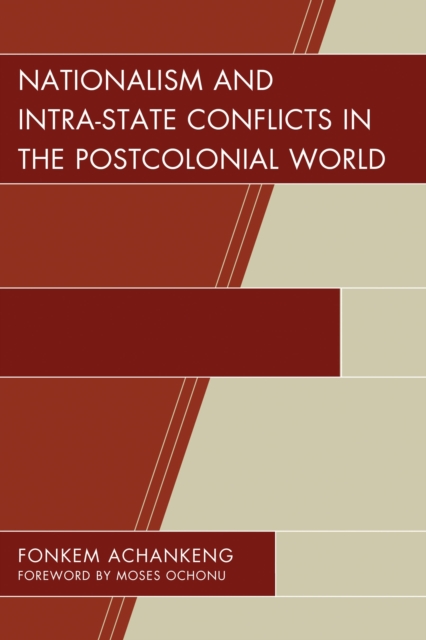
Nationalism and intra-state conflicts in the postcolonial world
This book explores issues of nationalism and intra-state conflicts in postcolonial nations. Drawing from international law, social anthropology, political science and strategic studies, peace and conflict studies, and memory studies, each chapter adopts a unique conceptual lens and discourse to understand the nationalism debate and its conflicts.
eBook

The Geography of Ethnic Violence
The Geography of Ethnic Violenceis the first among numerous distinguished books on ethnic violence to clarify the vital role of territory in explaining such conflict. Monica Toft introduces and tests a theory of ethnic violence, one that provides a compelling general explanation of not only most ethnic violence, civil wars, and terrorism but many interstate wars as well. This understanding can foster new policy initiatives with real potential to make ethnic violence either less likely or less destructive. It can also guide policymakers to solutions that endure.
The book offers a distinctively powerful synthesis of comparative politics and international relations theories, as well as a striking blend of statistical and historical case study methodologies. By skillfully combining a statistical analysis of a large number of ethnic conflicts with a focused comparison of historical cases of ethnic violence and nonviolence--including four major conflicts in the former Soviet Union--it achieves a rare balance of general applicability and deep insight.
Toft concludes that only by understanding how legitimacy and power interact can we hope to learn why some ethnic conflicts turn violent while others do not. Concentrated groups defending a self-defined homeland often fight to the death, while dispersed or urbanized groups almost never risk violence to redress their grievances. Clearly written and rigorously documented, this book represents a major contribution to an ongoing debate that spans a range of disciplines including international relations, comparative politics, sociology, and history.
eBook

Partitions: A Transnational History of Twentieth-Century Territorial Separatism
Partition—the physical division of territory along ethno-religious lines into separate nation-states—is often presented as a successful political \"solution\" to ethnic conflict. In the twentieth century, at least three new political entities—the Irish Free State, the Dominions (later Republics) of India and Pakistan, and the State of Israel—emerged as results of partition. This volume offers the first collective history of the concept of partition, tracing its emergence in the aftermath of the First World War and locating its genealogy in the politics of twentieth-century empire and decolonization.Making use of the transnational framework of the British Empire, which presided over the three major partitions of the twentieth century, contributors draw out concrete connections among the cases of Ireland, Pakistan, and Israel—the mutual influences, shared personnel, economic justifications, and material interests that propelled the idea of partition forward and resulted in the violent creation of new post-colonial political spaces. In so doing, the volume seeks to move beyond the nationalist frameworks that served in the first instance to promote partition as a natural phenomenon.
eBook

Towards a stochastic programming modeling framework for districting
In this paper a stochastic districting problem is investigated. Demand is assumed to be represented by a random vector with a given joint probability distribution function. A two-stage mixed-integer stochastic programming model is proposed. The first stage comprises the decision about the initial territory design: the districts are defined and all the territory units assigned to one and exactly one of them. In the second stage, i.e., after demand becomes known, balancing requirements are to be met. This is ensured by means of two recourse actions: outsourcing and reassignment of territory units. The objective function accounts for the total expected cost that includes the cost for the first-stage territory design plus the expected cost incurred at the second stage by outsourcing and reassignment. The (re)assignment costs are associated with the distances between territory units, i.e., the focus is put on the compactness of the solution. The model is then extended in different ways to account for aspects of practical relevance such as a maximum desirable dispersion, reallocation constraints, or similarity of the second-stage solution w.r.t. the first-stage one. The new modeling framework proposed is tested computationally using instances built using real geographical data.
Journal Article

Berlin’s Manifold Strategies Towards Commercial and Industrial Spaces: The Different Cases of Zukunftsorte
Despite being the third largest industrial agglomeration in the world before World War II, Berlin was faced with an economic void after the partition and reunification of the city with many abandoned and alienated commercial and industrial spaces in a compact urban fabric. What has happened with this commercial and industrial heritage over the last 30 years? The main rationale behind this article is to show how Berlin planned and developed some of these spaces through the Zukunftsorte strategy by preserving its historical sites and modernizing its commercial and industrial base. As part of this undertaking, the article combines insights from urban planning and regional innovation studies. Methodologically, a two‐step approach is applied: First, the article conducts an analysis of fundamental planning frameworks and technology/innovation policy trajectories with regard to commercial and industrial spaces; second, a multiple‐case study
analysis of selected Zukunftsorte (Adlershof, Marzahn, Schöneberg, Siemensstadt) is carried out to test whether and to what extent those spaces are supported by planning frameworks and exhibit components of what we coined territorial ecosystem models. The data compiled stems from 15 years of work engaging in various planning and policy steering committees, individual or joint research projects, personal interviews with relevant stakeholders, and regular field observations. The findings suggest that Berlin’s strategies towards commercial and industrial spaces need to integrate highly contextual approaches since size, progress, operation, means, and timelines of Zukunftsorte vary substantially. Whereas Adlershof is a well‐functioning network of business, academia, planners, and policymakers with preliminary attempts to embed those
stakeholders in residential neighborhoods and the European Energy Forum in Schöneberg—which can be described as a miniature living lab of Adlershof—the other investigated Zukunftsorte do not yet deserve to carry this name.
Journal Article

What's in a Line? Is Partition a Solution to Civil War?
Does territorial partition of countries in civil wars help to end these wars, reducing the risk of recurrence? Researchers have proposed territorial partition with or without formal recognition of sovereignty as a solution to civil wars and a way to create self-enforcing peace. Quantitative studies of the effect of partition on the risk of renewed civil war, however, suffer several main shortcomings, including conflicting results in the extant literature that result mainly from data coding differences, selective use of case histories, and methodological problems. A new data set and a benchmark empirical analysis find that, on average, partition is unlikely to reduce the risk of a return to civil war and, in some cases, may increase that risk.
Journal Article

States of Credit
States of Creditprovides the first comprehensive look at the joint development of representative assemblies and public borrowing in Europe during the medieval and early modern eras. In this pioneering book, David Stasavage argues that unique advances in political representation allowed certain European states to gain early and advantageous access to credit, but the emergence of an active form of political representation itself depended on two underlying factors: compact geography and a strong mercantile presence.
Stasavage shows that active representative assemblies were more likely to be sustained in geographically small polities. These assemblies, dominated by mercantile groups that lent to governments, were in turn more likely to preserve access to credit. Given these conditions, smaller European city-states, such as Genoa and Cologne, had an advantage over larger territorial states, including France and Castile, because mercantile elites structured political institutions in order to effectively monitor public credit. While creditor oversight of public funds became an asset for city-states in need of finance, Stasavage suggests that the long-run implications were more ambiguous. City-states with the best access to credit often had the most closed and oligarchic systems of representation, hindering their ability to accept new economic innovations. This eventually transformed certain city-states from economic dynamos into rentier republics.
Exploring the links between representation and debt in medieval and early modern Europe,States of Creditcontributes to broad debates about state formation and Europe's economic rise.
eBook

The Soldier and the Changing State
The Soldier and the Changing State is the first book to systematically explore, on a global scale, civil-military relations in democratizing and changing states. Looking at how armies supportive of democracy are built, Zoltan Barany argues that the military is the most important institution that states maintain, for without military elites who support democratic governance, democracy cannot be consolidated. Barany also demonstrates that building democratic armies is the quintessential task of newly democratizing regimes. But how do democratic armies come about? What conditions encourage or impede democratic civil-military relations? And how can the state ensure the allegiance of its soldiers?
Barany examines the experiences of developing countries and the armed forces in the context of major political change in six specific settings: in the wake of war and civil war, after military and communist regimes, and following colonialism and unification/apartheid. He evaluates the army-building and democratization experiences of twenty-seven countries and explains which predemocratic settings are most conducive to creating a military that will support democracy. Highlighting important factors and suggesting which reforms can be expected to work and fail in different environments, he offers practical policy recommendations to state-builders and democratizers.
eBook

Keeping the Peace after Secession: Territorial Conflicts between Rump and Secessionist States
Secession is an attempt to resolve a domestically based territorial dispute by dividing a country's homeland territory into new, secessionist (e.g., Eritrea) and rump (e.g., Ethiopia) states. Yet, the secession may not have resolved the original dispute to the states' satisfaction. In the aftermath of a secession, the leader of the rump state is motivated to use force by the benefits of retaking (some of) the land lost to the secessionist state, while the secessionist state's leader is motivated by the benefits of acquiring even more land. The peaceful versus violent secession process further affects whether these desires escalate into the use of force. The results-based on the examination of the consequences of all twentieth-century secessions-reveal that ethnically based territorial disputes play a much greater role in conflict onset than do their economically or strategically based counterparts and that peaceful secessions lead to peaceful relations.
Journal Article