
Catalogue Search | MBRL


Are you sure you want to remove the book from the shelf?

{{itemTitle}}
2,175
result(s) for
"Party affiliation."
Sort by:

Non-policy politics : richer voters, poorer voters, and the diversification of electoral strategies
\"Political parties can select the policies they offer, but have different reputations for competence, unequal capacity to mobilize activists, and different resources to deliver pork and patronage. These are crucial non-policy resources shaping their electoral success. We show how these non-policy resources also shape parties' ideological positions and which type of electoral offers they target to poorer or richer voters. Hence, non-policy politics shapes both electoral success and which voters get what. We describe how the book assesses voters' non-policy preferences with detailed survey and administrative data from Argentina and Chile, including a novel methodology for measuring partisan networks, and how those preferences shapes parties policy and non-policy offers\"-- Provided by publisher.
Book

Red State
In November 1960, the Democratic party dominated Texas. The newly elected vice president, Lyndon Johnson, was a Texan. Democrats held all thirty statewide elective positions. The state legislature had 181 Democrats and no Republicans or anyone else. Then fast forward fifty years to November 2010. Texas has not voted for a Democratic president since 1976. Every statewide elective office is held by Republicans. Representing Texas in Washington is a congressional delegation of twenty-five Republicans and nine Democrats. Republicans control the Texas Senate by a margin of nineteen to twelve and the Texas House of Representatives by 101 to 49. Red State explores why this transformation of Texas politics took place and what these changes imply for the future. As both a political scientist and a Republican party insider, Wayne Thorburn is especially qualified to explain how a solidly one-party Democratic state has become a Republican stronghold. He analyzes a wealth of data to show how changes in the state’s demographics—including an influx of new residents, the shift from rural to urban, and the growth of the Mexican American population—have moved Texas through three stages of party competition, from two-tiered politics, to two-party competition between Democrats and Republicans, and then to the return to one-party dominance, this time by Republicans. His findings reveal that the shift from Democratic to Republican governance has been driven not by any change in Texans’ ideological perspective or public policy orientation—even when Texans were voting Democrat, conservatives outnumbered liberals or moderates—but by the Republican party’s increasing identification with conservatism since 1960.
eBook


Patchwork nation
The unprecedented geographic and socioeconomic mobility of twentieth-century America was accompanied by a major reshuffling of political support in many parts of the country. Yet at the dawn of the new century these local and regional movements are still poorly understood. How can we account for persistent political regionalism and the sectional changes that have radically altered the nation's political landscape, from the Sun Belt to the Rust Belt? Patchwork Nation reveals answers to these vital questions. The masterful analysis in Patchwork Nation reminds us that the traditions and histories of individual states differ widely. Gimpel and Schuknecht's insightful examination of territorial cleavages thus provides us with a key to understanding the raw material that politicians use to fashion our party system. Their findings are an important reminder of geography's central role in our nation's political behavior. From the news analysts and pundits who use maps to identify electoral behavior patterns to the politicians and campaign strategists who study them to locate centers of support, experts of all stripes continue to recognize geography's importance to our political understanding. But in the wake of the survey research revolution of the late twentieth century, scholars often overlooked the relevance of geographic factors for the study of politics. Patchwork Nation retrieves this lost knowledge and extends it in important new directions, encouraging scholars to fundamentally reassess their thinking about the geographic basis of contemporary political behavior.
eBook

Are politics local? : the two dimensions of party nationalization around the world
\"Are politics local? Why? Where? When? How do we measure local versus national politics? And what are the effects? This book provides answers to these questions, within an explicitly comparative framework, including both advanced and developing democracies. It does so by using a statistically-based and graphical account of party nationalization, providing methodology and data for legislative elections covering scores of parties across dozens of countries. The book divides party nationalization into two dimensions - static and dynamic - to capture different aspects of localism, both with important implications for representation. Static nationalization measures the consistency in a party's support across the country and thus shows whether parties are able to encompass local concerns into their platforms. Dynamic nationalization, in turn, measures the consistency among the districts in over-time change in electoral results, under the presumption that where districts differ in their electoral responses, local factors must drive politics. Each of the two dimensions, in sum, considers representation from the perspective of the mix of national versus local politics\"-- Provided by publisher.
Book
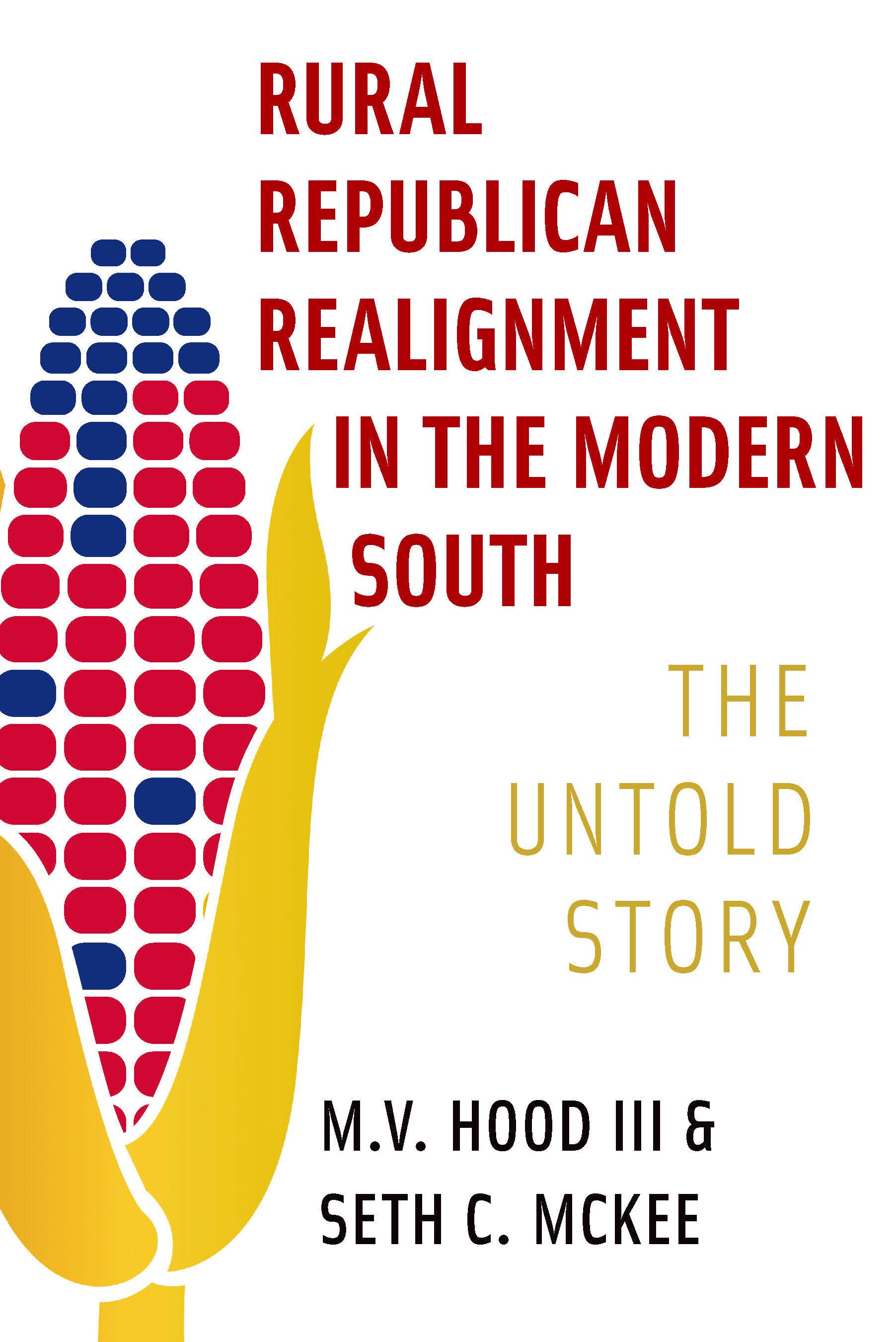
Rural Republican Realignment in the Modern South
An inside look at why the Republican Party has come to dominate
the rural American South
Beginning with the Dixiecrat Revolt of 1948 and extending
through the 2020 election cycle, political scientists M.V. Hood III
and Seth C. McKee trace the process by which rural white
southerners transformed from fiercely loyal Democrats to stalwart
Republicans. While these rural white southerners were the slowest
to affiliate with the Grand Old Party, they are now its staunchest
supporters. This transition and the reasons for it are vital to
understanding the current electoral landscape of the American
South, including states like Georgia, Florida, North Carolina,
Texas, and Virginia, all of which have the potential to exert
enormous influence over national electoral outcomes.
In this first book-length empirically based study focusing on
rural southern voters, Hood and McKee examine their changing
political behavior, arguing that their Democratic-to-Republican
transition is both more recent and more durable than most political
observers realize. By analyzing data collected from their own
region-wide polling along with a variety of other carefully mined
sources, the authors explain why the initial appeal of 1950s
Republicanism to upscale white southerners in metropolitan settings
took well over a half-century to yield to, and morph into, its
culturally conservative variant now championed by rural residents.
Hood and McKee contend that it is impossible to understand current
American electoral politics without understanding the longer
trajectory of voting behavior in rural America and they offer not
only a framework but also the data necessary for doing so.
eBook


Why Americans split their tickets
Why do some voters split their ballots, selecting a Republican for one office and a Democrat for another? Why do voters often choose one party to control the White House while the other controls the Congress? Citizens and politicians have been grappling with the consequences of such \"divided government\" for thirty years. In Why Americans Split their Tickets, Barry C. Burden and David C. Kimball address these fundamental puzzles of American elections. Burden and Kimball explain the causes of divided government and, rejecting the dominant explanations for split-ticket voting, they debunk the myth that voters prefer divided government to one-party control. Likewise, they make a case against interpreting the frequency of divided government as a mandate for compromise between the parties' extremist positions. Instead, the authors argue that ticket splitting and divided government are the unintentional results of lopsided campaigns and the blurring of party differences. In Why Americans Split their Tickets, Burden and Kimball use new quantitative methods to analyze the important changes in presidential, House, and Senate campaigns in the latter half of the twentieth century. Their approach explains the effects on voters' behavior of such developments as the rise of incumbency advantage and the increasing importance of money to campaigns in the 1960s and 1970s. The authors also observe that ticket splitting has declined in recent years. They link this emerging voting pattern to the sharpening policy differences between parties, illuminating the ways that ideological positions of candidates still matter in American elections.
eBook


The Great Migration and the Democratic Party : Black voters and the realignment of American politics in the 20th century
Where Black people live has long been an important determinant of their ability to participate in political processes. The Great Migration significantly changed the way Democratic Party elites interacted with Black communities in northern cities, Detroit, New York, and Chicago. Many white Democratic politicians came to believe the growing pool of Black voters could help them reach their electoral goals—and these politicians often changed their campaign strategies and positions to secure Black support. Furthermore, Black migrants were able to participate in politics because there were fewer barriers to Black political participations outside the South.
The Great Migration and the Democratic Party frames the Great Migration as an important economic and social event that also had serious political consequences. Keneshia Grant created one of the first listings of Black elected officials that classifies them based on their status as participants in the Great Migration. She also describes some of the policy/political concerns of the migrants. The Great Migration and the Democratic Party lays the groundwork for ways of thinking about the contemporary impact of Black migration on American politics.
eBook