
Catalogue Search | MBRL


Are you sure you want to remove the book from the shelf?

{{itemTitle}}
2,154
result(s) for
"Patents as Topic - legislation "
Sort by:

Drug wars : how big pharma raises prices and keeps generics off the market
\"While the shockingly high prices of prescription drugs continue to dominate the news, the strategies used by pharmaceutical companies to prevent generic competition are poorly understood, even by the lawmakers responsible for regulating them. In this groundbreaking work, Robin Feldman and Evan Frondorf illuminate the inner workings of the pharmaceutical market and show how drug companies twist health policy to achieve goals contrary to the public interest. In highly engaging prose, they offer specific examples of how generic competition has been stifled for years, with costs climbing into the billions and everyday consumers paying the price. Drug Wars is a guide to the current landscape, a roadmap for reform, and a warning of what is to come. It should be read by policymakers, academics, patients, and anyone else concerned with the soaring costs of prescription drugs\"-- Provided by publisher.
Book

The global patent landscape of functional food innovation
An analysis of patent documents reveals a trend of increasing interest in functional food innovations that may aid future decision-making in research, business and policymaking.
Journal Article

The patentability and bioethics of molecular de-extinction
The resurrection of strings of extinct molecules raises intriguing questions of patentability and bioethical considerations in an emerging area of patent law.
Journal Article

Addressing the challenge of high-priced prescription drugs in the era of precision medicine: A systematic review of drug life cycles, therapeutic drug markets and regulatory frameworks
Recent public outcry has highlighted the rising cost of prescription drugs worldwide, which in several disease areas outpaces other health care expenditures and results in a suboptimal global availability of essential medicines.
A systematic review of Pubmed, the Financial Times, the New York Times, the Wall Street Journal and the Guardian was performed to identify articles related to the pricing of medicines.
Changes in drug life cycles have dramatically affected patent medicine markets, which have long been considered a self-evident and self-sustainable source of income for highly profitable drug companies. Market failure in combination with high merger and acquisition activity in the sector have allowed price increases for even off-patent drugs. With market interventions and the introduction of QALY measures in health care, governments have tried to influence drug prices, but often encounter unintended consequences. Patent reform legislation, reference pricing, outcome-based pricing and incentivizing physicians and pharmacists to prescribe low-cost drugs are among the most promising short-term policy options. Due to the lack of systematic research on the effectiveness of policy measures, an increasing number of ad hoc decisions have been made with counterproductive effects on the availability of essential drugs. Future challenges demand new policies, for which recommendations are offered.
A fertile ground for high-priced drugs has been created by changes in drug life-cycle dynamics, the unintended effects of patent legislation, government policy measures and orphan drug programs. There is an urgent need for regulatory reform to curtail prices and safeguard equitable access to innovative medicines.
Journal Article
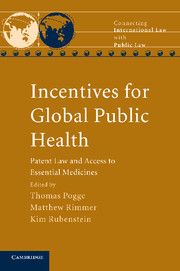
Incentives for Global Public Health
This portrait of the global debate over patent law and access to essential medicines focuses on public health concerns about HIV/AIDS, malaria, tuberculosis, the SARS virus, influenza, and diseases of poverty. The essays explore the diplomatic negotiations and disputes in key international fora, such as the World Trade Organization, the World Health Organization and the World Intellectual Property Organization. Drawing upon international trade law, innovation policy, intellectual property law, health law, human rights and philosophy, the authors seek to canvass policy solutions which encourage and reward worthwhile pharmaceutical innovation while ensuring affordable access to advanced medicines. A number of creative policy options are critically assessed, including the development of a Health Impact Fund, prizes for medical innovation, the use of patent pools, open-source drug development and forms of 'creative capitalism'.
eBook

Traditional knowledge on health: balancing innovation, ethics and intellectual property
Traditional knowledge on health has long contributed to global health-care systems. Rooted in the cultural and ecological heritage of Indigenous Peoples and local communities, traditional knowledge has influenced pharmaceutical research, biodiversity conservation and public health strategies. However, concerns over misappropriation of traditional knowledge and inadequate benefit-sharing with the sources of such knowledge persist. The World Intellectual Property Organization Treaty on Intellectual Property, Genetic Resources and Associated Traditional Knowledge mandates patent disclosure requirements for genetic resources and traditional knowledge. While a step forward, the treaty's success depends on its effective implementation, ethical documentation of traditional knowledge, governance of artificial intelligence and equitable benefit-sharing mechanisms, among other factors. We examine traditional knowledge protection under intellectual property systems, the provisions of the World Intellectual Property Organization treaty, challenges to documentation of traditional knowledge and the role of artificial intelligence in the governance of traditional knowledge. By fostering a legally robust and technology-driven protection system for traditional knowledge, policy-makers can ensure that traditional knowledge remains both a protected cultural heritage and a resource for sustainable innovation in global health.
Journal Article

Achieving greater independence from commercial influence in research
As part of The BMJ’s campaign for greater independence from commercial influence in the creation and use of evidence, Joel Lexchin and colleagues outline some approaches to minimise bias in clinical trials
Journal Article

Gender inventorship equity in patent prosecution
There are pervasive gender gaps throughout the patent process. Here, we add to the literature by providing an in-depth analysis of gendered outcomes across each stage of patent prosecution. We show that female inventors are more likely to face rejection, experience unsuccessful appeals, and exhibit lower responsiveness to rejections than male counterparts. Not only are women less likely to patent their invention, but each stage of examination individually contributes to a lower aggregate grant rate for female inventors. Our research finds that, unlike small and large entity industry equivalents, university-filed patent applications demonstrate increased gender parity in allowance rates and continued prosecution after rejection. Moreover, small entities—patent applicants with typically smaller budgets—are either more than or equally likely to exhibit gender parity when compared to larger firms. We anticipate this study to be a starting point for a more sophisticated discussion around closing gender gaps in patenting and STEM.
Journal Article
The sufficiency of disclosure of medical artificial intelligence patents
Analysis of medical artificial intelligence patents reveals substantial gaps in disclosure, underscoring the need for improved examination guidelines to ensure AI patent specifications contain enabling disclosures.
Journal Article