
Catalogue Search | MBRL


Are you sure you want to remove the book from the shelf?

{{itemTitle}}
1,244
result(s) for
"Patriotism in literature."
Sort by:


Detective Fiction in a Post-Truth World: Eva Rossmann’s Patrioten
Detective fiction is known as a genre that is concerned with revealing truths, both in the fictional world of the text as well as in the society after which it is patterned. The current socio-political environment, however, has been described as an era of post-truth politics and political propaganda, in which truth is more often determined by the relative strength of its representation. While some contemporary crime novels continue to propagate a reassuring message of truth, select Austrian narratives reflect this new so-called post-truth world. Bringing together theories of detective fiction and post-truth discourse, this article demonstrates how Eva Rossmann’s 2017 crime novel Patrioten (Patriots) adapts the themes and structures of traditional detective narratives to expose a society in which certainty is determined less by objective facts than by their construction in the media and socio-political discourse. The analysis concludes that the novel’s thematic and formal innovations help to redefine the socio-critical potential of contemporary detective fiction by showing the imminent dangers of an unregulated post-truth society.
Journal Article

Stalin's Empire of Memory
Based on declassified materials from eight Ukrainian and Russian archives,Stalin's Empire of Memory, offers a complex and vivid analysis of the politics of memory under Stalinism. Using the Ukrainian republic as a case study, Serhy Yekelchyk elucidates the intricate interaction between the Kremlin, non-Russian intellectuals, and their audiences.
Yekelchyk posits that contemporary representations of the past reflected the USSR's evolution into an empire with a complex hierarchy among its nations. In reality, he argues, the authorities never quite managed to control popular historical imagination or fully reconcile Russia's 'glorious past' with national mythologies of the non-Russian nationalities.
Combining archival research with an innovative methodology that links scholarly and political texts with the literary works and artistic images,Stalin's Empire of Memorypresents a lucid, readable text that will become a must-have for students, academics, and anyone interested in Russian history.
eBook

History and hope in American literature
Through the examination of literary works by twentieth and twenty-first century American authors, this book shows how literature can allow us to cope with difficult periods of history (slavery, the Great Depression, the AIDS crisis, etc.) and give hope for a brighter future when those realities are confronted head-on.
eBook

The virtues of Captain America : modern-day lessons on character from a World War II superhero
The first look at the philosophy behind the Captain America comics and movies, publishing in advance of the movie release of Captain America: The Winter Solider in April 2014. In The Virtues of Captain America, philosopher and long-time comics fan Mark D. White argues that the core principles, compassion, and judgment exhibited by the 1940's comic book character Captain America remain relevant to the modern world. Simply put, \"Cap\" embodies many of the classical virtues that have been important to us since the days of the ancient Greeks: honesty, courage, loyalty, perseverance, and, perhaps most importantly, honor. Full of entertaining examples from more than 50 years of comic books, White offers some serious philosophical discussions of everyone's favorite patriot in a light-hearted and accessible way. Presents serious arguments on the virtues of Captain America while being written in a light-hearted and often humorous tone Introduces basic concepts in moral and political philosophy to the general reader Utilizes examples from 50 years of comics featuring Captain America, the Avengers, and other Marvel superheroes Affirms the value of \"old-fashioned\" virtues for the modern world without indulging in nostalgia for times long passed Reveals the importance of the sound principles that America was founded upon Publishing in advance of Captain America: The Winter Soldier out in April 2014.
eBook
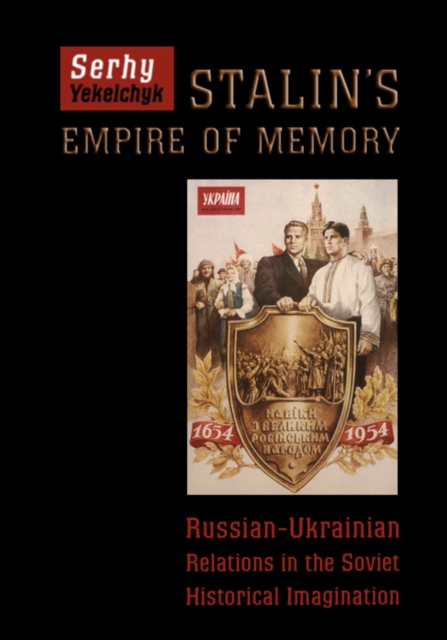
Stalin's Empire of Memory
Based on declassified materials from eight Ukrainian and Russian archives, this text offers a complex and vivid analysis of the politics of memory under Stalinism, using the Ukrainian republic as a case study.
eBook
Taking Liberties
As narrow, nationalist views of patriotic allegiance have become widespread and are routinely invoked to justify everything from flag-waving triumphalism to xenophobic bigotry, the concept of a nonnationalist patriotism has vanished from public conversation.Taking Libertiesis a study of what may be called patriotism without borders: a nonnational form of loyalty compatible with the universal principles and practices of democracy and human rights, respectful of ethnic and cultural diversity, and, overall, open-minded and inclusive.Moving beyond a traditional study of Polish dramatic literature, Halina Filipowicz turns to the plays themselves and to archival materials, ranging from parliamentary speeches to polemical pamphlets and verse broadsides, to explore the cultural phenomenon of transgressive patriotism and its implications for society in the twenty-first century.In addition to recovering lost or forgotten materials, the author builds an innovative conceptual and methodological framework to make sense of those materials. The result is not only a significant contribution to the debate over the meaning and practice of patriotism, but a masterful intellectual history.
eBook
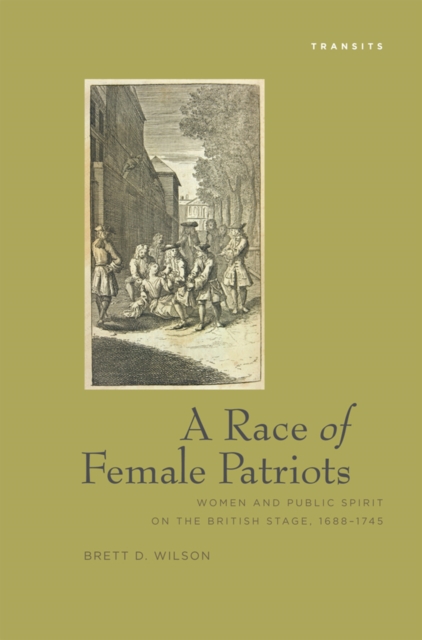
A race of female patriots
A Race of Female Patriots argues that public-spirited women proliferated on the eighteenth-century British stage to catalyze an affective experience of political belonging, as dramatists imagined new forms of affiliation, allegiance, and loyalty suitable to the new British constitution established by the Glorious Revolution of 1688. Brett D. Wilson examines both staples of the repertory (The Fair Penitent, Jane Shore) and lesser-known plays (Liberty Asserted, The Revolution of Sweden, Edward and Eleonora) to define the parameters of a prevalent yet under-examined dramatic mode: “civic” dramas that use scenes of political strife and private distress to stage the fashioning of communities around women. Onstage, women act to benefit the public—crucially, Wilson argues, by infusing the commonwealth with sentimental ardor: public spirit. Playwrights like Nicholas Rowe, Catharine Trotter, John Dennis, and James Thomson make the female-centered unions they imagine into synecdoches for a British nation transformed from turmoil to harmony. Restoring to view key neglected texts that portray women who feel deeply as agents of inclusion and icons of civic virtue, A Race of Female Patriots is a persuasive study of tragic drama at a time of great political change that yields new insight into the relation between women, feeling, and the public sphere.
eBook


Chosen land: Affection and ambivalence in Nadav Lapid's films about Israel
Some of world cinema's most celebrated filmmakers have tumultuous ties with their homelands, and Israel's Nadav Lapid - who has made three features to date, including 2019 golden bear winner 'synonyms' - is no different. In conversation with the writer/director, Anthony Carew examines how this relationship manifests in oppositions between artistry and aggression, opulence and oppression, patriotism and protest.
Magazine Article