
Catalogue Search | MBRL


Are you sure you want to remove the book from the shelf?

{{itemTitle}}
184
result(s) for
"Patronage, Political -- Case studies"
Sort by:

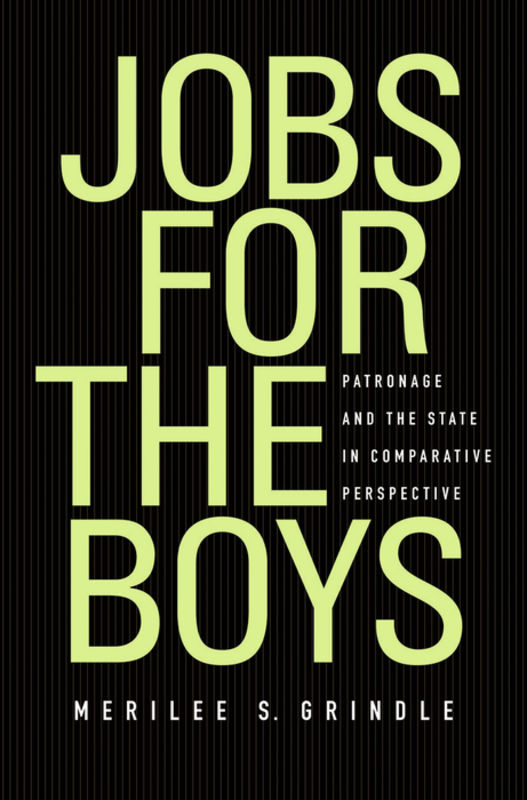
Jobs for the boys : patronage and the state in comparative perspective
Patronage systems in public service are reviled as undemocratic and corrupt. Yet patronage was the prevailing method of staffing government for centuries, and in some countries it still is. Grindle considers why patronage has been ubiquitous in history and explores the processes through which it is replaced by merit-based civil service systems.
eBook


Clientelism in Indian Villages
We study the operation of local governments (Panchayats) in rural Maharashtra, India, using a survey that we designed for this end. Elections are freely contested, fairly tallied, highly participatory, non-coerced, and lead to appointment of representative politicians. However, beneath this veneer of ideal democracy we find evidence of deeply ingrained clientelist vote-trading structures maintained through extra-political means. Elite minorities undermine policies that would redistribute income toward the majority poor. We explore the means by which elites use their dominance of land ownership and traditional social superiority to achieve political control in light of successful majoritarian institutional reforms.
Journal Article

Patronage and politics in the USSR
How did Soviet politicians rise to power? How were conflicting political interests brought together as policies were developed in the Soviet Union? These questions long absorbed historians and political scientists, yet none had systematically examined the crucial role played by patron-client relations until John P. Willerton.
Book

Exploring the impact of political patronage networks on financial stability: Lebanon's 2019 economic crisis
Amid Lebanon's multifaceted economic crisis, this paper explores the intricate dynamics between political patronage networks and financial stability. Grounded in the theoretical frameworks of New Institutional Economics (NIE) and Project Management (PM), the study delves into how entrenched political elites and patronage networks have shaped Lebanon's financial system, exacerbating vulnerabilities and perpetuating the ongoing crisis. Utilizing qualitative methods including in-depth interviews, document analysis, and case studies, the research illuminates the pivotal role of political actors and their vested interests in economic policies and financial institutions. The findings reveal systemic governance failures, crony capitalism, and institutional decay as underlying causes of Lebanon's economic stress. In response, the paper proposes a comprehensive framework for governance reform that integrates insights from NIE and PM, emphasizing structured planning, accountability mechanisms, and institutional strengthening. The purpose of this study is not only to contribute to a nuanced understanding of Lebanon's challenges but also to offer actionable insights for policymakers, academics, and stakeholders to address the root causes of the crisis and pave the way for sustainable economic recovery and revitalization.
Journal Article

Sultans, Merchants, and the Issue of Islamic Patronage on the Kazakh Steppe (1820s–1850s)
This article challenges historiographical interpretations that emphasize tsarist sponsorship of Muslim religious institutions on the nineteenth-century Kazakh steppe. Drawing on both tsarist archival records and local Muslim sources, it highlights the crucial role of Muslim patrons in fostering an Islamic transformation—or revival—marked by the rapid expansion of mosques, madrasas, and networks of Islamic scholars that connected the steppe to other centers of Islamic learning in the region. These patrons included influential political leaders, Muslim tsarist administrators, and merchants such as Qunanbay Oskenbay-ughli, Tinibay Kauken-ughli, and Jolaman Jandarbek-ughli, who financed Islamic institutions while navigating increasingly restrictive tsarist religious policies. Paradoxically, while the tsarist regime imposed legal constraints on Islam, its broader policies inadvertently contributed to the rise of these Muslim benefactors by enabling their accumulation of wealth, status, and political leverage.
Journal Article

The Role of “Resources” in Regime Durability in Laos
This article argues the Lao People’s Democratic Republic, or Laos, draws upon three key types of “resources” in consolidating regime durability. Intentionally broad, our conception of resources encompasses not just natural resources managed by the state on behalf of the national community, but also the ideological and institutional resources that underpin the Lao People’s Revolutionary Party (LPRP) program of industrial resourcification and modernization. Our argument focuses on the mutual constitution and coproduction of natural, ideological, and institutional regime resources using a triptychal model to understand their integrative contribution to regime durability in Laos. This approach illuminates an evolving and pragmatic form of “statist market socialism” that contrasts with the common view of Laos as an aspiring if imperfect market-based developing economy. After defining statist market socialism and the regime’s three key resources, the article presents a case study from Laos’ strategic hydropower sector, to demonstrate how the triptych of regime resources combine in practice to support and sustain LPRP rule.
Journal Article

Economic Performance and Elite Defection from Hegemonic Parties
Hegemonic party regimes are non-democratic regimes that (1) rule with the aid of a dominant political party and (2) hold multi-party elections. Elite coalitions organized under the aegis of a hegemonic party are most vulnerable in elections that coincide with poor economic performance. A declining economy provides elites with a platform around which they can mobilize support to challenge incumbents in elections. As a result, the likelihood of defections from hegemonic parties increases as income declines. This study’s original dataset, which includes 227 elections for the chief executive in hegemonic party dictatorships from 1946 to 2004, and its case studies of defections in Zimbabwe under ZANU-PF in 2008 and Turkey under the Democratic Party in 1955 provide evidence for this proposition.
Journal Article

Constitutional coups and military interventions: Reassessing extended presidential tenure and its impact on governance in Africa
This paper critically examines the consolidation of executive power in Africa through constitutional amendments, often referred to as “constitutional coups,” and its correlation with the resurgence of military interventions. The study’s objective is to explore how the removal of presidential term limits, electoral law manipulation, and similar structural changes contribute to the erosion of democratic norms, institutional accountability, and political stability. Using a conceptual and theoretical analysis grounded in recent case studies, the paper demonstrates how these tactics entrench aging political elites and deepen systemic challenges such as corruption, poverty, and tribalism. It highlights how gerontocracy and ethnically skewed political appointments generate exclusionary governance structures that monopolize key institutions, including the judiciary, legislature, and the military, within dominant ethnic factions, thereby intensifying political marginalisation and social unrest. The paper argues that when peaceful mechanisms for political transition are closed off by such legal manipulations, the likelihood of mass protest and military coups increases. As a policy response, the study recommends the codification of African Union norms on constitutional amendment procedures, the enforcement of term limits, and the strengthening of continental early warning systems. These measures are vital for restoring institutional checks, deterring authoritarian entrenchment, and safeguarding democratic governance across the continent. The paper thus contributes to the discourse on constitutionalism and political accountability in Africa by offering practical, policy-relevant strategies for reform.
Journal Article