
Catalogue Search | MBRL


Are you sure you want to remove the book from the shelf?

{{itemTitle}}
1,370
result(s) for
"Performance art Fiction."
Sort by:

The museum of modern love
\"Arky Levin has reached a creative dead end. Guilty and restless after an unexpected separation from his wife, almost by chance he stumbles upon an art exhibit that will change his life. Based on a real piece of performance art, the installation that the fictional Arky Levin discovers is inexplicably powerful. Visitors to the Museum of Modern Art sit across a table from artist Marina Abramović for as short or long a period of time as they choose. Although some go in skeptical, almost all leave moved. And the participants are not the only ones to find themselves changed by this unusual experience: Arky finds himself returning daily to watch others with Abramović. As the performance unfolds over the course of 75 days, so too does Arky. As he bonds with other people drawn to the exhibit, he slowly starts to understand what might be missing in his life and what he must do\"-- Provided by publisher.
Book

Magic(al) Realism
Bestselling novels by Angela Carter, Salman Rushdie, Gabriel Garcia Marquez and a multitude of others have enchanted us by blurring the lines between reality and fantasy. Their genre of writing has been variously defined as 'magic', 'magical' or 'marvellous' realism and is quickly becoming a core area of literary studies. This guide offers a first step for those wishing to consider this area in greater depth, by:
exploring the many definitions and terms used in relation to the genre
tracing the origins of the movement in painting and fiction
offering an historical overview of the contexts for magic(al) realism
providing analysis of key works of magic(al) realist fiction, film and art.
This is an essential guide for those interested in or studying one of today's most popular genres.
'[Bower's] overall purpose is \"to guide the non-expert through the minefield of terms, to identify the origins of the terms and concepts in art, literature and film and to introduce readers to a range of innovative and engaging fictions\". All of this she achieves: the text is easily understood without being simplistic, and the glossary, though short, is clear and very helpful.' British Bulletin of Publications
'What renders Bower's Magic(al) Realism such a valuable and comprehensive introduction is that in addition to literature, she also considers artefacts from other fields of cultural production ... Bower's analysis of magical realism also proves exceptional in that she repeatedly draws attention to the importance of the cultural location of the audience in receiving a work as magic realist.' - Wasafiri
Introduction 1. Origins of Magic(al) Realism 2. Delimiting the Terms 3. Locations of the Magic(al) Realism 4. Transgressive Variants of Magical Realism 5. Cross-cultural variants of Magical realism 6. Magic(al) Realism and Cultural Productions 7. The Future of Magic(al) Realism Glossary Bibliography Index
Maggie Ann Bowers teaches American and Canadian literature at the University of Antwerp, Belgium. She has published numerous articles on contemporary American and Canadian authors, and is the co-editor of Convergences and Interferences (2002).
eBook

Marina Abramovic turned herself into art and wasn't sorry
Marina Abramovic is a world-famous artist who uses her body to perform in unexpected and unusual ways that make an audiences think. She once sat back-to-back with her partner and tied their hair together for over 17 hours. Another time, museum visitors watch her scrub 1500 cow bones for six hours a day. This innovative book tells an inspiring story about the pioneering performance artist who is also the first female artist to hold a major solo exhibition at the Royal Academy of Arts in London.
CHILDBOOK
Anonymous club
Grammy-nominated singer/songwriter Courtney Barnett allows rare access to her life on tour and artistic process in this intimate 16mm documentary for devotees and new fans alike.
Streaming Video
Indigiqueerness
Evolving from a conversation between Joshua Whitehead and Angie Abdou, Indigiqueerness is part dialogue, part collage, and part memoir. Beginning with memories of his childhood poetry and prose and travelling through the library of his life, Whitehead contemplates the role of theory, Indigenous language, queerness, and fantastical worlds in all his artistic pursuits. This volume is imbued with Whitehead’s energy and celebrates Indigenous writers and creators who defy expectations and transcend genres.
eBook

Understanding Reality Through Science Fiction and Digitalization: The Hybrid Theatrical Space in Sun Xiaoxing’s Rhinoceros (2020)
This essay looks into theatre director Sun Xiaoxing’s play Rhinoceros (2020) to explore the reflective potentials of theatre at historical moments of uncertainty with the facilitation of technology. An adaptation of Eugène Ionesco’s Rhinoceros (1959), Sun’s Rhinoceros inherits the discursive power of the original script as the latter circulates across time and space. Through the use of digital technology, this contemporary Chinese adaptation particularly carves out a hybrid theatrical space that represents the “mediated presence” of the audience. As this “mediated presence” engages surreal elements to mediate the representation of reality, it utters the historical moment of “post-truth.” Such theatrical theory and practice of the “re-theatre” redefines the idea of liveness, reinventing the audience as active audience-actors and making the virtual realm a new proscenium stage that penetrates the boundaries between onstage and offstage.
Journal Article

Attunement to the Great Near with Rebecca Belmore's Wave Sound
In 2017, on the 150th anniversary of Canadian confederation, Anishinaabe-kwe performance artist Rebecca Belmore set a quartet of listening trumpets entitled Wave Sound on shorelines across Canada’s national parks. Her metallic instruments amplify the water’s frequencies by drawing them in close, inviting visitors to stop and listen to the found sounds. This technology operates on the scale of W.E.B. Du Bois’s rarely considered sci-fi “megascope,” inviting a new mode of listening to the vital and resilient voice of the lands and waters beyond narratives of settler colonialism.
Journal Article
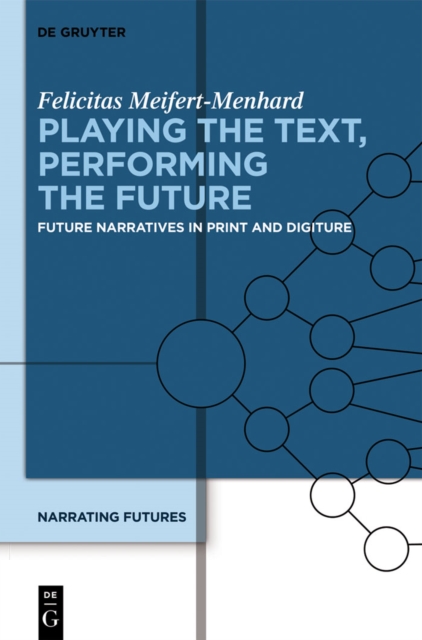
Playing the text, performing the future : future narratives in print and digiture
This volume examines the structure of text-based Future Narratives in the widest sense, including choose-your-own-adventure books, forking-path novels, combinatorial literature, hypertexts, interactive fiction, and alternate reality games. How ´radical` can printed Future Narratives really be, given the constraints of their media? When exactly do they not only play with the mere idea of multiple continuations, but actually stage genuine openness and potentiality? Process-rather than product-oriented, text-based Future Narratives are seen as performative and contingent systems, simulating their own emergence.
eBook

Live Poetry
Given the increasing popularity of literary festivals, open mics, and poetry slams, one could justifiably claim that the English-speaking world is currently experiencing a 'Live Poetry' boom. Yet, despite this raised awareness for the aesthetic and social potential of performed poetry, academia has barely responded, failing in the process to update and adapt its concept of poetry to meet these recent developments. Bridging this critical gap, this volume provides for the first time a full methodological 'toolkit' for the analysis of live poetry by drawing together approaches from diverse disciplines concerned with speech and forms of cultural performance. Most notably, these include literary studies, paralinguistics, musicology, kinesics, theatre and performance studies, and folklore studies. This innovative methodology is demonstrated through sample analyses based on a mixed corpus of audio and video recordings of poetry performances, as well as on personal interviews with practitioners of live poetry. Of value to the scholar and poetry enthusiast alike, this volume presents an indispensable guide for anyone interested in understanding and analysing poetry's evolution through its current 'spoken word' renaissance.
eBook

How the Music Machine Makes Myths Real: AI, Holograms, and Ashley Eternal
Since ancient times, music has been instrumental in giving life to the stories we build our identities and cultures around. I will examine how, in our time, music creates new myths by creating its own heroes and heroines through capital and the star system. In traditional literary and cultural analysis, a distinction was drawn between the natural and the supernatural when discussing literary mythology; in the twentieth century, an equivalent distinction was made in works of art that, in Baudrillard’s terminology, make use of the realms of the real and the “hyperreal” (1981). In today’s mythmaking, the supernatural has been largely replaced by the technological, and recent developments blur the line between science fiction and fantasy; tech has become megalotech. A recent episode of the television series Black Mirror, “Rachel, Jack, and Ashley Too” (2019), explores these concepts with an examination of the pros and cons of replacing human performers with AI simulacra.
Journal Article