
Catalogue Search | MBRL


Are you sure you want to remove the book from the shelf?

{{itemTitle}}
18,575
result(s) for
"Performance standards Management."
Sort by:

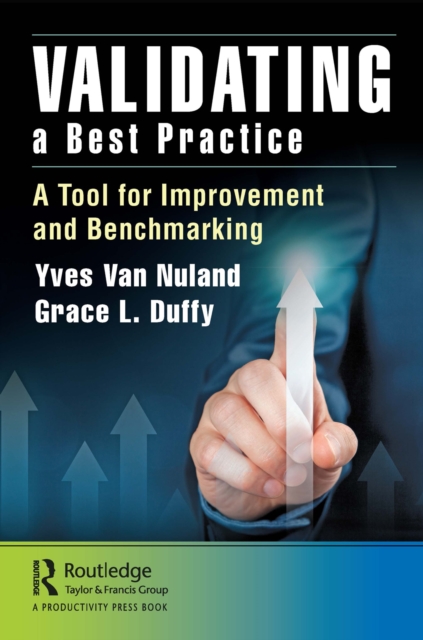
Validating a Best Practice
Sharing Best Practices across industries and functions is an accepted method for continuous improvement. All organizations using process - focused improvement, whether public, private, government or non-government, benefit from managing core activities at a Best Practice level. Best Practices are tools for designing processes more effectively. The Benchmarking trend of the 1990s evolved with the help of competitive analysis, performance excellence awards, and other corporate recognition programs into an ongoing record of what works. Bob Camp introduced benchmarking against a Best Practice based on his work at Xerox in the 1980s. Nowhere before now has there been a tool to identify and document an effective Best Practice. The BEST method, offered in this book, provides the reader a quick and user-friendly tool to assess a Best Practice process and set action plans to improve performance to World Class level.
eBook

Performance management for dummies
\"A step-by-step guide to designing and implementing a state-of-the-science performance management system in your business. Learn to develop it, assess how it's working, improve your leadership skills, and help your employees grow.\"--Provided by publisher.
Book

Leading Practices and Key Performance Indicators for Asset Maintenance
As part of the WERF Strategic Asset Management (SAM) benchmarking activity, the research team identified three areas of competency of best management practices related to maintenance. To maintain continuity, the maintenance and KPI survey was broken down into the three broad competencies to help identify the best maintenance management performance indicators. The areas of competency were Strategy and Tactics, Work Flow Management, and Managing and Monitoring. Data was gathered from 27 utilities using Survey Statements and KPIs. Analysis results showed that there were no clear top performers who did everything well within the three categories. Therefore, the competencies were further broken down into 10 specific competencies: Overall maintenance strategy, Maintenance tactic selection, Information Technology Infrastructure, CMMS access and use Data quality, Planning and scheduling, Material management, Condition based maintenance, Reliability analysis, CMMS history and performance measures. There were clear top performers for these 10 competencies and the research team created Maintenance Practice Case Studies on these topics. The research gathered information from the utilities on the Maintenance Program and the KPIs used to support the program through personal interviews, reports, data sheets, survey results etc. This information was used to create 5 case studies, each covering 2 maintenance practices and 1 utility. Each case study contains brief information about the utility, process of implementing maintenance practices, current program, KPIs to support the practice, value and lessons learnt for other utilities. The research indicated that the utilities were able to implement the maintenance practice successfully with external and/or internal help. The research also found that the implementation and integration of new maintenance practices were far reaching, having impacts to organization structure, the technology in use and asset maintenance
Book

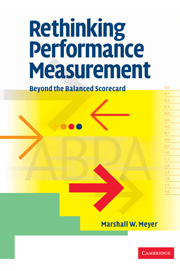
Rethinking Performance Measurement
Performance measurement remains a vexing problem for business firms and other kinds of organisations. This book explains why: the performance we want to measure (long-term cash flows, long-term viability) and the performance we can measure (current cash flows, customer satisfaction, etc.) are not the same. The 'balanced scorecard', which has been widely adopted by US firms, does not solve these underlying problems of performance measurement and may exacerbate them because it provides no guidance on how to combine dissimilar measures into an overall appraisal of performance. A measurement technique called activity-based profitability analysis (ABPA) is suggested as a partial solution, especially to the problem of combining dissimilar measures. ABPA estimates the revenue consequences of each activity performed for the customer, allowing firms to compare revenues with costs for these activities and hence to discriminate between activities that are ultimately profitable and those that are not.
eBook

Competency mapping and assessment : a practitioner handbook
\"This book provides an in-depth coverage on competency mapping and assessment centre - it includes an extensive list of generic competencies, competency models for HR, leadership, model for future competency, automobile sector, and academic institutions and experiences of some consultancy assignments. It presents the complete know-how of the developing competency framework in detail for all practitioners and professionals. The volume examines 'what, why, how' on the subject and extensive support models that have been developed over years of research, consultancy, and training experience across private, public and government sectors in India, Bangladesh, Saudi Arabia, Nepal, UK and other countries. The book has been designed to help scholars and practitioners to understand, develop, manage, and map competencies with their organizations. The chapters are illustrated with figures and tables, along with examples, for a better understanding. The glossary of job task analysis will be helpful in job analysis, which is one of the most important tasks in developing competency models. The volume would be useful to both the academic and corporate world. The students, researchers, and faculty of Business Management courses especially those specializing in Human Resource Management will have in- depth understanding of 'What and Why' of Competency Frameworks, Models and Assessment Centre. It will also be an essential resource for Corporates - Public and Private sector, multi-national organizations, Staff Training Institutions, Learning & Development Centres, Consultancy firms, Trainers, Government and Public Service organizations etc. to have hands on understanding of 'How' of developing Competency Framework, Competency mapping and Assessment centre in their organizations\"-- Provided by publisher.
BOOK

Competence in social work practice : a practical guide for students and professionals
Since the publication of the first edition of this classic text, the major reforms in social work education resulted in the National Occupational Standards Framework (NOSF), which requires all social workers to demonstrate competence in a number of key areas.This practical text book covers all areas of the NOSF including social work ethics, residential care practice, child protection, risk analysis and protecting adults with learning difficulties. Numerous case studies effectively convey competent practice in social work practice, and relate core areas of competence explicitly to the relevant section of the framework.Professionals and students involved in social work training, as well as new practitioners will value this book as an indispensable resource.
eBook


Enhancing the prospects for growth and trade of the Kyrgyz Republic
The Kyrgyz Republic has made major strides in the past decade in its transition to a market-based economy. Its trade and investment policies are arguably the most liberal among the member countries of the Commonwealth of Independent States. Despite the generally progressive stance on structural policies and a sound record of macroeconomic management in recent years, economic growth has been modest, living standards are low, a large burden of external debt has accumulated, and integration into global production and trade remains limited. The growth agenda must address more carefully the constraints to greater supply-side response to ongoing reformsan agenda that can facilitate a broad-based growth of economic activity and exports. Risks to sustainability of current growth rates and continued poverty reduction will otherwise remain high as will the economys vulnerability to external shocks. This report is aimed at assisting authorities fashioning this agenda by focusing on three key challenges:Identifying strategic options to strengthen prospects for medium- and long-term growth and poverty reduction; Assessing ways of leveraging domestic trade policy reforms and existing regional and multilateral trade agreements for further regional and global integration; and Identifying key areas where greater efforts are necessary to facilitate improvements in enterprise capability and productivity.
eBook