
Catalogue Search | MBRL


Are you sure you want to remove the book from the shelf?

{{itemTitle}}
52,245
result(s) for
"Perfume"
Sort by:


Perfume and Flavor Engineering: A Chemical Engineering Perspective
In the last two decades, scientific methodologies for the prediction of the design, performance and classification of fragrance mixtures have been developed at the Laboratory of Separation and Reaction Engineering. This review intends to give an overview of such developments. It all started with the question: what do we smell? The Perfumery Ternary Diagram enables us to determine the dominant odor for each perfume composition. Evaporation and 1D diffusion model is analyzed based on vapor-liquid equilibrium and Fick’s law for diffusion giving access to perfume performance parameters. The effect of matrix and skin is addressed and the trail of perfumes analyzed. Classification of perfumes with the perfumery radar is discussed. The methodology is extended to flavor and taste engineering. Finally, future research directions are suggested.
Journal Article

The perfume collector : a novel
Newlywed Grace Monroe doesn't fit anyone's expectations of a successful 1950s London socialite, least of all her own. When she receives an unexpected inheritance from a complete stranger, Madame Eva d'Orsey, Grace is drawn to uncover the identity of her mysterious benefactor. Weaving through the decades, from 1920s New York to Monte Carlo, Paris, and London, the story Grace uncovers is that of an extraordinary women who inspired one of Paris's greatest perfumers. Immortalized in three evocative perfumes, Eva d'Orsey's history will transform Grace's life forever, forcing her to choose between the woman she is expected to be and the person she really is.
Book


Evolution of Acquired Perfumes and Endogenous Lipid Secretions in Orchid Bees
Male orchid bees are unique in the animal kingdom for making perfumes that function as sex pheromone. Males collect volatile chemicals from the environment in the neotropical forests, including floral and non-floral sources, creating complex but species-specific blends. Male orchid bees exhibit several adaptations to facilitate perfume collection and storage. When collecting volatile compounds, males apply lipid substances that they secrete from cephalic labial glands onto the fragrant substrate. These lipids help dissolve and retain the volatiles, similar to the process of ‘enfleurage’ in the traditional perfume industry. We investigated how the chemical composition of acquired perfume and labial gland secretions varied across the phylogeny of orchid bees, including 65 species in five genera from Central and South America. Perfumes showed rapid evolution as revealed by low overall phylogenetic signal, in agreement with the idea that perfume compounds diverge rapidly and substantially among closely related species due to their role in species recognition. A possible exception were perfumes in the genus Eulaema, clustering closely in chemospace, partly mediated by high proportions of carvone and trans-carvone oxide. Labial gland secretions, in contrast, showed a strong phylogenetic signal at the genus level, with secretions of Eufriesea and Exaerete dominated by fatty acids and Eulaema dominated by saturated acetates of chain lengths 12 to 16 C-atoms. Secretions of the majority of Euglossa were heavily dominated by one unsaturated long chain diacetate, (9Z)-Eicosen-1,20-diyldiacetate. However, we also identified few highly divergent species of Euglossa in four subclades (11 species) that appear to have secondarily replaced the diacetate with other compounds. In comparison with environment-derived perfumes, the evolution of labial gland secretion is much slower, likely constrained by the underlying biochemical pathways, but perhaps influenced by perfume-solvent chemical interactions.
Journal Article
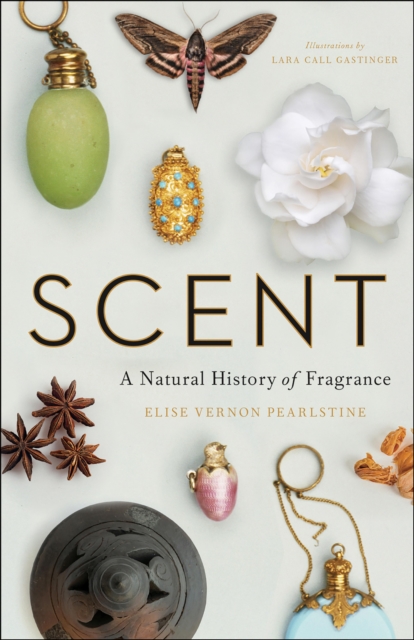
Scent
A fascinating exploration of the natural history of scent
and human perceptions of fragrance from the viewpoint of plant and
pollinator Plants have long harnessed the chemical
characteristics of aromatic compounds to shape the world around
them. Frankincense resin from the genus Boswellia seals
injured tissues and protects trees from invading pathogens. Jasmine
produces a molecule called linalool that attracts pollinating moths
with its flowery scent. Tobacco uses a similarly sweet-smelling
compound called benzyl acetone to attract pollinators. Only
recently in the evolutionary history of plants, however, have
humans learned to co-opt their fragrances to seduce, heal, protect,
and alter moods themselves. In this wide-ranging and accessible new
book, biologist-turned-perfumer Elise Vernon Pearlstine turns our
human-centered perception of fragrance on its head and investigates
plants' evolutionary reasons for creating aromatic molecules.
Delving into themes of spirituality, wealth, power, addiction,
royalty, fantasy, and more, Pearlstine uncovers the natural history
of aromatic substances and their intersection with human culture
and civilization.
eBook

A novel approach for evaluating the effects of odor stimulation on dynamic cardiorespiratory functions
We aimed to develop a novel method to quantitatively evaluate the effects of odor stimulation on cardiorespiratory functions over time, and to examine the potential usefulness of clinical aromatherapy. Eighteen subjects participated. Nine people were assigned to each of the two resting protocols. Protocol 1: After resting for 2 min in a sitting position breathing room air, the subject inhaled either air or air containing sweet marjoram essential oil from the Douglas bag for 6 min, Protocol 2: After resting for 5 min in a supine position, the subject inhaled the essential oil for 10 min, and then recovered for 10 min breathing room air. All subjects inhaled the essential oil through a face mask attached to one-way valve, and beat-to-beat heart rate (HR) and arterial blood pressure (BP) as well as breath-by-breath respiratory variables were continuously recorded. In both protocols, during fragrance inhalation of the essential oil, time-dependent decrease in mean BP and HR were observed (P<0.05). During post-inhalation recovery, the significant fragrance-induced bradycardic effect lasted at least 5 min (- 3.1 ± 3.9% vs. pre-inhalation baseline value, p<0.05). The mean BP response at the start of odor stimulation was approximated by a first-order exponential model. However, such fragrance-induced changes were not observed in the respiratory variables. We established a novel approach to quantitatively and accurately evaluate the effects of quantitative odor stimulation on dynamic cardiorespiratory functions, and the duration of the effect. This methodological approach may be useful for scientific evaluation of aromatherapy as an approach to integrated medicine, and the mechanisms of action of physiological effects in fragrance compounds.
Journal Article
The Characteristic Fragrant Sesquiterpenes and 2-(2-Phenylethyl)chromones in Wild and Cultivated “Qi-Nan” Agarwood
Recently, cultivated “Qi-Nan” (CQN) agarwood has emerged as a new high-quality agarwood in the agarwood market owing to its similar characteristics, such as high content of resin and richness in two 2-(2-phenylethyl)chromone derivatives, 2-(2-phenylethyl)chromone (59) and 2-[2-(4-methoxyphenyl)ethyl]chromone (60), to the wild harvested “Qi-Nan” (WQN) agarwood. In this study, we compared the chemical constituents and fragrant components of two types of WQN agarwood from A. agallocha Roxb. and A. sinensis, respectively, with CQN agarwood and ordinary agarwood varieties. Additionally, we analyzed different samples of WQN agarwood and CQN agarwood by GC-MS, which revealed several noteworthy differences between WQN and CQN agarwood. The chemical diversity of WQN was greater than that of CQN agarwood. The content of (59) and (60) was higher in CQN agarwood than in WQN agarwood. For the sesquiterpenes, the richness and diversity of sesquiterpenes in WQN agarwood, particularly guaiane and agarofuran sesquiterpenes, were higher than those in CQN. Moreover, guaiane-furans sesquiterpenes were only detected by GC-MS in WQN agarwood of A. sinensis and could be a chemical marker for the WQN agarwood of A. sinensis. In addition, we summarized the odor descriptions of the constituents and established the correlation of scents and chemical constituents in the agarwood.
Journal Article