
Catalogue Search | MBRL


Are you sure you want to remove the book from the shelf?

{{itemTitle}}
322
result(s) for
"Perfumes History"
Sort by:

Fashion scents : style & perfume from Chanel to Madonna
A history of trends, illustrated through the evolution of tastes and styles of perfumes, scents and eaux de toilette - a celebration of women and their perfumes from the 1920s to the 1980s.
Book

Past Scents
In this comprehensive and engaging volume, medical historian Jonathan Reinarz offers a historiography of smell from ancient to modern times. Synthesizing existing scholarship in the field, he shows how people have relied on their olfactory sense to understand and engage with both their immediate environments and wider corporal and spiritual worlds. This broad survey demonstrates how each community or commodity possesses, or has been thought to possess, its own peculiar scent. Through the meanings associated with smells, osmologies develop--what cultural anthropologists have termed the systems that utilize smells to classify people and objects in ways that define their relations to each other and their relative values within a particular culture. European Christians, for instance, relied on their noses to differentiate Christians from heathens, whites from people of color, women from men, virgins from harlots, artisans from aristocracy, and pollution from perfume. This reliance on smell was not limited to the global North. Around the world, Reinarz shows, people used scents to signify individual and group identity in a morally constructed universe where the good smelled pleasant and their opposites reeked. With chapters including \"Heavenly Scents,\" \"Fragrant Lucre,\" and \"Odorous Others,\" Reinarz's timely survey is a useful and entertaining look at the history of one of our most important but least-understood senses.
eBook

Scent : a natural history of fragrance
In this wide-ranging and accessible new book, biologist-turned-perfumer Elise Vernon Pearlstine turns our human-centered perception of fragrance on its head and investigates plants' evolutionary reasons for creating aromatic molecules. Delving into themes of spirituality, wealth, power, addiction, royalty, fantasy, and more, Pearlstine uncovers the natural history of aromatic substances and their intersection with human culture and civilization.
BOOK
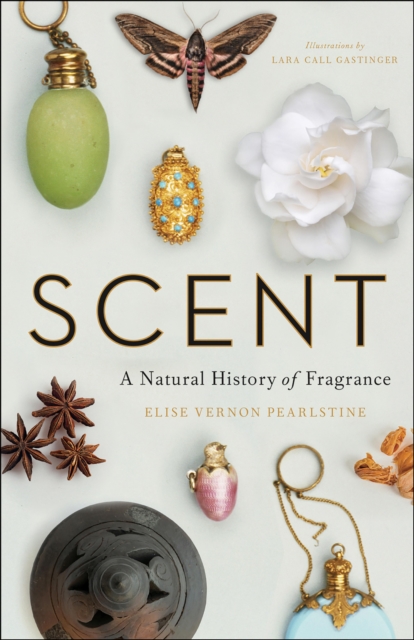
Scent
A fascinating exploration of the natural history of scent
and human perceptions of fragrance from the viewpoint of plant and
pollinator Plants have long harnessed the chemical
characteristics of aromatic compounds to shape the world around
them. Frankincense resin from the genus Boswellia seals
injured tissues and protects trees from invading pathogens. Jasmine
produces a molecule called linalool that attracts pollinating moths
with its flowery scent. Tobacco uses a similarly sweet-smelling
compound called benzyl acetone to attract pollinators. Only
recently in the evolutionary history of plants, however, have
humans learned to co-opt their fragrances to seduce, heal, protect,
and alter moods themselves. In this wide-ranging and accessible new
book, biologist-turned-perfumer Elise Vernon Pearlstine turns our
human-centered perception of fragrance on its head and investigates
plants' evolutionary reasons for creating aromatic molecules.
Delving into themes of spirituality, wealth, power, addiction,
royalty, fantasy, and more, Pearlstine uncovers the natural history
of aromatic substances and their intersection with human culture
and civilization.
eBook

Scent & subversion : decoding a century of provocative perfume /
Examines vintage perfume's powerful past, including reviews of more than 300 scents, with period advertisements throughout.
Book

The ephemeral history of perfume : scent and sense in early modern England
In contrast to the other senses, smell has long been thought of as too elusive, too fleeting for traditional historical study. Holly Dugan disagrees, arguing that there are rich accounts documenting how men and women produced, consumed, and represented perfumes and their ephemeral effects. She delves deeply into the cultural archive of olfaction to explore what a sense of smell reveals about everyday life in early modern England.
In this book, Dugan focuses on six important scents—incense, rose, sassafras, rosemary, ambergris, and jasmine. She links these smells to the unique spaces they inhabited—churches, courts, contact zones, plague-ridden households, luxury markets, and pleasure gardens—and the objects used to dispense them. This original approach provides a rare opportunity to study how early modern men and women negotiated the environment in their everyday lives and the importance of smell to their daily actions.
Dugan defines perfume broadly to include spices, flowers, herbs, animal parts, trees, resins, and other ingredients used to produce artificial scents, smokes, fumes, airs, balms, powders, and liquids. In researching these Renaissance aromas, Dugan uncovers the extraordinary ways, now largely lost, that people at the time spoke and wrote about smell: objects \"ambered, civited, expired, fetored, halited, resented, and smeeked\" or were described as \"breathful, embathed, endulced, gracious, halited, incensial, odorant, pulvil, redolent, and suffite.\"
A unique contribution to early modern studies, The Ephemeral History of Perfume is an unparalleled study of olfaction in the Renaissance, a period in which new scents and important cultural theories about smell were developed. Dugan's inspired analysis of a wide range of underexplored sources makes available to scholars a remarkable wealth of information on the topic.
eBook


Scent from the garden of paradise : musk and the Medieval Islamic world
Scent from the Garden of Paradise: Musk and the Medieval Islamic World traces the history of musk from ancient Asia to the early medieval Islamic world and examines the important role musk played in perfumery and medicine in this new context.
eBook
Scent : a natural history of fragrance
In this wide-ranging and accessible new book, biologist-turned-perfumer Elise Vernon Pearlstine turns our human-centered perception of fragrance on its head and investigates plants' evolutionary reasons for creating aromatic molecules. Delving into themes of spirituality, wealth, power, addiction, royalty, fantasy, and more, Pearlstine uncovers the natural history of aromatic substances and their intersection with human culture and civilization.