
Catalogue Search | MBRL


Are you sure you want to remove the book from the shelf?

{{itemTitle}}
11
result(s) for
"Persian Gulf States Emigration and immigration."
Sort by:


Crossing the Gulf : love and family in migrant lives
The lines between what constitutes migration and what constitutes human trafficking are messy at best. State policies rarely acknowledge the lived experiences of migrants, and too often the laws and policies meant to protect individuals ultimately increase the challenges faced by migrants and their kin. In some cases, the laws themselves lead to illegality or statelessness, particularly for migrant mothers and their children.
Crossing the Gulf tells the stories of the intimate lives of migrants in the Gulf cities of Dubai, Abu Dhabi, and Kuwait City. Pardis Mahdavi reveals the interconnections between migration and emotion, between family and state policy, and shows how migrants can be both mobilized and immobilized by their family relationships and the bonds of love they share across borders. The result is an absorbing and literally moving ethnography that illuminates the mutually reinforcing and constitutive forces that impact the lives of migrants and their loved ones—and how profoundly migrants are underserved by policies that more often lead to their illegality, statelessness, deportation, detention, and abuse than to their aid.
eBook

Between dreams and ghosts : Indian migration and Middle Eastern oil
\"More than one million Indians travel annually to work in oil projects in the Gulf, one of the few international destinations where men without formal education can find lucrative employment. Between Dreams and Ghosts follows their migration, taking readers to sites in India, the United Arab Emirates, and Kuwait, from villages to oilfields and back again. Engaging all parties involved-the migrants themselves, the recruiting agencies that place them, the government bureaucrats that regulate their emigration, and the corporations that hire them-Andrea Wright examines labor migration as a social process as it reshapes global capitalism. With this book, Wright demonstrates how migration is deeply informed both by workers' dreams for the future and the ghosts of history, including the enduring legacies of colonial capitalism. As workers navigate bureaucratic hurdles to migration and working conditions in the Gulf, they in turn influence and inform state policies and corporate practices. Placing migrants at the center of global capital rather than its periphery, Wright shows how migrants are not passive bodies at the mercy of abstract forces-and reveals through their experiences a new understanding of contemporary resource extraction, governance, and global labor\"-- Provided by publisher.
Book
City of strangers : Gulf migration and the Indian community in Bahrain
Exploring the everyday experiences of workers from India who have migrated to Bahrain, this study contributes significantly to our understanding of politics and society among the Persian Gulf states and of the migrant labor phenomenon that is an increasingly important aspect of globalization. \"Andrew M. Gardner expertly combines in-depth ethnography with theoretical sophistication in this important look at the complex linkages between labor, migration, globalization, and the structural violence that accompanies the new world economic order. Gardner follows the labyrinthine paths of migrant workers in the Gulf, drawing on powerful qualitative data to complicate existing assumptions about the lives of skilled and unskilled workers in the Middle East's fastest growing region. Beautifully written and compelling, the book sheds light on a population and area of the world that remains understudied despite its rapid emergence onto the global market.\"—Pardis Mahdavi, Pomona College
eBook
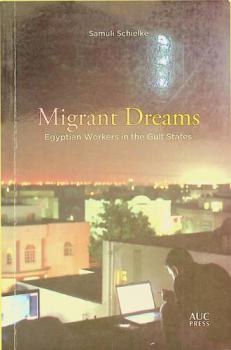
Migrant dreams : Egyptian workers in the Gulf states
\"A vivid ethnography of Egyptian migrants to the Arab Gulf states, Migrant Dreams is about the imagination which migration thrives on, and the hopes and ambitions generated by the repeated experience of leaving and returning home. What kind of dreams for a good or better life drives labor migrants? What does being a migrant worker do to one's hopes and ambitions? How does the experience of migration to the Gulf, with its attendant economic and legal precarities, shape migrants' particular dreams of a better life? What do those dreams--be they realistic and productive, or fantastic and unlikely--do to the social worlds of the people who pursue them, and to their families and communities back home upon their return? Based on ten years of ethnographic fieldwork and conversations with Egyptian men from mostly low-income rural backgrounds who migrated as workers to the Gulf, returned home, and migrated again over a period of about a decade, this fine-grained study explores and engages with these questions and more, as the men reflect on their strivings and the dreams they hope to fulfill. Throughout the book, Samuli Schielke highlights the story of one man, Tawfiq, who is particularly gifted at analyzing his own situation and struggles, resulting in a richly nuanced account that will appeal not only to Middle East scholars, but to anyone interested in the lived lives of labor migrants and what their experiences ultimately mean to them.\"--Publisher's description
Book

Soft weapons
Azar Nafisi’s Reading Lolita in Tehran, Marjane Satrapi’s comics, and “Baghdad Blogger” Salam Pax’s Internet diary are just a few examples of the new face of autobiography in an age of migration, globalization, and terror. But while autobiography and other genres of life writing can help us attend to people whose experiences are frequently unseen and unheard, life narratives can also be easily co-opted into propaganda. In Soft Weapons, Gillian Whitlock explores the dynamism and ubiquity of contemporary life writing about the Middle East and shows how these works have been packaged, promoted, and enlisted in Western controversies. Considering recent autoethnographies of Afghan women, refugee testimony from Middle Eastern war zones, Jean Sasson’s bestsellers about the lives of Arab women, Norma Khouri’s fraudulent memoir Honor Lost, personal accounts by journalists reporting the war in Iraq, Satrapi’s Persepolis, Nafisi’s book, and Pax’s blog, Whitlock explores the contradictions and ambiguities in the rapid commodification of life memoirs. Drawing from the fields of literary and cultural studies, Soft Weapons will be essential reading for scholars of life writing and those interested in the exchange of literary culture between Islam and the West.
eBook

Indian migration to the Gulf : issues, perspectives and opportunities
\"This book explores issues of rights, issues and challenges faced by Indian migrant workers in GCC countries. It focuses on the struggle of migrants in the state of origin and destination states and how the process of migration shapes the identity and existence of migrant workers. The essays in the volume focus on policy, rights, issues, and challenges faced by the migrants as well as the long-term challenges posed by the COVID-19 pandemic. With contributions from academics and policymakers, this book will be of interest to scholars and researchers of migration and diaspora studies, public policy, and South Asian Studies\"-- Provided by publisher.
Book

Immigration: Perspectives from receiving countries
The author examines the issue of international migration from the standpoint of receiving countries. He attempts \"to understand how and why migrant-receiving countries respond as they do, and to suggest some of the new issues in international migration that arise in a world in which the supply of would-be migrants and refugees is now greater than receiving countries are willing to accept.\"
Journal Article


U.S. Plans to Resettle 7,000 Iraqi Refugees
About 20,000 fled from Iraq when President Saddam Hussein crushed an uprising by Shiite Muslims in the south just after the war; 10,000 were Iraqi prisoners of war who asked not to be returned, Mr. [Richard A. Boucher] said. About 25,000 Iraqi refugees remained in Saudi Arabia, he added.
Newspaper Article