
Catalogue Search | MBRL


Are you sure you want to remove the book from the shelf?

{{itemTitle}}
379
result(s) for
"Persian language Texts"
Sort by:

The Sanskrit, Syriac and Persian sources in the Comprehensive book of Rhazes
In this study of the Sanskrit, Syriac and Persian sources in Rhazes' (d. 925 CE) famous Arabic encyclopedia titled al-Ḥāwī, Oliver Kahl offers for the first time a textual and historical documentation of an hitherto neglected 'foreign' cluster of material.
eBook
Recognition of visual scene elements from a story text in Persian natural language
Text-to-scene conversion systems map natural language text to formal representations required for visual scenes. The difficulty involved in this mapping is one of the most critical challenges for developing these systems. The current study mapped Persian natural language text as the headmost system to a conceptual scene model. This conceptual scene model is an intermediate semantic representation between natural language and the visual scene and contains descriptions of visual elements of the scene. It will be used to produce meaningful animation based on an input story in this ongoing study. The mapping task was modeled as a sequential labeling problem, and a conditional random field (CRF) model was trained and tested for sequential labeling of scene model elements. To the best of the authors’ knowledge, no dataset for this task exists; thus, the required dataset was collected for this task. The lack of required off-the-shelf natural language processing modules and a significant error rate in the available corpora were important challenges to dataset collection. Some features of the dataset were manually annotated. The results were evaluated using standard text classification metrics, and an average accuracy of 85.7% was obtained, which is satisfactory.
Journal Article
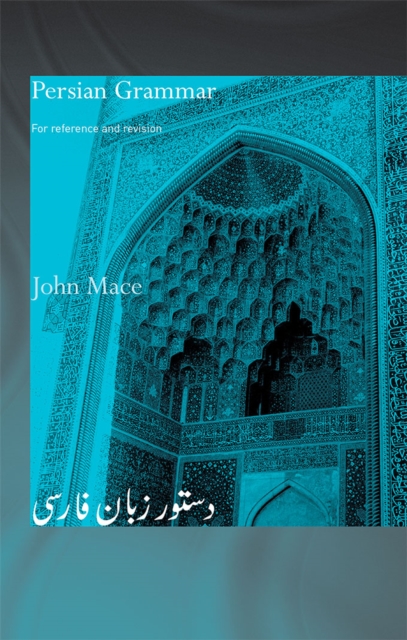
Persian Grammar
This is a book for reference and revision, especially for those in the early stages of studying the Persian language. It uses the official reformed spelling, and gives attention to handwriting, educated standard and educated colloquial pronunciation, and the important polite forms. The grammar is explained with copious examples, all shown both in Persian script and in Roman transliteration. The grammatical themes are grouped logically, and there are cross-references, appendices and a subject index to facilitate the search for the right form.
Introduction 1. Writing 2. Pronunciation 3. Nouns and adjectives 4. Pronouns 5. Verbs 6. Prepositions 7. Adverbs 8. Syntax 9. Numbers 10. Arabic forms 11. Wordbuilding 12. Polite forms Appendices Index
John Mace studied at Oxford University. He has worked as a British Council lecturer in Iran, in the Diplomatic Service, as a personnel officer in the Middle East, and as a European Commission Delegate. He has written Persian, Arabic and German language manuals, and a verse translation of Russian poetry.
\"Those interested in learning Farsi will find the book 'Persian Grammar' by John Mace a key resource in their learning activities. It offers support to student both in the early and intermediate stages… The author offers detailed explanations and many examples, all shown both in Persian script and in Roman transliteration, to help students to learn this language. Those who master this language will have the reward of enjoy the pleasure of reading the wonderful poetry of Hafiz, Rumi, Omar Khayyam, Attar and Sa’adi, among others, in their original language.\" -- Patricia Ordóñez de Pablos, Universidad de Oviedo, Spain (International Journal of Asian Business and Information Management, April-June 2011)
eBook
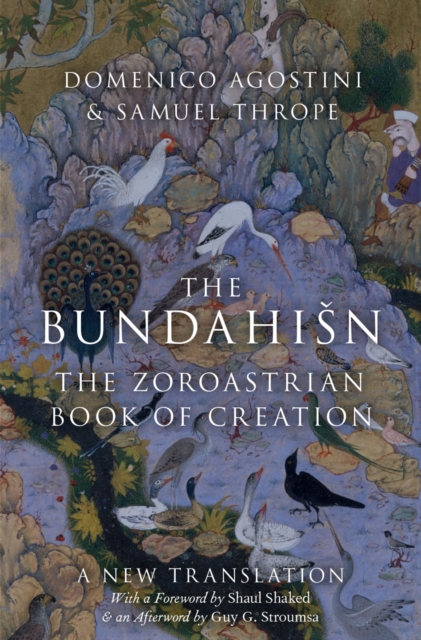
The Bundahišn : the Zoroastrian book of Creation
The Bundahišn, meaning primal or foundational creation, is the central Zoroastrian account of creation, cosmology, and eschatology and one of the most important of the surviving testaments to Zoroastrian literature and pre-Islamic Iranian culture. Touching on geography, cosmogony, anthropology, zoology, astronomy, medicine, legend, and myth, the Bundahišn can be considered a concise compendium of Zoroastrian knowledge.
The Bundahišn is well known in the field as an essential primary source for the study of ancient Iranian history, religions, literature, and languages. It is one of the most important texts composed in Zoroastrian Middle Persian, also known as Zoroastrian Book Pahlavi, in the centuries after the fall of the Sasanian Empire to the invading Arab and Islamic forces in the mid seventh century. The Bundahišn provides scholars with a particularly profitable window on Zoroastrianism’s intellectual and religious history at a crucial transitional moment: centuries after the composition of the Avesta, the Zoroastrian sacred scriptures, and before the transformation of Zoroastrianism into a minority religion within Iran and adherents’ dispersion throughout Central and South Asia. However, the Bundahišn is not only a scholarly tract. It is also a great work of literature in its own right and ranks alongside the creation myths of other ancient traditions: Genesis, the Babylonian Emunah Elish, Hesiod’s Theogony, and others. Informed by the latest research in Iranian Studies, this translation aims to bring to the fore the aesthetic quality, literary style, and complexity of this important work.
eBook

Study of automatic text summarization approaches in different languages
Nowadays we see huge amount of information is available on both, online and offline sources. For single topic we see hundreds of articles are available, containing vast amount of information about it. It is really a difficult task to manually extract the useful information from them. To solve this problem, automatic text summarization systems are developed. Text summarization is a process of extracting useful information from large documents and compressing them into short summary preserving all important content. This survey paper hand out a broad overview on the work done in the field of automatic text summarization in different languages using various text summarization approaches. The focal centre of this survey paper is to present the research done on text summarization on Indian languages such as, Hindi, Punjabi, Bengali, Malayalam, Kannada, Tamil, Marathi, Assamese, Konkani, Nepali, Odia, Sanskrit, Sindhi, Telugu and Gujarati and foreign languages such as Arabic, Chinese, Greek, Persian, Turkish, Spanish, Czeh, Rome, Urdu, Indonesia Bhasha and many more. This paper provides the knowledge and useful support to the beginner scientists in this research area by giving a concise view on various feature extraction methods and classification techniques required for different types of text summarization approaches applied on both Indian and non-Indian languages.
Journal Article