
Catalogue Search | MBRL


Are you sure you want to remove the book from the shelf?

{{itemTitle}}
392
result(s) for
"Personal narratives, French"
Sort by:


The Embattled Self
How did the soldiers in the trenches of the Great War understand and explain battlefield experience, and themselves through that experience? Situated at the intersection of military history and cultural history, The Embattled Self draws on the testimony of French combatants to explore how combatants came to terms with the war. In order to do so, they used a variety of narrative tools at hand-rites of passage, mastery, a character of the soldier as a consenting citizen of the Republic. None of the resulting versions of the story provided a completely consistent narrative, and all raised more questions about the \"truth\" of experience than they answered. Eventually, a story revolving around tragedy and the soldier as victim came to dominate-even to silence-other types of accounts. In thematic chapters, Leonard V. Smith explains why the novel structured by a specific notion of trauma prevailed by the 1930s.
Smith canvasses the vast literature of nonfictional and fictional testimony from French soldiers to understand how and why the \"embattled self\" changed over time. In the process, he undermines the conventional understanding of the war as tragedy and its soldiers as victims, a view that has dominated both scholarly and popular opinion since the interwar period. The book is important reading not only for traditional historians of warfare but also for scholars in a variety of fields who think critically about trauma and the use of personal testimony in literary and historical studies.
eBook

Teenage Resistance Fighter
\"A history book that reads like a novel, this testimony comes from one of the last living eyewitnesses\" of the Nazi occupation of France (Christiane Amanpour, CNN Chief International Correspondent).
September 5, 1944
The Americans are approaching; we follow their progress impatiently on the radio, by intercepting messages reserved for the commandos. They cannot be beaten now. But it is up to us to do the impossible to speed up the progression of the bulk of their troops, to facilitate the advance of their spearhead, and, above all, to prevent the Germans from withdrawing to the Rhine in good order, with all their equipment.
How many human lives will we manage to save?
Hubert Verneret was a fourteen-year-old schoolboy in Burgundy when the Nazis invaded Poland and fifteen when France fell. A Boy Scout, he helped refugees and the gendarmerie, moved wounded soldiers, and dug out bodies after air raids. Throughout, he kept a diary recording his actions, thoughts, and feelings as French troops retreated and Germans arrived.
In 1944, at nineteen, he decided to join the local maquis resistance fighters, operating from a hidden base in the forest. Though constantly in danger, he found himself frustrated, as he felt fated never to fight the Germans directly, never to take a prisoner. As the Allies approached, the maquisards worked to upset and weaken the retreating Germans to aid the Allied advance. Hubert details the joy with which the maquisards were welcomed in local villages when the fighting ended. Only as he listened to the speech given as the maquisards disbanded did he understand that his part in the war, while perhaps not heroic as that played by others, was still important in gaining the victory.
Years later, Hubert interviewed local maquisards to understand more about maquis history; their words and excerpts from the diary of a local civilian during the German retreat provide context to Hubert's youthful testimony. This first English edition of Hubert's diary retains the original prefaces by Col. Buckmaster, chief of the French section of the SOE, and Col. d'Escrienne, aide de camp to Gen. de Gaulle.
eBook

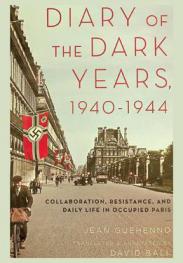
Diary of the dark years, 1940-1944 : collaboration, resistance, and daily life in occupied Paris
Diary of the Dark Years is a sharply observed record of day-to-day life in occupied Paris, but far more: it is \"a remarkable essay on courage and cowardice\" (Wall Street Journal), expressing both shame at French collaboration with the Nazis and the stubborn resistance of an intellectual under great pressure.
eBook
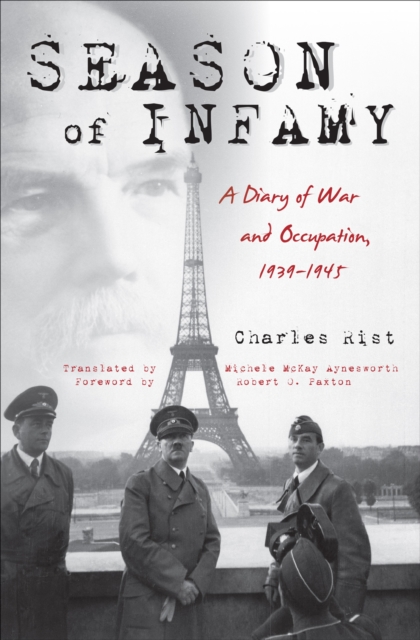
Season of Infamy
In 1939, the 65-year old French political economist Charles Rist was serving as advisor to the French government and consultant to the international banking and business world. As France anxiously awaited a German invasion, Rist traveled to America to negotiate embargo policy. Days after his return to Paris, the German offensive began and with it the infamous season of occupation. Retreating to his villa in Versailles, Rist turned his energies to the welfare of those closest to him, while in his diary he began to observe the unfolding of the war. Here the deeply learned Rist investigates the causes of the disaster and reflects on his country's fate, placing the behavior of the \"people\" and the \"elite\" in historical perspective. Though well-connected, Rist and his family and friends were not exempt from the perils and tragedies of war, as the diary makes clear. Season of Infamy presents a distinctive, closely-observed view of life in France under the occupation.
eBook

Patches of fire : a story of war and redemption
Albert French is the author of Billy, now a motion picture. In Patches of Fire, French recounts his own experiences in Vietnam and his return to an America torn by racial unrest in the wake of the assassination of Martin Luther King.

Pacification in Algeria, 1956-1958
When Algerian nationalists launched a rebellion against French rule in November 1954, France was forced to cope with a varied and adaptable Algerian strategy. In this volume, originally published in 1963, David Galula reconstructs the story of his highly successful command at the height of the rebellion. This groundbreaking work, with a new foreword by Bruce Hoffman, remains relevant to present-day counterinsurgency operations.
eBook