
Catalogue Search | MBRL


Are you sure you want to remove the book from the shelf?

{{itemTitle}}
547
result(s) for
"Peru - Economic conditions"
Sort by:


Resource Extraction and Protest in Peru
Natural resource extraction has fueled protest movements in Latin America and existing research has drawn considerable scholarly attention to the politics of antimarket contention at the national level, particularly in Ecuador, Bolivia, and Argentina. Despite its residents reporting the third-highest level of protest participation in the region, Peru has been largely ignored in these discussions.In this groundbreaking study, Moisés Arce exposes a longstanding climate of popular contention in Peru. Looking beneath the surface to the subnational, regional, and local level as inception points, he rigorously dissects the political conditions that set the stage for protest. Focusing on natural resource extraction and its key role in the political economy of Peru and other developing countries, Arce reveals a wide disparity in the incidence, forms, and consequences of collective action.Through empirical analysis of protest events over thirty-one years, extensive personal interviews with policymakers and societal actors, and individual case studies of major protest episodes, Arce follows the ebb and flow of Peruvian protests over time and space to show the territorial unevenness of democracy, resource extraction, and antimarket contentions. Employing political process theory, Arce builds an interactive framework that views the moderating role of democracy, the quality of institutional representation as embodied in political parties, and most critically, the level of political party competition as determinants in the variation of protest and subsequent government response. Overall, he finds that both the fluidity and fragmentation of political parties at the subnational level impair the mechanisms of accountability and responsiveness often attributed to party competition. Thus, as political fragmentation increases, political opportunities expand, and contention rises. These dynamics in turn shape the long-term development of the state.Resource Extraction and Protest in Peruwill inform students and scholars of globalization, market transitions, political science, contentious politics and Latin America generally, as a comparative analysis relating natural resource extraction to democratic processes both regionally and internationally.
eBook

Gender-sensitive approaches for the extractive industry in Peru : improving the impact on women in poverty and their families
This book presents the results of the study 'New Approaches for Improving the Development Outcomes of the Extractive Industry in Peru: Improving Impacts on Women in Poverty and Their Families.' In recent years, large amounts of 'development assistance' in the form of infrastructure and social programs have been made available to communities across Peru as a result of the presence of extractive industry (EI) companies. These funds have come through corporate-managed social programs; royalties; the tax on EI profits, which is redistributed through the various canons; trust funds; and the voluntary contribution, which was recently introduced. With increasing extractive industry presence, and a decreasing supply of international cooperation aid to Peru, 2 as of 2006, funds from the mining canon alone outstripped international cooperation aid to Peru. While recent commodities fluctuations have reduced company profits, and therefore taxes, canon, and voluntary contributions by companies, these payments are still very significant and are greater than international cooperation aid. Although it is hard in the current international economic climate to make clear projections, funding resources originating from mining in Peru will continue to be key to the development of the poorer communities surrounding the mining operations. One important way in which EI companies and local governments responsible for administering the oil, gas, and mining canons could significantly improve their development outcomes would be to make sure that their development assistance approaches have a stronger influence on women-particularly women from poorer families, who are the least likely to be able to take advantage of the employment opportunities and other benefits offered by the company's presence.
eBook

The Peculiar Revolution
On October 3, 1968, a military junta led by General Juan Velasco Alvarado took over the government of Peru. In striking contrast to the right-wing, pro–United States/anti-Communist military dictatorships of that era, however, Velasco’s “Revolutionary Government of the Armed Forces\" set in motion a left-leaning nationalist project aimed at radically transforming Peruvian society by eliminating social injustice, breaking the cycle of foreign domination, redistributing land and wealth, and placing the destiny of Peruvians into their own hands. Although short-lived, the Velasco regime did indeed have a transformative effect on Peru, the meaning and legacy of which are still subjects of intense debate. The Peculiar Revolution revisits this fascinating and idiosyncratic period of Latin American history. The book is organized into three sections that examine the era’s cultural politics, including not just developments directed by the Velasco regime but also those that it engendered but did not necessarily control; its specific policies and key institutions; and the local and regional dimensions of the social reforms it promoted. In a series of innovative chapters written by both prominent and rising historians, this volume illuminates the cultural dimensions of the revolutionary project and its legacies, the impact of structural reforms at the local level (including previously understudied areas of the country such as Piura, Chimbote, and the Amazonia), and the effects of state policies on ordinary citizens and labor and peasant organizations.
eBook

Voices from the global margin : confronting poverty and inventing new lives in the Andes
Voices from the Global Margin looks behind the generalities of debates about globalization to explore the personal impact of global forces on the Peruvian poor. In this highly readable ethnography, William Mitchell draws on the narratives of people he has known for forty years, offering deep insight into how they have coped with extreme poverty and rapid population growth—and their creation of new lives and customs in the process. In their own passionate words they describe their struggles to make ends meet, many abandoning rural homes for marginal wages in Lima and the United States. They chronicle their terror during the Shining Path guerrilla war and the government's violent military response. Mitchell's long experience as an anthropologist living with the people he writes about allows him to put the stories in context, helping readers understand the impact of the larger world on individuals and their communities. His book reckons up the human costs of the global economy, urging us to work toward a more just world.
eBook

Peru : country program evaluation for the World Bank Group, 2003-09
Since 2003, Peru has emerged as an open, rapidly growing economy. Over the review period of 2003-09, successive governments adopted policy platforms aimed at maintaining macroeconomic stability, furthering the private sector supply response, broadening participation in growth, improving social service delivery, and strengthening public institutions. The World Bank Group (WBG) supported each of the three pillars of the government's poverty reduction strategy, namely: (i) broad-based economic growth that engaged a higher share of the population; (ii) enhanced human development through improved social service delivery; and (iii) strengthened public sector institutions. Independent Evaluation Group (IEG) recommends that the WBG: (i) tailor its strategy to support long-term integration of Peru's three distinct regions; (ii) seek opportunities to support large-scale infrastructure development; (iii) develop a more strategic approach to helping improve public sector management; (iv) seek further innovations in International Bank for Reconstruction and Development (IBRD's) instruments against a backdrop of declining demand for its financial resources; (v) seek to help develop a strategic planning function in Peru; (vi) build a close strategic partnership with development partners that provides concessional finance in the social sectors to optimize synergies with IBRD policy lending and analytic and advisory activities; (vii) develop a strategic focus for International Finance Corporation (IFC) around employment- generating industries in emerging sectors; (viii) maintain IFC's additionality by supporting lower-tier and more regionally dispersed private companies; and (ix) leverage the strong country presence of IBRD and IFC to enhance Multilateral Investment Guarantee Agency's (MIGA's) marketing and risk assessment functions.
eBook
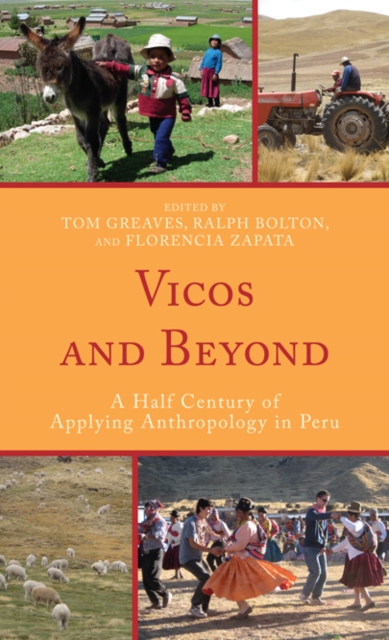
Vicos and beyond : a half century of applying anthropology in Peru
In 1952, Professor Allan Holmberg arranged for Cornell University to lease the Hacienda Vicos, an agricultural estate in the central Peruvian highlands on which some 1800 Quechua-speaking highland peasants resided. Between 1952 and 1957 Holmberg, with colleagues and students, initiated a set of social, economic, and agrarian changes, and nurtured mechanisms for community-based management of the estate by the resident peasants. By the end of a second lease in 1962, sufficient political pressure had been brought to bear on a reluctant national government to force the sale of Vicos to its people. Holmberg's twin goals for the Vicos Project were to bring about community possession of their land base and to study the process as it unfolded, advancing anthropological understanding of cultural change. To describe the process of doing both, he invented the term \"participant intervention.\" Despite the large corpus of existing Vicos publications, this book contains much information that here reaches print for the first time. The chapter authors do not entirely agree on various key points regarding the nature of the Vicos Project, the intentions of project personnel and community actors, and what interpretive framework is most valid; in part, these disagreements reflect the relevance and importance of the Vicos Project to contemporary applied anthropologists and the contrasting ways in which any historical event can be explained. Some chapters contrast Vicos with other projects in the southern Andean highlands; others examine new developments at Vicos itself. The conclusion suggests how those changes should be understood, within Andean anthropology and within anthropology more generally.
eBook
Acts of growth : development and the politics of abundance in Peru
Over the last decade, Peru has experienced a spectacular mining boom and astronomical economic growth. Yet, for villagers in Peru's southern Andes, few have felt the material benefits. With this book, Eric Hirsch considers what growth means—and importantly how it feels. Hirsch proposes an analysis of boom-time capitalism that starts not from considerations of poverty, but from the premise that Peru is wealthy. He situates his work in a network of villages near new mining sites, agricultural export markets, and tourist attractions, where Peruvian prosperity appears tantalizingly close, yet just out of reach. This book centers on small-scale development investments working to transform villagers into Indigenous entrepreneurs ready to capitalize on Peru's new national brand and access the constantly deferred promise of national growth. That meant identifying as Indigenous, where few actively did so; identifying as an entrepreneur, in a place where single-minded devotion to a business went against the tendency to diversify income sources; and identifying every dimension of one's daily life as a resource, despite the unwelcome intimacy this required. Theorizing growth as an affective project that requires constant physical and emotional labor, Acts of Growth follows a diverse group of Andean residents through the exhausting work of making an economy grow.
eBook

Reinventing the state
The political economic history of Latin America in the post-World War II era has largely been one of underachievement and opportunities lost. This all changed with the wave of market reforms that were implemented in the 1990s. However, the precise role of these reforms as an agent of change is still hotly debated. This in-depth analysis of the Peruvian case argues for an explanation that treats institutional innovation and state reconstruction as necessary conditions for the apparent success of the market in Latin America.
Exploring how state intervention has been both the cause of Latin America's economic downfall in the 1980s and the solution to its recovery, Reinventing the State analyzes three main phases of state intervention: the developmentalism that lasted until 1982, the state in retreat of the 1980s, and the streamlined state of the 1990s. Through a comprehensive examination of the Peruvian experience, the book explains the country's impressive turnaround from the standpoint of institutional modernization and internal state reform.
Written for a broad academic audience, the public-policy community, and the private sector, this book is also meant as a quick primer for any journalist, consultant, or private-sector analyst in need of an overview of the region's market-reform effort and how it has played out in Peru.
Carol Wise is Associate Professor, School of International Relations, University of Southern California.
eBook
Peru
This Peru Country Program Evaluation for the World Bank Group, 2003-2009 is part of IEG's country program evaluation series. To date, IEG's in-depth country evaluations have comprised IEG-WB Country Assistance Evaluations (CAEs) and IEG-IFC Country Impact Reviews (CIRs). Both the CAEs and CIRs have involved comprehensive evaluations of the respective institutions' activities in a country. In a pilot approach, this evaluation was prepared by a single IEG team that looked at development interventions across the three WBG institutions. The evaluation draws on WBG documents, external literature, and on interviews with government officials, representatives of the private sector and civil society, nongovernmental organizations, bilateral and multilateral development partners, and Bank, IFC, and MIGA staff in Washington and in Peru. An IEG mission visited Peru in September 2009. IEG also cooperated with the Evaluation Office of the Global Environment Facility that was conducting a parallel evaluation in Peru.
eBook