
Catalogue Search | MBRL


Are you sure you want to remove the book from the shelf?

{{itemTitle}}
589
result(s) for
"Peru Lima."
Sort by:


Paying the Price of Freedom
Christine Hünefeldt documents in impressive, moving detail the striving and ingenuity, the hard-won triumphs and bitter defeats of slaves who sought liberation in nineteenth-century urban Peru. Drawing on judicial, ecclesiastical, and notarial records--including the testimony of the slaves themselves--she uncovers the various strategies slaves invented to gain their freedom. Hünefeldt pays particular attention to marriage relations and family life. Slaves used their family solidarity as a strategy, while slaveowners used the conflicts within families to prevent manumission. The author's focus on gender relations between slaveowners and slaves, as well as between slaves, is particularly original. Her eye for ethnographic detail and her perceptive reading of the documentary evidence make this book a rich and important contribution to the study of slavery in Latin America. This title is part of UC Press's Voices Revived program, which commemorates University of California Press's mission to seek out and cultivate the brightest minds and give them voice, reach, and impact. Drawing on a backlist dating to 1893, Voices Revived makes high-quality, peer-reviewed scholarship accessible once again using print-on-demand technology. This title was originally published in 1994. Many titles in the Voices Revived program are also newly available as ebooks, offered at a discounted price to support wider access to scholarly work.
eBook

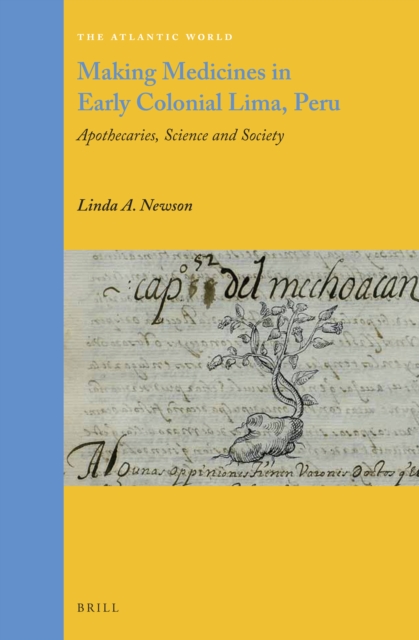
Making Medicines in Early Colonial Lima, Peru
Based on extensive archival research in Peru, Spain, and Italy, Making Medicines in Early Colonial Lima, Peru examines how apothecaries in Lima were trained, ran their businesses, traded medicinal products, prepared medicines, and found their place in society. In the book, Newson argues that apothecaries had the potential to be innovators in science, especially in the New World where they encountered new environments and diverse healing traditions. However, it shows that despite experimental tendencies among some apothecaries, they generally adhered to traditional humoral practices and imported materia medica from Spain rather than adopt native plants or exploit the region’s rich mineral resources. This adherence was not due to state regulation, but reflected the entrenchment of humoral beliefs in popular thought and their promotion by the Church and Inquisition.
eBook


The Moral Electricity of Print
Best Nineteenth-Century Book Award Winner, 2018, Latin
American Studies Association Nineteenth-Century Section
Moral electricity-a term coined by American transcendentalists in
the 1850s to describe the force of nature that was literacy and
education in shaping a greater society. This concept wasn't
strictly an American idea, of course, and Ronald Briggs introduces
us to one of the greatest examples of this power: the literary
scene in Lima, Peru, in the nineteenth century. As Briggs notes in
the introduction to The Moral Electricity of Print , \"the
ideological glue that holds the American hemisphere together is a
hope for the New World as a grand educational project combined with
an anxiety about the baleful influence of a politically and morally
decadent Old World that dominated literary output through its
powerful publishing interests.\" The very nature of living as a
writer and participating in the literary salons of Lima was, by
definition, a revolutionary act that gave voice to the formerly
colonized and now liberated people. In the actions of this literary
community, as men and women worked toward the same educational
goals, we see the birth of a truly independent Latin American
literature.
eBook

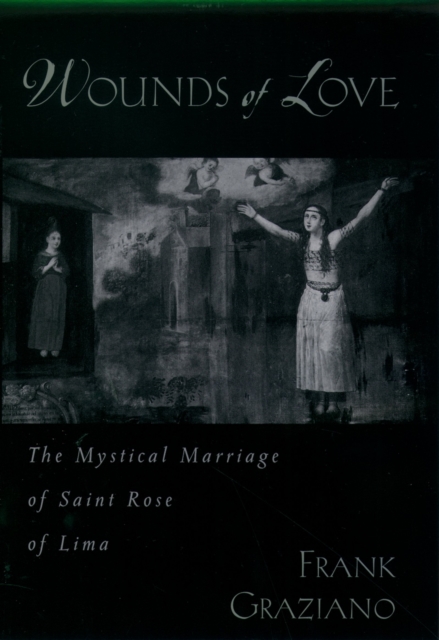
Wounds of love : the mystical marriage of Saint Rose of Lima
An in-depth study of St. Rose of Lima (1586–1617), canonized in 1671 as the first saint of the New World, serves to explore the meanings of female mysticism and the ways in which saints are products of their cultures. The opening chapter analyzes trends in scholarship on mysticism and the interrelations of sanctity and insanity. Rose and flower poetics are then pursued into the odor of sanctity, “deflowering,” edenic imagery, and the miracle by which Rose of Lima received her name. Two historical chapters analyze the politics of Rose of Lima’s canonization, exploring how mystical union bypasses sacramental and sacerdotal channels, poses an implicit threat to the bureaucratized church, and may be co-opted to integrate a competing claim into the Catholic canon. Virginity, austerity, mortification, eucharistic devotion, visions, expression of love through suffering, ecstasy, and mystical marriage are then studied both in themselves and in their relations to eroticism and to modern psychological disorders.
eBook


Death and Conversion in the Andes
When the Spanish invaded the Inca empire in 1532, the cult of the ancestors was an essential feature of pre-Columbian religion throughout the Andes. The dead influenced politics, protected the living, symbolized the past, and legitimized claims over the land their descendants occupied, while the living honored the presence of the dead in numerous aspects of daily life. A central purpose of the Spanish missionary endeavor was to suppress the Andean cult of the ancestors and force the indigenous people to adopt their Catholic, legal, and cultural views concerning death. In her book, Gabriela Ramos reveals the extent to which Christianizing death was essential for the conversion of the indigenous population to Catholicism. Ramos argues that understanding the relation between death and conversion in the Andes involves not only considering the obvious attempts to destroy the cult of the dead, but also investigating a range of policies and strategies whose application demanded continuous negotiation between Spaniards and Andeans. Drawing from historical, archaeological, and anthropological research and a wealth of original archival materials, especially the last wills and testaments of indigenous Andeans, Ramos looks at the Christianization of death as it affected the lives of inhabitants of two principal cities of the Peruvian viceroyalty: Lima, the new capital founded on the Pacific coast by the Spanish, and Cuzco, the old capital of the Incas in the Andean highlands. Her study of the wills in particular demonstrates the strategies that Andeans devised to submit to Spanish law and Christian doctrine, preserve bonds of kinship, and cement their place in colonial society.
eBook