
Catalogue Search | MBRL


Are you sure you want to remove the book from the shelf?

{{itemTitle}}
12,840
result(s) for
"Petroleum Environmental aspects."
Sort by:


Refining Expertise
Winner of the 2015 Rachel Carson Prize presented by the
Society for Social Studies of Science Residents of a small
Louisiana town were sure that the oil refinery next door was making
them sick. As part of a campaign demanding relocation away from the
refinery, they collected scientific data to prove it. Their
campaign ended with a settlement agreement that addressed many of
their grievances-but not concerns about their health. Yet, instead
of continuing to collect data, residents began to let refinery
scientists' assertions that their operations did not harm them
stand without challenge. What makes a community move so suddenly
from actively challenging to apparently accepting experts'
authority? Refining Expertise argues that the answer lies
in the way that refinery scientists and engineers defined
themselves as experts. Rather than claiming to be infallible, they
began to portray themselves as responsible-committed to operating
safely and to contributing to the well-being of the community. The
volume shows that by grounding their claims to responsibility in
influential ideas from the larger culture about what makes good
citizens, nice communities, and moral companies, refinery
scientists made it much harder for residents to challenge their
expertise and thus re-established their authority over scientific
questions related to the refinery's health and environmental
effects. Gwen Ottinger here shows how industrial facilities'
current approaches to dealing with concerned communities-approaches
which leave much room for negotiation while shielding industry's
environmental and health claims from critique-effectively undermine
not only individual grassroots campaigns but also environmental
justice activism and far-reaching efforts to democratize science.
This work drives home the need for both activists and politically
engaged scholars to reconfigure their own activities in response,
in order to advance community health and robust scientific
knowledge about it.
eBook


Bioremediation of petroleum and petroleum products
With petroleum-related spills, explosions, and health issues in the headlines almost every day, the issue of remediation of petroleum and petroleum products is taking on increasing importance, for the survival of our environment, our planet, and our future. This book is the first of its kind to explore this difficult issue from an engineering and scientific point of view and offer solutions and reasonable courses of action.
This book will guide the reader through the various methods that are used for the bioremediation of petroleum and petroleum products. The text is easy to read and includes many up-to-date and topical references.
This book introduces the reader to the science and technology of biodegradation—a key process in the bioremediation of petroleum and petroleum-based contaminants at spill sites. The contaminants of concern in the molecularly variable petroleum and petroleum products can be degraded under appropriate conditions. But the success of the process depends on the ability to determine the necessary conditions and establish them in the contaminated environment.
Although the prime focus of the book is to determine the mechanism, extent, and efficiency of biodegradation, it is necessary to know the composition of the original petroleum or petroleum product. The laws of science dictate what can or cannot be done with petroleum and petroleum products to ensure that biodegradation (hence, bioremediation) processes are effective. The science of the composition of petroleum and petroleum products is at the core of understanding the chemistry of biodegradation and bioremediation processes. Hence, inclusion of petroleum analyses and properties along with petroleum product analyses and properties is a necessary part of this text.
Bioremediation of Petroleum and Petroleum Products:
* Summarizes the pros and cons of remediation of petroleum and petroleum-based products, from an environmental perspective
* Gives examples of unethical behavior and how they should be corrected
* Offers arguments and elucidates engineering considerations on all sides of these difficult environmental and economic issues
eBook

Oilfield chemistry and its environmental impact
Consolidates the many different chemistries being employed to provide environmentally acceptable products through the upstream oil and gas industry.-- Provided by publisher.
Book

Dependent Convergence
Comparative analyses of social actors and policy outcomes in Bahia and Texas show the similarities and differences in the actors and the policies. The author makes recommendations for stronger international solidarity among progressive forces in developed and developing countries to promote preventive alternatives to pollution control.
eBook


Oil in the Environment
What light does nearly 25 years of scientific study of the Exxon Valdez oil spill shed on the fate and effects of a spill? How can the results help in assessing future spills? How can ecological risks be assessed and quantified? In this, the first book on the effects of Exxon Valdez in 15 years, scientists directly involved in studying the spill provide a comprehensive perspective on, and synthesis of, scientific information on long-term spill effects. The coverage is multidisciplinary, with chapters discussing a range of issues including effects on biota, successes and failures of post-spill studies and techniques, and areas of continued disagreement. An even-handed and critical examination of more than two decades of scientific study, this is an invaluable guide for studying future oil spills and, more broadly, for unraveling the consequences of any large environmental disruption. For access to a full bibliography of related publications, follow the Resources link at www.cambridge.org/9781107027176.
eBook
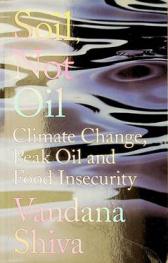
Soil, not oil : climate change, peak oil and food insecurity
\"This book has become a classic of the environmental movement. In it, Vandana Shiva envisions a world beyond our current dependence on fossil fuels and globalization, and makes the compelling case that food crises, oil dependency and climate change are all inherently interlinked. Any attempt to solve one without addressing the others is therefore doomed to failure. Condemning industrial agriculture and biofuels as recipes for ecological and economic disaster, Shiva instead champions small independent farmers. What is needed most, in a time of hunger and changing climates, are sustainable, biologically diverse farms that are better able to resist disease, drought and flooding. Calling for a return to local economies and small-scale agriculture, Shiva argues that humanity's choice is a stark one: we can either continue to pursue a market-centred approach, which will ultimately make our planet unliveable, or we can instead strive for a people-centred, oil-free future, one which offers a decent living for all. This edition features a new introduction by the author, in which she outlines recent developments in ecology and environmentalism, and offers new prescriptions for the environmental movement\"--Back cover.
Book

Petroleum development and environmental conflict in Aotearoa/New Zealand
Petroleum Development and Environmental Conflict in Aotearoa New Zealand: Texas of the South Pacific examines the dilemmas associated with economic growth through the expansion of resource extraction. States seeking to grow their economies through the expansion of resource extraction are forced to cope with the rising influence of transnational corporations on domestic politics and democratic institutions to mitigate the environmental damage from increased extraction activities to respond to the mounting evidence which indicates that unconventional oil and gas development practices are harming communities, local environments, and human health and to manage the international pressures and citizens’ demands that climate change is addressed through a transition from fossil fuel dependence to a clean-energy economy. Terrence M. Loomis analyzes the circumstances under which environmental opposition to state policies to promote oil and gas development—in collaboration with the petroleum industry—, has lead to far-reaching changes in institutional relations between the state and civil society.
eBook