
Catalogue Search | MBRL


Are you sure you want to remove the book from the shelf?

{{itemTitle}}
597
result(s) for
"Philadelphia (Pa.) History."
Sort by:


Governed by a spirit of opposition : the origins of American political practice in colonial Philadelphia
Civic engagement in the City of Brotherly Love gave birth to the American Revolution.
Winner of the Athenaeum of Philadelphia Literary Award of The Athenaeum of Philadelphia
During the colonial era, ordinary Philadelphians played an unusually active role in political life. Because the city lacked a strong central government, private individuals working in civic associations of their own making shouldered broad responsibility for education, poverty relief, church governance, fire protection, and even taxation and military defense. These organizations dramatically expanded the opportunities for white men—rich and poor alike—to shape policies that immediately affected their communities and their own lives.
In Governed by a Spirit of Opposition, Jessica Choppin Roney explains how allowing people from all walks of life to participate in political activities amplified citizen access and democratic governance. Merchants, shopkeepers, carpenters, brewers, shoemakers, and silversmiths served as churchwardens, street commissioners, constables, and Overseers of the Poor. They volunteered to fight fires, organized relief for the needy, contributed money toward the care of the sick, took up arms in defense of the community, raised capital for local lending, and even interjected themselves in Indian diplomacy. Ultimately, Roney suggests, popular participation in charity, schools, the militia, and informal banks empowered people in this critically important colonial city to overthrow the existing government in 1776 and re-envision the parameters of democratic participation.
Governed by a Spirit of Opposition argues that the American Revolution did not occasion the birth of commonplace political activity or of an American culture of voluntary association. Rather, the Revolution built upon a long history of civic engagement and a complicated relationship between the practice of majority-rule and exclusionary policy-making on the part of appointed and self-selected constituencies.
eBook


The Business of Private Medical Practice
Unevenly distributed resources and rising costs have become enduring problems in the American health care system. Health care is more expensive in the United States than in other wealthy nations, and access varies significantly across space and social classes. James A. Schafer Jr. shows that these problems are not inevitable features of modern medicine, but instead reflect the informal organization of health care in a free market system in which profit and demand, rather than social welfare and public health needs, direct the distribution and cost of crucial resources.
The Business of Private Medical Practiceis a case study of how market forces influenced the office locations and career paths of doctors in one early twentieth-century city, Philadelphia, the birthplace of American medicine. Without financial incentives to locate in poor neighborhoods, Philadelphia doctors instead clustered in central business districts and wealthy suburbs. In order to differentiate their services in a competitive marketplace, they also began to limit their practices to particular specialties, thereby further restricting access to primary care. Such trends worsened with ongoing urbanization.
Illustrated with numerous maps of the Philadelphia neighborhoods he studies, Schafer's work helps underscore the role of economic self-interest in shaping the geography of private medical practice and the growth of medical specialization in the United States.
eBook

A Fragile Freedom
This book is the first to chronicle the lives of African American women in the urban north during the early years of the republic.A Fragile Freedominvestigates how African American women in Philadelphia journeyed from enslavement to the precarious status of \"free persons\" in the decades leading up to the Civil War and examines comparable developments in the cities of New York and Boston.
Erica Armstrong Dunbar argues that early nineteenth-century Philadelphia, where most African Americans were free, enacted a kind of rehearsal for the national emancipation that followed in the post-Civil War years. She explores the lives of the \"regular\" women of antebellum Philadelphia, the free black institutions that took root there, and the previously unrecognized importance of African American women to the history of American cities.
eBook


Engineering Philadelphia
The Sellers brothers, Samuel and George, came to North America in 1682 as part of the Quaker migration to William Penn's new province on the shores of the Delaware River. Across more than two centuries, the Sellers family-especially Samuel's descendants Nathan, Escol, Coleman, and William-rose to prominence as manufacturers, engineers, social reformers, and urban and suburban developers, transforming Philadelphia into a center of industry and culture. They led a host of civic institutions including the Franklin Institute, Abolition Society, and University of Pennsylvania. At the same time, their vast network of relatives and associates became a leading force in the rise of American industry in Ohio, Georgia, Tennessee, New York, and elsewhere.
Engineering Philadelphiais a sweeping account of enterprise and ingenuity, economic development and urban planning, and the rise and fall of Philadelphia as an industrial metropolis. Domenic Vitiello tells the story of the influential Sellers family, placing their experiences in the broader context of industrialization and urbanization in the United States from the colonial era through World War II. The story of the Sellers family illustrates how family and business networks shaped the social, financial, and technological processes of industrial capitalism. As Vitiello documents, the Sellers family and their network profoundly influenced corporate and federal technology policy, manufacturing practice, infrastructure and building construction, and metropolitan development. Vitiello also links the family's declining fortunes to the deindustrialization of Philadelphia-and the nation-over the course of the twentieth century.
eBook

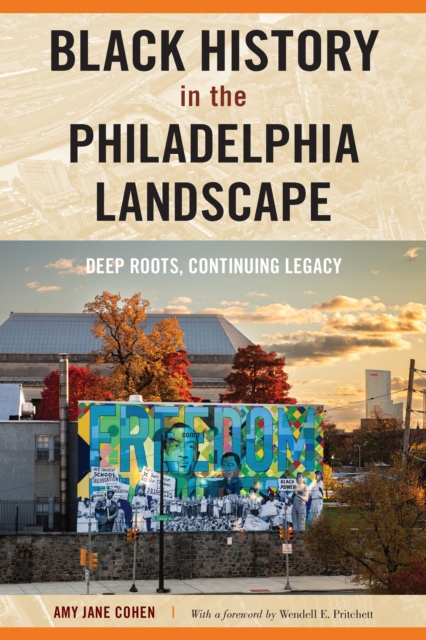
Black History in the Philadelphia Landscape
Black Philadelphians have shaped Philadelphia history since colonial times.In Black History in the Philadelphia Landscape , Amy Cohen recounts notable aspects of the Black experience in Philadelphia from the late 1600s to the 1960s and how this history is marked in the contemporary city.
eBook