
Catalogue Search | MBRL


Are you sure you want to remove the book from the shelf?

{{itemTitle}}
102
result(s) for
"Philip II, King of Spain, 1527-1598."
Sort by:


Mary and Philip
The co-monarchy of Mary I and Philip II put England at the heart of early modern Europe. This positive reassessment of their joint reign counters a series of parochial, misogynist and anti-Catholic assumptions, correcting the many myths that have grown up around the marriage and explaining the reasons for its persistent marginalisation in the historiography of sixteenth-century England. Using new archival discoveries and original sources, the book argues for Mary as a great Catholic queen, while fleshing out Philip’s important contributions as king of England. It demonstrates the many positive achievements of this dynastic union in everything from culture, music and art to cartography, commerce and exploration. An important corrective for anyone interested in the history of Tudor England and Habsburg Spain.
eBook

Lending to the borrower from hell : debt, taxes, and default in the age of Philip II
\"Why do lenders time and again loan money to sovereign borrowers who promptly go bankrupt? When can this type of lending work? As the United States and many European nations struggle with mountains of debt, historical precedents can offer valuable insights. Lending to the Borrower from Hell looks at one famous case--the debts and defaults of Philip II of Spain. Ruling over one of the largest and most powerful empires in history, King Philip defaulted four times. Yet he never lost access to capital markets and could borrow again within a year or two of each default. Exploring the shrewd reasoning of the lenders who continued to offer money, Mauricio Drelichman and Hans-Joachim Voth analyze the lessons from this important historical example.Using detailed new evidence collected from sixteenth-century archives, Drelichman and Voth examine the incentives and returns of lenders. They provide powerful evidence that in the right situations, lenders not only survive despite defaults--they thrive. Drelichman and Voth also demonstrate that debt markets cope well, despite massive fluctuations in expenditure and revenue, when lending functions like insurance. The authors unearth unique sixteenth-century loan contracts that offered highly effective risk sharing between the king and his lenders, with payment obligations reduced in bad times.A fascinating story of finance and empire, Lending to the Borrower from Hell offers an intelligent model for keeping economies safe in times of sovereign debt crises and defaults\"-- Provided by publisher.
Book

Courtier and the King
Ruy Gómez de Silva, or the prince of Eboli, was one of the central figures at the court of Spain in the sixteenth century. Thanks to his oily affability, social grace, and an uncanny knack for anticipating and catering to the desires of his prince, he rose from obscurity to become the favorite and chief minister of Philip II. From the scattered surviving sources James Boyden weaves a vivid, compelling narrative: one that breathes life not only into Ruy Gómez, but into the court, the era, and the enigmatic character of Phillip II as well. Elegantly written and highly readable, this book discovers in the career of Gómez the techniques, aspirations, and mentality of an accomplished courtier in the age of Castiglione. This title is part of UC Press's Voices Revived program, which commemorates University of California Press's mission to seek out and cultivate the brightest minds and give them voice, reach, and impact. Drawing on a backlist dating to 1893, Voices Revived makes high-quality, peer-reviewed scholarship accessible once again using print-on-demand technology. This title was originally published in 1995. Many titles in the Voices Revived program are also newly available as ebooks, offered at a discounted price to support wider access to scholarly work.
eBook


The Escorial
Few buildings have played so central a role in Spain's history as the monastery-palace of San Lorenzo del Escorial. Colossal in size and imposing-even forbidding-in appearance, the Escorial has invited and defied description for four centuries. Part palace, part monastery, part mausoleum, it has also served as a shrine, a school, a repository for thousands of relics, and one of the greatest libraries of its time. Constructed over the course of more than twenty years, the Escorial challenged and provoked, becoming for some a symbol of superstition and oppression, for others a \"wonder of the world.\" Now a World Heritage Site, it is visited by thousands of travelers every year.
In this intriguing study, Henry Kamen looks at the circumstances that brought the young Philip II to commission construction of the Escorial in 1563. He explores Philip's motivation, the influence of his travels, the meaning of the design, and its place in Spanish culture. It represents a highly engaging narrative of the high point of Spanish imperial dominance, in which contemporary preoccupations with art, religion, and power are analyzed in the context of this remarkable building.
eBook

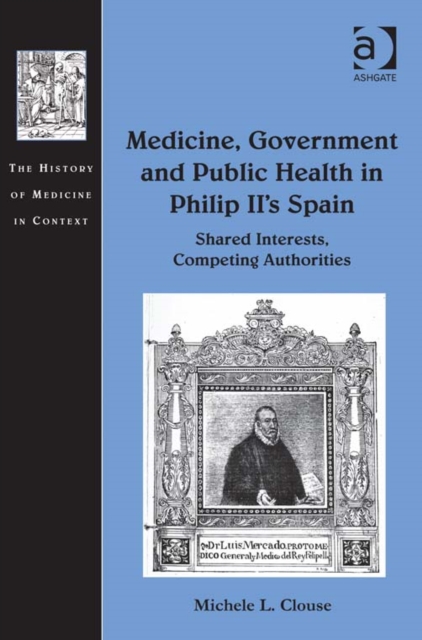
Medicine, Government and Public Health in Philip II's Spain
Bridging the gap between histories of medicine and political/institutional histories of the early modern crown, this book explores the relationship between one of the most highly bureaucratic regimes in early modern Europe, Spain, and crown interest in and regulation of medical practices. Complementing recent histories that have emphasized the interdependent nature of governance between the crown and municipalities in sixteenth-century Spain, this study argues that medical policies were the result of negotiation and cooperation among the crown, the towns, and medical practitioners. During the reign of Philip II (1556-1598), the crown provided unique opportunities for advancements in the medical field among practitioners and support for the creation and dissemination of innovative medical techniques. In addition, crown support for and regulation of medicine served as an important bureaucratic tool in the crown's effort to expand and solidify its authority over the distinct kingdoms and territories under Castilian authority and the municipalities within the kingdom of Castile itself. The crown was not the only agent of change in the medical world, however. Medical policies and their successful implementation required consensus and cooperation among competing political authorities. Bringing to life a cast of characters from early modern Spain, from the female empiric who practiced bonesetting and surgery to the university-trained, Latin physician whose medical textbook standardized medical education in the universities, the book will broaden the scope of medical history to include not only the development of medical theory and innovative practice, but also address the complex tensions between various authorities which influenced the development and nature of medical practice and perceptions of 'public health' in early modern Europe. Juxtaposing the history of medicine with the history of early modern state-building brings a unique perspective to this challenging boo
eBook

People, Pamphlets and Popular Mobilisation in the Aragonese Rebellion of 1591
In 1591, Philip II faced a revolt from his Aragonese subjects. A good number of nobles, priests and citizens were involved in the rebellion, but artisans, farmers and other members of the people also played a role in it. The article focuses on this important conflict, emphasising the relevance of popular intervention and how it was mobilised by the pamphlets which the leaders of the movement commissioned and spread by diverse means in order to gain the support of the less privileged ranks of Aragonese society. In this sense, the Aragonese Rebellion of 1591 offers a good example of popular mobilisation and of the limits of popular agency within a political conflict during the Early Modern Age.
Journal Article

Lending to the Borrower from Hell: Debt and Default in the Age of Philip II
What sustained borrowing without third-party enforcement in the early days of sovereign lending? Philip II of Spain accumulated towering debts while stopping all payments to his lenders four times. How could the sovereign borrow much and default often? We argue that bankers' ability to cut off Philip II's access to smoothing services was key. A form of syndicated lending created cohesion among his Genoese bankers. As a result, lending moratoria were sustained through a 'cheat-thecheater' mechanism. Our article thus lends empirical support to a recent literature that emphasises the role of bankers' incentives for continued sovereign borrowing.
Journal Article