
Catalogue Search | MBRL


Are you sure you want to remove the book from the shelf?

{{itemTitle}}
13
result(s) for
"Philippines Colonization Social aspects History."
Sort by:


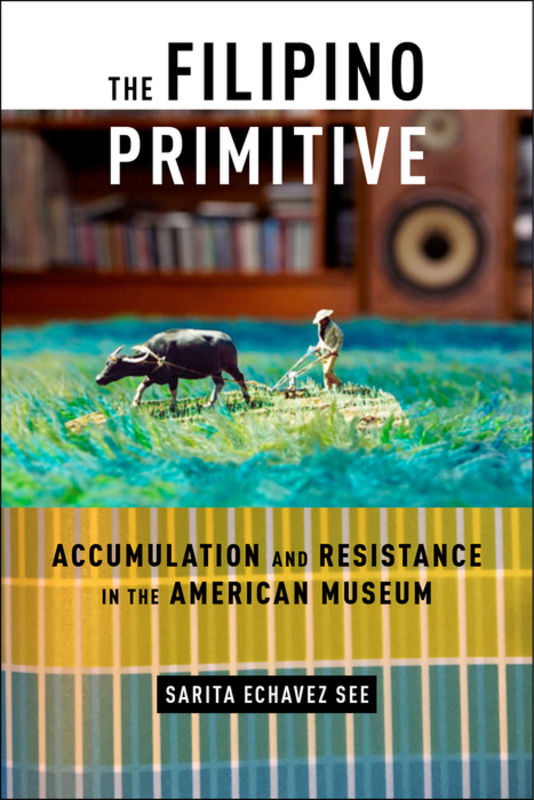
The Filipino Primitive
How museums' visual culture contributes to knowledge accumulation
Sarita See argues that collections of stolen artifacts form the foundation of American knowledge production. Nowhere can we appreciate more easily the triple forces of knowledge accumulation-capitalist, colonial, and racial-than in the imperial museum, where the objects of accumulation remain materially, visibly preserved. The Filipino Primitive takes Karl Marx's concept of \"primitive accumulation,\" usually conceived of as an economic process for the acquisition of land and the extraction of labor, and argues that we also must understand it as a project of knowledge accumulation.
Taking us through the Philippine collections at the University of Michigan Natural History Museum and the Frank Murphy Memorial Museum, also in Michigan, See reveals these exhibits as both allegory and real case of the primitive accumulation that subtends imperial American knowledge, just as the extraction of Filipino labor contributes to American capitalist colonialism. With this understanding of the Filipino foundations of the American drive toward power and knowledge, we can appreciate the value of Filipino American cultural producers like Carlos Bulosan, Stephanie Syjuco, and Ma-Yi Theater Company who have created incisive parodies of this accumulative epistemology, even as they articulate powerful alternative, anti-accumulative social ecologies.
eBook

Body parts of empire : visual abjection, Filipino images, and the American archive
\"Body Parts of Empire is a study of abjection in American visual culture and popular literature from the Philippine-American War (1899-1902). During this period, the American national territory expanded beyond its continental borders to islands in the Pacific and the Caribbean. Simultaneously, new technologies of vision emerged for imagining the human body, including the moving camera, stereoscopes, and more efficient print technologies for mass media. Rather than focusing on canonical American authors who wrote at the time of U.S. imperialism, this book examines abject texts--images of naked savages, corpses, clothed native elites, and uniformed American soldiers--as well as bodies of writing that document the good will and violence of American expansion in the Philippine colony. Contributing to the fields of American studies, Asian American studies, and gender studies, the book analyzes the actual archive of the Philippine-American War and how the racialization and sexualization of the Filipino colonial native have always been part of the cultures of America and U.S. imperialism. By focusing on the Filipino native as an abject body of the American imperial imaginary, this study offers a historical materialist optic for reading the cultures of Filipino America\"-- Provided by publisher.
Book

Home Bound
Filipino Americans, who experience life in the United States as immigrants, colonized nationals, and racial minorities, have been little studied, though they are one of our largest immigrant groups. Based on her in-depth interviews with more than one hundred Filipinos in San Diego, California, Yen Le Espiritu investigates how Filipino women and men are transformed through the experience of migration, and how they in turn remake the social world around them. Her sensitive analysis reveals that Filipino Americans confront U.S. domestic racism and global power structures by living transnational lives that are shaped as much by literal and symbolic ties to the Philippines as they are by social, economic, and political realities in the United States. Espiritu deftly weaves vivid first-person narratives with larger social and historical contexts as she discovers the meaning of home, community, gender, and intergenerational relations among Filipinos. Among other topics, she explores the ways that female sexuality is defined in contradistinction to American mores and shows how this process becomes a way of opposing racial subjugation in this country. She also examines how Filipinos have integrated themselves into the American workplace and looks closely at the effects of colonialism.
eBook

Southeast Asia in the age of jazz: Locating popular culture in the colonial Philippines and Indonesia
Referencing insights from Cultural Studies and taking a jazz-age perspective, this essay aims to historicise and ‘locate the popular’ in colonial Indonesia and the Philippines. A new cultural era dawned in the 1920s urban hubs of Southeast Asia, associated with the creation of novel forms of vernacular literature, theatre, music and their consumption via the print press, gramophone, radio broadcasting and cinema. By investigating the complex relationship between the elusive phenomena of modernity, cosmopolitanism and nationalism as articulated by two pioneering artists active in commercial music and theatre, the social significance of popular culture is scrutinised.
Journal Article

Undecided Empire The Travails of Imperial Representation of Filipinos at the Greater America Exposition, 1899
This article examines the first formal exhibit of Filipinos under American rule at the Greater America Exposition in Omaha, Nebraska, in 1899. It focuses specifically on the remarkably discursive forms of representation at a time before official discourses of empire and the \"Philippines\" or \"Filipinos\" were established. In this sense the exposition marked a rare instance of true colonial encounter in which the contingencies and vulnerabilities of empire were plainly manifest. The exposition also provided a critical baseline by which to gauge evolving discourses of representation at subsequent expositions, particularly the 1904 St. Louis World's Fair.
Journal Article

Sexualised citizenship : a cultural history of Philippines-Australian migration
This book considers the intersections of race, gender and class in multicultural Australia through the lens of migration to the country. Focusing on Philippines-born migration, it presents the profile and history of this minority group through an examination of their print material culture over the last 40 years. Particularly, it examines the growth of the production of Filipino cultural identity and the politics of community building in relation to the sexualisation of their acquired citizenship. Given the promotion of Australia as a modern, multicultural, Western nation in the Asia-Pacific region, the book questions the bases on which this claim stands using the example of Filipino settlement in Australia. Considering the social contradictions that continue to shape multicultural politics in Australia, it examines how the community makes sense of its migration through print material culture. The book analyses the community's responses to their minoritisation to understand how Filipino-Australian migration— the affective and economic appropriation of women's labour—is instructive of the social reality of millions in the global diaspora today. Based on archival and ethnographic research, this text straddles the interdisciplinary fields of gender and cultural studies, and is a key read for all scholars of Asian and Australian area studies.
eBook
Upholding Filipino nationhood: The debate over Mindanao in the Philippine Legislature, 1907–1913
Christian Filipino legislators in the bicameral US civil administration played a hitherto unacknowledged role in pushing for the colonisation of Mindanao, as part of the Philippines, by proposing a series of Assembly bills (between 1907 to 1913) aimed at establishing migrant farming colonies on Mindanao. This legislative process was fuelled by anger over the unequal power relations between the Filipino-dominated Assembly and the American-dominated Commission, as well as rivalry between resident Christian Filipino leaders versus the American military government, business interests and some Muslim datus in Mindanao itself for control over its land and resources. Focusing on the motives and intentions of the bills' drafters, this study concludes that despite it being a Spanish legacy, the Christian Filipino elite's territorial map — emphasising the integrity of a nation comprising Luzon, the Visayas and Mindanao — provided the basis for their claim of Philippine sovereignty over Mindanao.
Journal Article
Food supply problem in Leyte, Philippines, during the Japanese Occupation (1942–44)
This article analyses the problem of food supply in Leyte, Philippines, during the Japanese occupation, which has not been studied in depth so far. It focuses on the interaction that took place among the Japanese occupying forces, anti-Japanese guerrilla groups, the Filipino collaborators, and the local residents over the procurement of foodstuffs. It also aims at clarifying the factors contributing to the disruption of the policy formulated by the Japanese and the Filipinos on the island. It is apparent in this study that the political and social characteristics in the province as well as the agricultural depression inherited from the American colonisation period brought about an outcome, which was different from the policy implemented in Manila.
Journal Article