
Catalogue Search | MBRL


Are you sure you want to remove the book from the shelf?

{{itemTitle}}
2
result(s) for
"Philippines History Philippine American War, 1899-1902 Sources."
Sort by:

Body parts of empire : visual abjection, Filipino images, and the American archive
\"Body Parts of Empire is a study of abjection in American visual culture and popular literature from the Philippine-American War (1899-1902). During this period, the American national territory expanded beyond its continental borders to islands in the Pacific and the Caribbean. Simultaneously, new technologies of vision emerged for imagining the human body, including the moving camera, stereoscopes, and more efficient print technologies for mass media. Rather than focusing on canonical American authors who wrote at the time of U.S. imperialism, this book examines abject texts--images of naked savages, corpses, clothed native elites, and uniformed American soldiers--as well as bodies of writing that document the good will and violence of American expansion in the Philippine colony. Contributing to the fields of American studies, Asian American studies, and gender studies, the book analyzes the actual archive of the Philippine-American War and how the racialization and sexualization of the Filipino colonial native have always been part of the cultures of America and U.S. imperialism. By focusing on the Filipino native as an abject body of the American imperial imaginary, this study offers a historical materialist optic for reading the cultures of Filipino America\"-- Provided by publisher.
Book
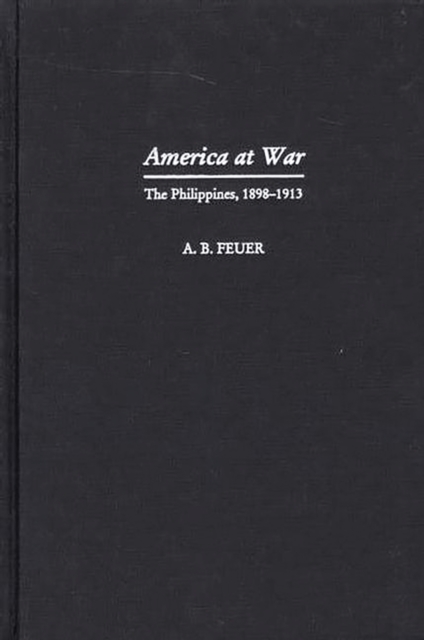
America at War: The Philippines, 1898-1913
Using previously unpublished diaries, letters, and photographs—plus the writings of war correspondent John T. McCutcheon—Feuer offers a vivid account of America's war in the Philippine Islands during the early part of the 20th century. This story highlights the experiences of the American soldiers, sailors, and marines who participated in the major battles. Not only did they fight a determined enemy, they also battled the weather, the jungle, and the diseases that threatened to take their lives. Their writings, including a section of poems and songs of the era, reveal the thoughts and anxieties of the American fighting man, serving his country nearly 8,000 miles from home. In 1895 Emilio Aguinaldo became the leader of Katipunan, a revolutionary society that sought complete independence from Spain. A year later, his ragtag band of soldiers defeated a Spanish regiment, a victory that incited the Filipino people to rise up against their oppressors. While the Spanish ultimately paid Aguinaldo to enter voluntary exile, in 1898, after the sinking of the ^IMaine^R, the United States would promise independence for the islands in exchange for Aguinaldo's return to lead an uprising against Spain. The U.S. State Department would later repudiate this promise, a move that would embroil United States troops in a bloody struggle to subdue the islands. This is their story.
eBook