
Catalogue Search | MBRL


Are you sure you want to remove the book from the shelf?

{{itemTitle}}
9,970
result(s) for
"Philosophical analysis"
Sort by:

Between saying and doing : towards an analytic pragmatism
This book aims to reconcile pragmatism (in both its classical American and its Wittgensteinian forms) with analytic philosophy. It investigates relations between the meaning of linguistic expressions and their use. Giving due weight both to what one has to do in order to count as saying various things and to what one needs to say in order to specify those doings makes it possible to shed new light on the relations between semantics (the theory of the meanings of utterances and the contents of thoughts) and pragmatics (the theory of the functional relations among meaningful or contentful items). Among the vocabularies whose interrelated use and meaning are considered are: logical, indexical, modal, normative, and intentional vocabulary. As the argument proceeds, new ways of thinking about the classical analytic core programs of empiricism, naturalism, and functionalism are offered, as well as novel insights about the ideas of artificial intelligence, the nature of logic, and intentional relations between subjects and objects.
eBook


Kazimierz Twardowski: A Grammar for Philosophy
Kazimierz Twardowski (1866-1938) is the founder of the Lvov-Warsaw School with its strong tradition in logic and its scientific approach to philosophy. Twardowski's unique way of doing philosophy, his method, is of central importance for understanding his impact as a teacher. This method can be understood as a philosophical grammar, which is also how Leibniz conceived his universal language of thought.Analytic philosophy in the twentieth century can be characterized by its opposition to psychologism, on the one hand, and its opposition to metaphysics, on the other. This is changing now, as questions within the philosophy of mind and metaphysics are raised by analytic philosophers today.Maria van der Schaar shows in her book that we can improve our analytic methods by making use of Twardowski's philosophical grammar. Twardowski's positive attitude to psychology and metaphysics may also help us to develop an analytic metaphysics and to get a better understanding of the relation between psychology and philosophy.
eBook

Conceptual Analysis and Philosophical Naturalism
A new program of philosophical analysis that reconciles a certain account of analysis with philosophical naturalism is applied to a range of philosophical issues.
Many philosophical naturalists eschew analysis in favor of discovering metaphysical truths from the a posteriori, contending that analysis does not lead to philosophical insight. A countercurrent to this approach seeks to reconcile a certain account of conceptual analysis with philosophical naturalism; prominent and influential proponents of this methodology include the late David Lewis, Frank Jackson, Michael Smith, Philip Pettit, and David Armstrong. Naturalistic analysis (sometimes known as “the Canberra Plan” because many of its proponents have been associated with Australian National University in Canberra) is a tool for locating in the scientifically given world objects and properties we quantify over in everyday discourse. This collection gathers work from a range of prominent philosophers who are working within this tradition, offering important new work as well as critical evaluations of the methodology. Its centerpiece is an important posthumous paper by David Lewis, “Ramseyan Humility,” published here for the first time. The contributors first address issues of philosophy of mind, semantics, and the new methodology's a priori character, then turn to matters of metaphysics, and finally consider problems regarding normativity. Conceptual Analysis and Philosophical Naturalism is one of the first efforts to apply this approach to such a wide range of philosophical issues.
Contributors
David Braddon-Mitchell, Mark Colyvan, Frank Jackson, Justine Kingsbury, Fred Kroon, David Lewis, Dustin Locke, Kelby Mason, Jonathan McKeown-Green, Peter Menzies, Robert Nola, Daniel Nolan, Philip Pettit, Huw Price, Denis Robinson, Steve Stich, Daniel Stoljar
eBook
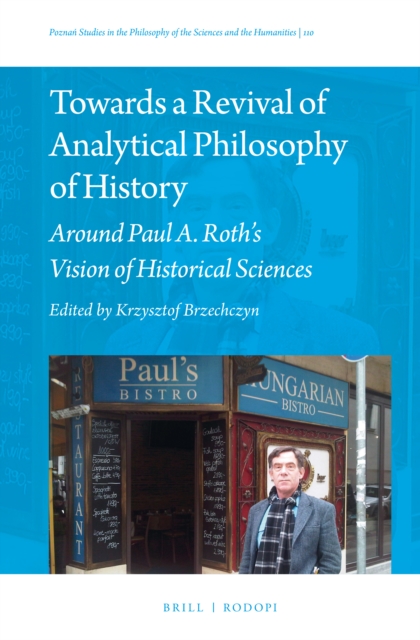
Towards a Revival of Analytical Philosophy of History
The purpose of Towards a Revival of Analytical Philosophy of History: Around Paul A. Roth's Vision of Historical Sciences is to discuss the revival of analytical philosophy of history proposed by Paul A. Roth. The authors characterize the status of philosophy of history and discuss its ontological, epistemological and explanatory dimensions.
eBook
The end of philosophy of religion
The End of Philosophy of Religion explores the hitherto unchartered waters of the 'meta-philosophy of religion', that is, the methods and assumptions underlying the divergent ways of writing and studying the philosophy of religion that have emerged over the last century.
eBook

The cultural politics of analytic philosophy : Britishness and the spectre of Europe
The Cultural Politics of Analytic Philosophy examines three generations of analytic philosophers, who between them founded the modern discipline of analytic philosophy in Britain.The book explores how philosophers such as Bertrand Russell, A.J.
eBook
An Invitation to Analytic Christian Theology
In recent decades a new movement has arisen, bringing the conceptual tools of analytic philosophy to bear on theological reflection. Called analytic theology, it seeks to bring a clarity of thought and a disciplined use of logic to the work of constructive Christian theology. In this introduction to analytic theology for specialists and nonspecialists alike, Thomas McCall lays out what it is and what it isn't. The goal of this growing and energetic field is not the removal of all mystery in theology. At the same time, it insists that mystery must not be confused with logical incoherence.McCall explains the connections of analytic theology to Scripture, Christian tradition and culture, using case studies to illuminate his discussion. Beyond mere description, McCall calls the discipline to a deeper engagement with the traditional resources of the theological task.
eBook
Postanalytic and Metacontinental
Analytic and Continental philosophy have become increasingly specialised and differentiated fields of endeavour. This important collection of essays details some of the more significant methodological and philosophical differences that have separated the two traditions, as well as examining the manner in which received understandings of the divide are being challenged by certain thinkers whose work might best be described as post-analytic and meta-continental. Together these essays offer a well-defined sense of the field, of its once dominant distinctions and of some of the most productive new areas generating influential ideas and controversy. In an attempt to get to the bottom of precisely what it is that separates the analytic and continental traditions, the essays in this volume compare and contrast them on certain issues, including truth, time and subjectivity. The book engages with a range of key thinkers from phenomenology, post-structuralism, analytic philosophy and post-analytic philosophy, examines the strengths and weaknesses of each tradition, and ultimately encourages enhanced understanding, dialogue and even rapprochement between these sometimes antagonistic adversaries.
eBook