
Catalogue Search | MBRL


Are you sure you want to remove the book from the shelf?

{{itemTitle}}
7,222
result(s) for
"Philosophical thought"
Sort by:

Minimal Model Explanations
This article discusses minimal model explanations, which we argue are distinct from various causal, mechanical, difference-making, and so on, strategies prominent in the philosophical literature. We contend that what accounts for the explanatory power of these models is not that they have certain features in common with real systems. Rather, the models are explanatory because of a story about why a class of systems will all display the same large-scale behavior because the details that distinguish them are irrelevant. This story explains patterns across extremely diverse systems and shows how minimal models can be used to understand real systems.
Journal Article
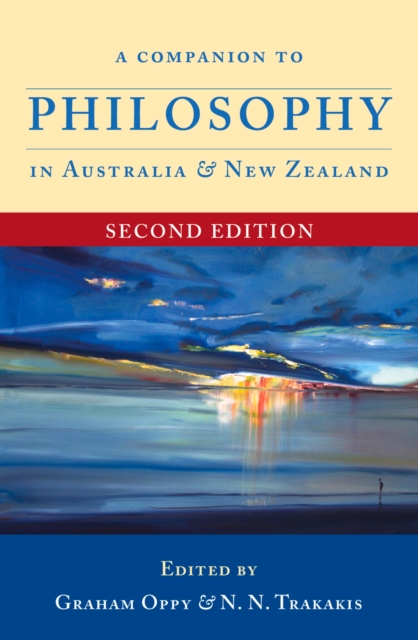
A companion to philosophy in Australia & New Zealand
This second edition of the Companion now includes the following topics: Australian Aboriginal Philosophy; History and Philosophy of Science; and The Oxbridge Connection. Also, an Addendum has been added to the article on the Australian Society of Legal Philosophy. Philosophy in Australia and New Zealand has for some time now been experiencing something of a 'golden age'. The richness of Australasia's philosophical past, though less well known, should also not be forgotten. Australasian philosophy, although heavily indebted to overseas trends, includes much distinctive and highly original work. The Companion contains a wide range of articles contributed by prominent philosophers and scholars, and includes biographical essays on selected philosophers, topics and controversies, as well as shorter entries on associations, research centres, departments, journals, pedagogy, and international links. Important philosophical contributions made by those working outside of the academy are also included, along with philosophy's recent inroads into the wider community--in primary and secondary schools, community-based forums and 'philosophy cafés'. A Companion to Philosophy in Australia and New Zealand will provide scholars and the wider community, in Australia, New Zealand and beyond, with a greater appreciation of the philosophical heritage of this region, and will be a standard work of reference for many years to come.
eBook

L'origine greco-romana di categorie filosofiche nell'educazione
Analyzing the pedagogical history of Western culture leads to the discovery of the Greek-Roman root of multiple categories of philosophical thought that are related to the dynamics of education and recall educational and didactic paths. The same Roman philosophers, in particular the Stoics, draw directly from the Greek world and the idea of \"paideia\" meanings that then will open \"humanitas\" of the Roman imperial era. Keywords. Humanitas–paideia–ideas–virtus–philosophical thought
Journal Article

Reclaiming Virtue Ethics for Economics
Virtue ethics is an important strand of moral philosophy, and a significant body of philosophical work in virtue ethics is associated with a radical critique of the market economy and of economics. Expressed crudely, the charge sheet is this: The market depends on instrumental rationality and extrinsic motivation; market interactions therefore fail to respect the internal value of human practices and the intrinsic motivations of human actors; by using market exchange as its central model, economics normalizes extrinsic motivation, not only in markets but also in social life more generally; therefore economics is complicit in an assault on virtue and on human flourishing. We will argue that this critique is flawed, both as a description of how markets actually work and as a representation of how classical and neoclassical economists have understood the market. We show how the market and economics can be defended against the critique from virtue ethics, and crucially, this defense is constructed using the language and logic of virtue ethics. Using the methods of virtue ethics and with reference to the writings of some major economists, we propose an understanding of the purpose (telos) of markets as cooperation for mutual benefit, and identify traits that thereby count as virtues for market participants. We conclude that the market need not be seen as a virtue-free zone.
Journal Article

A New Philosophy for International Law
As many philosophers have pointed out, there is mystery in the bare assumption that promising creates obligation. How can an individual change his moral situation just by speaking a runic phrase? If we want to explain why promises do create moral obligations, we must point to different, more basic moral principles that a promise invokes. Philosophers have suggested a variety of such principles. We must look for similar, more basic principles within international law. Dworkin posits that if law is understood as a special part of political morality, and if it serves its community well, its doctrines will crystallize over time. Its roots in political morality will grow less prominent--though will be available when needed--in ordinary legal argument.
Journal Article
Utopophobia
We are told, by Machiavelli and others, that political philosophy must not be utopian. I am sure there is wisdom in this, but there is also the danger of a chilling effect. Unless we get very clear about what kind of theorizing is appropriately proscribed, there is the risk that a broader set of possible projects will go unpursued, for no good reason. I take up just one part of this question. My thesis is that moral theories of social justice, political authority, political legitimacy, and many other moral-political concepts are not shown to have any defect in virtue of the fact, if it is one, that the alleged requirements or preconditions of these things are not likely ever to be met. If a theory of social justice is offered, and it is objected, \"But you and I both know people will never do that,\" I believe the right response is (as a starter), \"I never said they would.\"
Journal Article

The Deleuze-Guattarian assemblage: plastic habits
This paper will attend to the emergence of the concept of assemblage in human geography and looks towards some vigilant steps we might take in using Deleuze and Guattari's version of it The paper is in three parts: first, it briefly looks backwards, charting this emergence to the uptake of the work of Gilles Deleuze and Felix Guattari as a counterpoint and extension of the earlier engagement with the concept of the network, primarily in actor-network theory (ANT); second, it makes this argument for being vigilant with assemblages through focusing attention on the tetravalent characteristics of the concept of the Deleuze-Guattarian assemblage, emphasising the way this points to alternative arrays of matter and thought This segues into the third section, which situates the debates in our contemporary understandings of our technological and biochemical condition. The point being that we need precisely the kind of assemblage thinking proposed by Deleuze and Guattari to seize the agenda on the emergent micro-and eco-logical implications these arrays of matter and thought produce; the agenda proposed is exampled through understanding the assemblage concept through the work of Catherine Malabou on that of plasticity and habit, clear extensions in the 21st century of Deleuze and Guattari's earlier ideas.
Journal Article

PRECARITY'S FORMS
Writing matters if objects of analysis are to be understood as emergent forms with qualities, intensities, and trajectories that can be described or evoked. Writing is not epiphenomenal to thought but its medium. As it sidles up to worlds, disparate and incommensurate things throw themselves together. As it attunes, spatial and temporal dimensions come into play; writing skids over surfaces, pauses on a detail, grows capacious or pinched. Here, I write four very different scenes of precarity as a form that accretes, accrues, and wears out and one that takes place through attachments, tempos, materialities, and states of being. Such objects of analysis register the tactility and significance of something coming into form through an assemblage of affects, routes, conditions, sensibilities, and habits.
Journal Article

Cultural geography: non-representational conditions and concerns
Lately, geographers have been thinking hard about non-representational theory (NRT): thinking hard about its first principles, about its promise of a politics and ethics reborn, and about the necessity of certain philosophical postures being struck. The clutch of constructive criticisms now emerging are welcome (Thien, 2005; Saldanha, 2005; 2006; Cresswell, 2006; Tolia-Kelly, 2006; Laurier and Philo, 2006a) as, for the most part, are declarative statements made in response (Anderson and Harrison, 2006; McCormack, 2006). If NRT continues to be variously regarded a provocative, quizzical, enigmatic, unsettling or brilliant feature on the disciplines intellectual landscape, arguably its status is more certain as a result of thoroughgoing examination and dialogue, and efforts--still unresolved--to refine, recalibrate, extend or conjoin its original mandate with cognate sorts of social concern (Cadman, 2008). Should doubts remain over the stickability of NRT, or its seriousness of purpose, the expanded entry in the Dictionary of human geography sets out a concise manifesto for free thinking: Non-representational theory enacts a break with the specic version of culture as structuralizing/signifying that defined the new Cultural Geography. Such a move is understood to be a necessary response to a contemporary political moment in which various non-representational modalities--including affect--are caught up in the emergence of new forms of sovereign and bio power. (Anderson, 2008: xx) To begin reporting on recent exchanges, I turn first to debates centring on affect as a primary issue of concern. I then consider conditions for progress and matters of historicity in light of non-representational argument, before closing with a quick-re review of research based around geographies of bodily movement and practical association. [PUBLICATION ABSTRACT]
Journal Article
The Logic of Explanatory Power
This article introduces and defends a probabilistic measure of the explanatory power that a particular explanans has over its explanandum. To this end, we propose several intuitive, formal conditions of adequacy for an account of explanatory power. Then, we show that these conditions are uniquely satisfied by one particular probabilistic function. We proceed to strengthen the case for this measure of explanatory power by proving several theorems, all of which show that this measure neatly corresponds to our explanatory intuitions. Finally, we briefly describe some promising future projects inspired by our account.
Journal Article