
Catalogue Search | MBRL


Are you sure you want to remove the book from the shelf?

{{itemTitle}}
2,834
result(s) for
"Photojournalists"
Sort by:

Midnight target
\"It's all-out war between the cartel and the mercenaries--with two couples caught in the middle of the blood feud. Love and redemption are within their reach--but first they have to make it home alive\"--Back cover.
Book
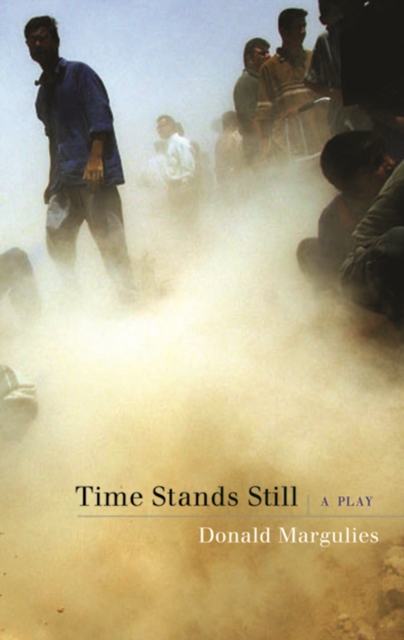
Time stands still : a play
\"The play's two hours fly by as if you've barely taken a breath. . . . Ethical dilemmas arise like exploding mines.\"-Variety\"Mr. Margulies is a skilled practitioner of fluid dialogue that is naturally funny and sensibly smart.\" -The New York TimesIn his \"absorbing intelligent\" (Los Angeles Times) and timely new play, Donald Margulies uncovers the layers of a relationship between a photojournalist and foreign correspondent-once addicted to the adrenaline of documenting the atrocities of war, and now grounded in the couple's Brooklyn loft. Photographer Sarah was seriously injured while covering the war in Iraq; her reporter partner James had left weeks earlier, when the stress and horrors became too much for him. Now James writes online movie reviews while Sarah recovers, mourning for her Iraqi driver (and former lover) killed in the explosion, and itching to get back behind the camera. With this play-coming to Broadway this winter-Margulies revisits themes of being an artist, as characters ask: What does it mean to capture suffering on film, rather than stopping to intervene?Donald Margulies received the 2000 Pulitzer Prize for Drama for Dinner with Friends, which has been produced throughout the world. Other plays include Sight Unseen (OBIE Award), Brooklyn Boy, and Collected Stories, among many others.
eBook


Marvels
\"Within the Marvel Universe, heroes soar high in the skies, ready to battle the villains who threaten their world. Yet living in the shadow of these extraordinary icons are ordinary men and women who view the \"Marvels\" with a mixture of fear, disbeliev, envy and admiration. Among them is Phil Sheldon, a New York City photojournalist who has dedicated his career to covering the exploits of the Marvels and their effect on humankind. Written by Kurt Busiek and masterfully illustrated by Alex Ross, Marvels presents a richly painted historical overview of the entire Marvel Universe, spanning from the 1939 debut of the Human Torch to the fearsome coming of the world-devouring Galactus--and culminating in the shocking death of Gwen Stacy, Spider-Man's first love\"--Amazon.com
Book

Rhetorical Exposures
Documentary photography aims to capture the material reality of life. In Rhetorical Exposures , Christopher Carter demonstrates how the creation and display of documentary photographs—often now called “imagetexts”—both invite analysis and raise persistent questions about the political and social causes for the bleak scenes of poverty and distress captured on film.
Carter’s carefully reasoned monograph examines both formal qualities of composition and the historical contexts of the production and display of documentary photographs. In Rhetorical Exposures , Carter explores Jacob Riis’s heartrending photos of Manhattan’s poor in late nineteenth-century New York, Walker Evans’s iconic images of tenant farmers in west Alabama, Ted Streshinsky’s images of 1960s social movements, Camilo José Vergara’s photographic landscapes of urban dereliction in the 1970s, and Chandra McCormick’s portraits of New Orleans’s Ninth Ward scarred by Hurricane Katrina.
While not ascribing specifically political or Marxist intentions to the photographers discussed, Carter frames his arguments in a class-based dialectic that addresses material want as an ineluctable result of social inequality. Carter argues that social documentary photography has the powerful capacity to disrupt complacent habits of viewing and to prompt viewers to confront injustice. Though photography may induce socially disruptive experiences, it remains vulnerable to the same power dynamics it subverts. Therefore, Carter offers a “rhetoric of exposure” that outlines how such social documentary images can be treated as highly tensioned rhetorical objects. His framework enables the analysis of photographs as heterogeneous records of the interaction of social classes and expressions of specific built environments. Rhetorical Exposures also discusses how photographs interact with oral and print media and relate to creations as diverse as public memorials, murals, and graphic novels.
As the creation and dissemination of new media continues to evolve in an environment of increasing anxiety about growing financial inequality, Rhetorical Exposures offers a very apt and timely discussion of the ways social documentary photography is created, employed, and understood.
eBook


You Know You Can’t Help It, Who You Are
The author writes a letter to a friend, the noted journalist James Foley that was killed, revisiting the moments they shared together in an MFA program, specifically a workshop where the author felt unsafe. This friend becomes an anchor and a person to cycle back to in memory. In writing the letter, the past is invoked to aid the author in making sense of the lingering grief.
Journal Article