
Catalogue Search | MBRL


Are you sure you want to remove the book from the shelf?

{{itemTitle}}
21,037
result(s) for
"Physics Philosophy"
Sort by:


Concepts of Mass in Contemporary Physics and Philosophy
The concept of mass is one of the most fundamental notions in physics, comparable in importance only to those of space and time. But in contrast to the latter, which are the subject of innumerable physical and philosophical studies, the concept of mass has been but rarely investigated. Here Max Jammer, a leading philosopher and historian of physics, provides a concise but comprehensive, coherent, and self-contained study of the concept of mass as it is defined, interpreted, and applied in contemporary physics and as it is critically examined in the modern philosophy of science. With its focus on theories proposed after the mid-1950s, the book is the first of its kind, covering the most recent experimental and theoretical investigations into the nature of mass and its role in modern physics, from the realm of elementary particles to the cosmology of galaxies.
The book begins with an analysis of the persistent difficulties of defining inertial mass in a noncircular manner and discusses the related question of whether mass is an observational or a theoretical concept. It then studies the notion of mass in special relativity and the delicate problem of whether the relativistic rest mass is the only legitimate notion of mass and whether it is identical with the classical (Newtonian) mass. This is followed by a critical analysis of the different derivations of the famous mass-energy relationship E = mc2 and its conflicting interpretations. Jammer then devotes a chapter to the distinction between inertial and gravitational mass and to the various versions of the so-called equivalence principle with which Newton initiated his Principia but which also became the starting point of Einstein's general relativity, which supersedes Newtonian physics. The book concludes with a presentation of recently proposed global and local dynamical theories of the origin and nature of mass.
Destined to become a much-consulted reference for philosophers and physicists, this book is also written for the nonprofessional general reader interested in the foundations of physics.
eBook


Void : the strange physics of nothing
The New York Times bestselling author of The Physics of Wall Street \" deftly explains all you wanted to know about nothingness—a.k.a. the quantum vacuum\" (Priyamvada Natarajan, author of Mapping the Heavens ).
James Owen Weatherall's bestselling book, The Physics of Wall Street, was named one of Physics Today's five most intriguing books of 2013. In this work, he takes on a fundamental concept of modern physics: nothing. The physics of stuff—protons, neutrons, electrons, and even quarks and gluons—is at least somewhat familiar to most of us. But what about the physics of nothing? Isaac Newton thought of empty space as nothingness extended in all directions, a kind of theater in which physics could unfold. But both quantum theory and relativity tell us that Newton's picture can't be right. Nothing, it turns out, is an awful lot like something, with a structure and properties every bit as complex and mysterious as matter. In his signature lively prose, Weatherall explores the very nature of empty space—and solidifies his reputation as a science writer to watch.
Included on the 2017 Best Book List by the American Association for the Advancement of Science (AAAS)
\"An engaging and interesting account.\"— The Economist
\"Readers get a dose of biography while following such figures as Einstein, Dirac, and Newton to see how top theories about the void have been discovered, developed, and debunked. Weatherall's clear language and skillful organization adroitly combines history and physics to show readers just how much 'nothing really matters.'\"— Publishers Weekly
eBook

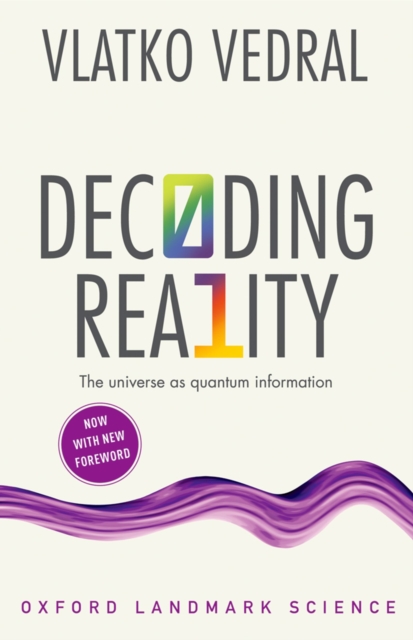
Decoding Reality
In this engaging and mind-stretching book, Vlatko Vedral explores the nature of information and looks at quantum computing, discussing the bizarre effects that arise from the quantum world. He concludes by asking the ultimate question: where did all of the information in the Universe come from?.
eBook

Philosophy of physics : quantum theory
In this book, Tim Maudlin, one of the world's leading philosophers of physics, offers a sophisticated, original introduction to the philosophy of quantum mechanics. The briefest, clearest, and most refined account of his influential approach to the subject, the book will be invaluable to all students of philosophy and physics. Quantum mechanics holds a unique place in the history of physics. It has produced the most accurate predictions of any scientific theory, but, more astonishing, there has never been any agreement about what the theory implies about physical reality. Maudlin argues that the very term \"quantum theory\" is a misnomer. A proper physical theory should clearly describe what is there and what it does--yet standard textbooks present quantum mechanics as a predictive recipe in search of a physical theory. In contrast, Maudlin explores three proper theories that recover the quantum predictions: the indeterministic wavefunction collapse theory of Ghirardi, Rimini, and Weber; the deterministic particle theory of deBroglie and Bohm; and the conceptually challenging Many Worlds theory of Everett. Each offers a radically different proposal for the nature of physical reality, but Maudlin shows that none of them are what they are generally taken to be.
Book

Renaissance meteorology : Pomponazzi to Descartes
Craig Martin takes a careful look at how Renaissance scientists analyzed and interpreted rain, wind, and other natural phenomena like meteors and earthquakes and their impact on the great thinkers of the scientific revolution.
Martin argues that meteorology was crucial to the transformation that took place in science during the early modern period. By examining the conceptual foundations of the subject, Martin links Aristotelian meteorology with the new natural philosophies of the seventeenth century. He argues that because meteorology involved conjecture and observation and forced attention to material and efficient causation, it paralleled developments in the natural philosophies of Descartes and other key figures of the scientific revolution.
Although an inherently uncertain endeavor, forecasting the weather was an extremely useful component not just of scientific study, but also of politics, courtly life, and religious doctrine. Martin explores how natural philosophers of the time participated in political and religious controversies by debating the meanings, causes, and purposes of natural disasters and other weather phenomena.
Through careful readings of an impressive range of texts, Martin situates the history of meteorology within the larger context of Renaissance and early modern science. The first study on Renaissance theories of weather in five decades, Renaissance Meteorology offers a novel understanding of traditional natural philosophy and its impact on the development of modern science.
eBook


Mind and nature
Hermann Weyl (1885-1955) was one of the twentieth century's most important mathematicians, as well as a seminal figure in the development of quantum physics and general relativity. He was also an eloquent writer with a lifelong interest in the philosophical implications of the startling new scientific developments with which he was so involved.Mind and Natureis a collection of Weyl's most important general writings on philosophy, mathematics, and physics, including pieces that have never before been published in any language or translated into English, or that have long been out of print. Complete with Peter Pesic's introduction, notes, and bibliography, these writings reveal an unjustly neglected dimension of a complex and fascinating thinker. In addition, the book includes more than twenty photographs of Weyl and his family and colleagues, many of which are previously unpublished.
Included here are Weyl's exposition of his important synthesis of electromagnetism and gravitation, which Einstein at first hailed as \"a first-class stroke of genius\"; two little-known letters by Weyl and Einstein from 1922 that give their contrasting views on the philosophical implications of modern physics; and an essay on time that contains Weyl's argument that the past is never completed and the present is not a point. Also included are two book-length series of lectures,The Open World(1932) andMind and Nature(1934), each a masterly exposition of Weyl's views on a range of topics from modern physics and mathematics. Finally, four retrospective essays from Weyl's last decade give his final thoughts on the interrelations among mathematics, philosophy, and physics, intertwined with reflections on the course of his rich life.
eBook