
Catalogue Search | MBRL


Are you sure you want to remove the book from the shelf?

{{itemTitle}}
29,509
result(s) for
"Piano Performance."
Sort by:

Notes from the pianist's bench
Berman addresses virtually every aspect of musical artistry and pedagogy. Ranging from such practical matters as sound, touch, and pedaling to the psychology of performing and teaching, this volume provides a master class for the performer, instructor, and student alike.
Book
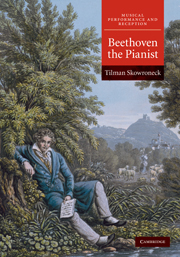
Beethoven the Pianist
The widely held belief that Beethoven was a rough pianist, impatient with his instruments, is not altogether accurate: it is influenced by anecdotes dating from when deafness had begun to impair his playing. Presenting a new, detailed biography of Beethoven's formative years, this book reviews the composer's early career, outlining how he was influenced by teachers, theorists and instruments. Skowroneck describes the development and decline of Beethoven's pianism, and pays special attention to early pianos, their construction and their importance for Beethoven and the modern pianist. The book also includes new discussions of legato and Beethoven's trills, and a complete annotated review of eyewitnesses' reports about his playing. Skowroneck presents a revised picture of Beethoven which traces his development from an impetuous young musician into a virtuoso in command of many musical resources.
eBook

Teaching performance : a philosophy of piano pedagogy
\"How can the studio teacher teach a lesson so as to instill refined artistic sensibilities, ones often thought to elude language? How can the applied lesson be a form of aesthetic education? How can teaching performance be an artistic endeavor in its own right? These are some of the questions Teaching Performance attempts to answer, drawing on the author's several decades of experience as a studio teacher and music scholar. The architects of absolute music (Hanslick, Schopenhauer, and others) held that it is precisely because instrumental music lacks language and thus any overt connection to the non-musical world that it is able to expose essential elements of that world. More particularly, for these philosophers, it is the density of musical structure--the intricate interplay among purely musical elements--that allows music to capture the essences behind appearances. By analogy, the author contends that the more structurally intricate and aesthetically nuanced a pedagogical system is, the greater its ability to illuminate music and facilitate musical skills. The author terms this phenomenon relational autonomy. Eight chapters unfold a piano-pedagogical system pivoting on the principle of relational autonomy. In grounding piano pedagogy in the aesthetics of absolute music, each domain works on the other. On the one hand, Romantic aesthetics affords pedagogy a source of artistic value in its own right. On the other hand, pedagogy concretizes Romantic aesthetics, deflating its transcendental pretentions and showing the dichotomy of absolute/utilitarian to be specious.\" -- Back cover.
Book
The pianist's craft : mastering the works of great composers
No pianist can experience the full flowering of her art without eventually grappling with those great musical minds who composed specifically for piano. In The Pianist's Craft, Richard Anderson collects from his fellow pianist-scholars 19 articles on the teaching, preparation, and performance of works by the greatest composers in the standard piano repertoire. This collection ranges in subject matter from Inge Rosar's meditation on playing Bach on the modern keyboard to Gary Amato's assessment of Haydn's sonatas, from Christie Skousen's review of tone production in Chopin to GwenolynMok's foray into recreating Ravel's works on an Erard piano, the same used by Ravel himself.
Readers will find essays as well on Mozart's piano compositions, Beethoven's sonatas, the influence of Schubert's lieder on his piano works, and works by Schumann, Liszt, Brahms, Debussy, Rachmaninoff, Scriabin, Prokofiev, Shostakovich, Bartók, Gershwin, and Crumb. The contributors—all recognized nationally and internationally for their contributions as performing artists, teachers, recording artists, and clinicians—write thoughtfully about the composers whose work they have studied and played for years. Each author addresses issues unique to the individual composer they have chosen to explore, examining questions of phrasing, tempo, articulation, dynamics, rhythm, color, gesture, lyricism, instrumentation, and genre. Valuable insight is provided into teaching, performing, and preparing these great works.
In The Pianist's Craft these great artists and teachers answer questions for readers that are otherwise only addressed in conferences, master classes, and private lessons. In this collection of essays, key points of information and instruction are offered with over 200 musical examples included as illustration. The Pianist's Craft is intended for teachers and students of the intermediate and advanced levels of piano, instructors and performers at the university level, and those who love piano and piano music generally.
eBook

The pianist’s craft 2
In The Pianist's Craft 2, pianist and scholar Anderson gathers together a new collection of essays by renowned performing artists and teachers and discusses the preparation, pedagogy, and performance of selected works by an entirely different set of composers whose works are standard in the piano literature.
eBook

Playing beyond the notes : a pianist's guide to musical interpretation
Playing Beyond the Notes: A Pianist's Guide to Musical Interpretation demystifies the complex topic of musical interpretation by boiling it down to basic principles in an accessible writing style. The book targets pianists, piano teachers, and piano pedagogy students and incorporates over 200 musical examples from the intermediate and advanced piano repertoire.
eBook

The art of performance
Heinrich Schenker's The Art of Performance shows this great music theorist in a new light.While his theoretical writings helped transform music theory in the twentieth century, this book draws on his experience as a musician and teacher to propose a sharp reevaluation of how musical compositions are realized in performance.
eBook