
Catalogue Search | MBRL


Are you sure you want to remove the book from the shelf?

{{itemTitle}}
948
result(s) for
"Plaats"
Sort by:

Creative engagements with ecologies of place : geopoetics, deep mapping and slow residencies
\"This book explores an exciting range of creative engagements with ecologies of place, using geopoetics, deep mapping and slow residency to propose broadly based collaborations in a form of disciplinary agnosticism'. Providing a radical alternative to current notions of interdisciplinarity, this book demonstrates the breadth of new creative approaches and attitudes that now challenge assumptions of the solitary genius and a culture of possessive individualism'. Drawing upon a multiplicity of perspectives, the book builds on a variety of differing creative approaches, contrasting ways in which both visual art and the concept of the artist are shifting through engagement with ecologies of place. Through examples of specific established practices in the UK, Australia and the USA, and other emergent practices from across the world, it provides the reader with a rich illustration of the ways in which ensemble creative undertakings are reactivating art's relationship with place and transforming the role of the artist. This book will be of interest to artists, art educators, environmental activists, cultural geographers, place-based philosophers and postgraduate students and to all those concerned with the revival of place through creative work in the twenty-first century\"-- Provided by publisher
BOOK

The fate of place
In this imaginative and comprehensive study, Edward Casey, one of the most incisive interpreters of the Continental philosophical tradition, offers a philosophical history of the evolving conceptualizations of place and space in Western thought. Not merely a presentation of the ideas of other philosophers, The Fate of Place is acutely sensitive to silences, absences, and missed opportunities in the complex history of philosophical approaches to space and place. A central theme is the increasing neglect of place in favor of space from the seventh century A.D. onward, amounting to the virtual exclusion of place by the end of the eighteenth century. Casey begins with mythological and religious creation stories and the theories of Plato and Aristotle and then explores the heritage of Neoplatonic, medieval, and Renaissance speculations about space. He presents an impressive history of the birth of modern spatial conceptions in the writings of Newton, Descartes, Leibniz, and Kant and delineates the evolution of twentieth-century phenomenological approaches in the work of Husserl, Merleau-Ponty, Bachelard, and Heidegger. In the book's final section, Casey explores the postmodern theories of Foucault, Derrida, Tschumi, Deleuze and Guattari, and Irigaray.
eBook

Recent Progress in N-Acylethanolamine Research: Biological Functions and Metabolism Regulated by Two Distinct N-Acyltransferases: cPLA2ε and PLAAT Enzymes
N-Acylethanolamines (NAEs) are a class of lipid mediators that consist of long-chain fatty acids condensed with ethanolamine and exert various biological activities depending on their fatty acyl groups. NAEs are biosynthesized from membrane phospholipids by two-step reactions or alternative multi-step reactions. In the first reaction, N-acyltransferases transfer an acyl chain from the sn-1 position of phospholipids to the amino group (N position) of phosphatidylethanolamine (PE), generating N-acyl-PE (NAPE), a precursor of NAE. So far, two types of N-acyltransferases have been identified with different levels of Ca2+-dependency: cytosolic phospholipase A2 ε (cPLA2ε) as a Ca2+-dependent N-acyltransferase and phospholipase A and acyltransferase (PLAAT) enzymes as Ca2+-independent N-acyltransferases. Recent in vivo studies using knockout mice with cPLA2ε and PLAAT enzymes, combined with lipidomic approaches, have clarified their roles in the skin and brain and in other physiological events. In this review, we summarize the current understanding of the functions and properties of these enzymes.
Journal Article

Heidegger and the Thinking of Place
The idea of place--topos--runs through Martin Heidegger's thinking almost from the very start. It can be seen not only in his attachment to the famous hut in Todtnauberg but in his constant deployment of topological terms and images and in the situated, \"placed\" character of his thought and of its major themes and motifs. Heidegger's work, argues Jeff Malpas, exemplifies the practice of \"philosophical topology.\" In Heidegger and the Thinking of Place, Malpas examines the topological aspects of Heidegger's thought and offers a broader elaboration of the philosophical significance of place. Doing so, he provides a distinct and productive approach to Heidegger as well as a new reading of other key figures--notably Kant, Aristotle, Gadamer, and Davidson, but also Benjamin, Arendt, and Camus. Malpas, expanding arguments he made in his earlier book Heidegger's Topology (MIT Press, 2007), discusses such topics as the role of place in philosophical thinking, the topological character of the transcendental, the convergence of Heideggerian topology with Davidsonian triangulation, the necessity of mortality in the possibility of human life, the role of materiality in the working of art, the significance of nostalgia, and the nature of philosophy as beginning in wonder. Philosophy, Malpas argues, begins in wonder and begins in place and the experience of place. The place of wonder, of philosophy, of questioning, he writes, is the very topos of thinking.
eBook
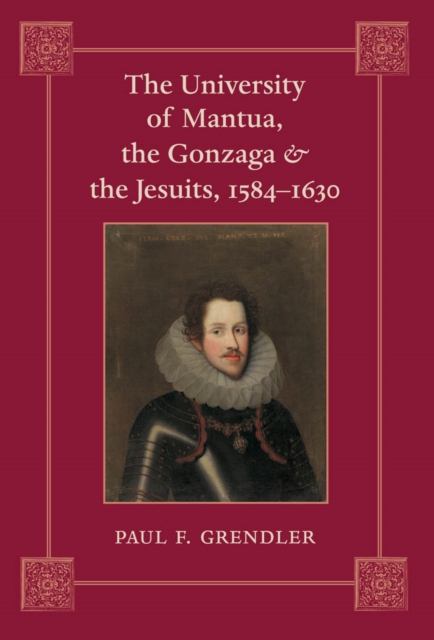
The University of Mantua, the Gonzaga, and the Jesuits, 1584–1630
Universities were driving forces of change in late Renaissance Italy. The Gonzaga, the ruling family of Mantua, had long supported scholarship and dreamed of founding an institution of higher learning within the city. In the early seventeenth century they joined forces with the Jesuits, a powerful intellectual and religious force, to found one of the most innovative universities of the time.Paul F. Grendler provides the first book in any language about the Peaceful University of Mantua, its official name. He traces the efforts of Duke Ferdinando Gonzaga, a prince savant who debated Galileo, as he made his family’s dream a reality. Ferdinando negotiated with the Jesuits, recruited professors, and financed the school. Grendler examines the motivations of the Gonzaga and the Jesuits in the establishment of a joint civic and Jesuit university.The University of Mantua lasted only six years, lost during the brutal sack of the city by German troops in 1630. Despite its short life, the university offered original scholarship and teaching. It had the first professorship of chemistry more than 100 years before any other Italian university. The leading professor of medicine identified the symptoms of angina pectoris 140 years before an English scholar named the disease. The star law professor advanced new legal theories while secretly spying for James I of England. The Jesuits taught humanities, philosophy, and theology in ways both similar to and different from lay professors.A superlative study of education, politics, and culture in seventeenth-century Italy, this book reconsiders a period in Italy’s history often characterized as one of feckless rulers and stagnant learning. Thanks to extensive archival research and a thorough examination of the published works of the university's professors, Grendler's history tells a new story.
eBook
