
Catalogue Search | MBRL


Are you sure you want to remove the book from the shelf?

{{itemTitle}}
2,269
result(s) for
"Plague History"
Sort by:


The Great Manchurian Plague of 1910-1911
When plague broke out in Manchuria in 1910 as a result of transmission from marmots to humans, it struck a region struggling with the introduction of Western medicine, as well as with the interactions of three different national powers: Chinese, Japanese, and Russian. In this fascinating case history, William Summers relates how this plague killed as many as 60,000 people in less than a year, and uses the analysis to examine the actions and interactions of the multinational doctors, politicians, and ordinary residents who responded to it.
Summers covers the complex political and economic background of early twentieth-century Manchuria and then moves on to the plague itself, addressing the various contested stories of the plague's origins, development, and ecological ties. Ultimately, Summers shows how, because of Manchuria's importance to the world powers of its day, the plague brought together resources, knowledge, and people in ways that enacted in miniature the triumphs and challenges of transnational medical projects such as the World Health Organization.
eBook


The Black Death and Later Plague Epidemics in the Scandinavian Countries
This monograph represents an expansion and deepening of previous works by Ole J. Benedictow - the author of highly esteemed monographs and articles on the history of plague epidemics and historical demography. In the form of a collection of articles, the author presents an in-depth monographic study on the history of plague epidemics in Scandinavian countries and on controversies of the microbiological and epidemiological fundamentals of plague epidemics.
eBook

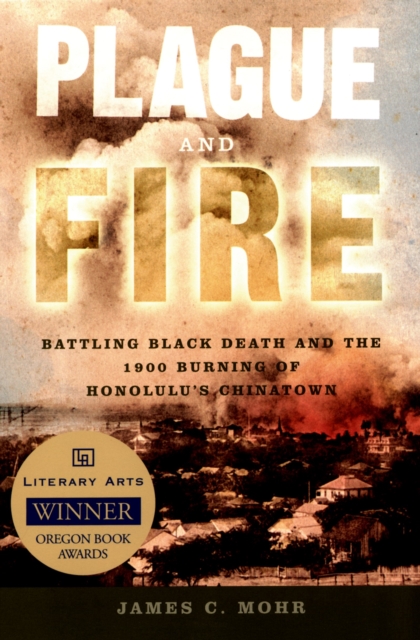
Plague and fire : battling black death and the 1900 burning of Honolulu's Chinatown
The bubonic plague reached Hawaii for the first time in 1899, just as the archipelago was being annexed by the US. To deal with the epidemic, governmental authorities granted absolute emergency powers to the Honolulu Board of Health. Committed to the new science of bacteriology, the Board physicians eventually decided to burn buildings where victims had died, hoping thereby to destroy any remaining plague bacilli. On January 20, 1900, one of those controlled burns burgeoned into a larger inferno that obliterated the Chinatown section of the city. In a few hours, over 5,000 people lost everything they had and were marched to detention camps where they were held under armed guard. Next to the bombing of Pearl Harbor, this remains the worst civic disaster in Hawaiian history, and probably the worst civic disaster ever to result from an American public health initiative. In the larger context of medical history, ethnic studies, and American imperialism, this book tells the story of how that catastrophe came about and how the principal racial and ethnic groups in Honolulu — Chinese, Japanese, Hawaiians, and whites — responded to the crisis.
eBook

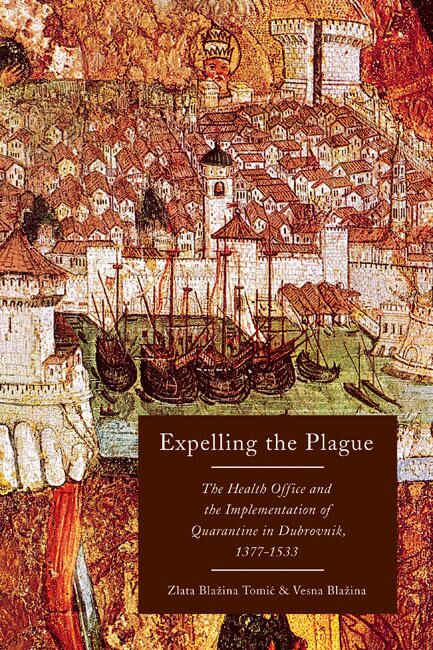
Expelling the Plague
A vibrant city-state on the Adriatic sea, Dubrovnik, also known as Ragusa, was a hub for the international trade between Europe and the Ottoman Empire. As a result, the city suffered frequent outbreaks of plague. Through a comprehensive analysis of these epidemics in Dubrovnik, Expelling the Plague explores the increasingly sophisticated plague control regulations that were adopted by the city and implemented by its health officials. In 1377, Dubrovnik became the first city in the world to develop and implement quarantine legislation, and in 1390 it established the earliest recorded permanent Health Office. The city’s preoccupation with plague control and the powers granted to its Health Office led to a rich archival record chronicling the city’s experience of plague, its attempts to safeguard public health, and the social effects of its practices of quarantine, prosecution, and punishment. These sources form the foundation of the authors' analysis, in particular the manuscript Libro deli Signori Chazamorbi, 1500-30, a rare health record of the 1526-27 calamitous plague epidemic. Teeming with real people across the spectrum, including gravediggers, laundresses, and plague survivors, it contains the testimonies collected during trial proceedings conducted by health officials against violators of public health regulations. Outlining the contributions of Dubrovnik in conceiving and establishing early public health measures in Europe, Expelling the Plague reveals how health concerns of the past greatly resemble contemporary anxieties about battling epidemics such as SARS, avian flu, and the Ebola virus.
eBook

Viruses, plagues, and history : past, present, and future
\"Here, my previous edition of Viruses, Plagues, & History is updated to reflect both progress and disappointment since that publication. This edition describes newcomers to the range of human infections, specifically, plagues that play important roles in this 21st century. The first is Middle East Respiratory Syndrome (MERS), an infection related to Sudden Acute Respiratory Syndrome (SARS). SARS was the first new-found plague of this century. Zika virus, which is similar to yellow fever virus in being transmitted by mosquitos, is another of the recent scourges. Zika appearing for the first time in the Americas is associated with birth defects and a paralytic condition in adults. Lastly, illness due to hepatitis viruses were observed prominently during the second World War initially associated with blood transfusions and vaccine inoculations. Since then, hepatitis virus infections have afflicted millions of individuals, in some leading to an acute fulminating liver disease or more often to a life-long persistent infection. A subset of those infected has developed liver cancer. However, in a triumph of medical treatments for infectious diseases, pharmaceuticals have been developed whose use virtually eliminates such maladies. For example, Hepatitis C virus infection has been eliminated from almost all (> ; 97%) of its victims. This incredible result was the by-product of basic research in virology as well as cell and molecular biology during which intelligent drugs were designed to block events in the hepatitis virus life-cycle\" -- Provided by publisher.
Book

The Justinianic Plague
Existing mortality estimates assert that the Justinianic Plague (circa 541 to 750 CE) caused tens of millions of deaths throughout the Mediterranean world and Europe, helping to end antiquity and start the Middle Ages. In this article, we argue that this paradigm does not fit the evidence. We examine a series of independent quantitative and qualitative datasets that are directly or indirectly linked to demographic and economic trends during this two-century period: Written sources, legislation, coinage, papyri, inscriptions, pollen, ancient DNA, and mortuary archaeology. Individually or together, they fail to support the maximalist paradigm: None has a clear independent link to plague outbreaks and none supports maximalist reconstructions of late antique plague. Instead of large-scale, disruptive mortality, when contextualized and examined together, the datasets suggest continuity across the plague period. Although demographic, economic, and political changes continued between the 6th and 8th centuries, the evidence does not support the now commonplace claim that the Justinianic Plague was a primary causal factor of them.
Journal Article