
Catalogue Search | MBRL


Are you sure you want to remove the book from the shelf?

{{itemTitle}}
23
result(s) for
"Plakat"
Sort by:


Predation Time for Halfmoon and Multicolor Plakat of Varieties of Betta Fish Against Aedes aegypti Larvae in Different Water Volume
One biological strategy for controlling mosquito vectors is using larvivorous fish as larvae predators. Larvivorous fish are an alternative to overcome the problem of larval resistance to temephos. Among the many varieties of Betta fish, the specific predation rates associated with each variety and their behavior in different water volumes remain unclear. This study aims to analyze the differences in predation time for halfmoon and a multicolor plakatof varieties of Betta fish against Aedes aegypti larvae in different water volumes.. The research was conducted as a laboratory experiment using a post-test-only design with five replications. Four treatment groups were established, each consisting of one aquarium filled with a specific water volume, one fish, and 25 Ae. aegypti larvae. The tests began at 12:00 WIB, and the predation time was recorded until all larvae were consumed. The findings showed that all All varieties of Betta fish can typically predate Ae. aegypti larvae. Halfmoon and multicolor plakat have the same predation ability against Ae. aegypti larvae (p > 0.05). The Mann Whitney's results indicated that Betta fish placed in water with a water volume of 1 and 3 liters had no significantly different predation against Ae. aegypti larvae (p > 0.05). However, the Kruskall-Wallis test results showed a significant difference in predation abilities between the two varieties when exposed to different water volumes (p < 0.05) . The multicolor plakat variety displayed the fastest predation time in 1 liter of water, whereas the halfmoon variety predated more quickly in 3 liters of water.
Journal Article


Planners Becoming Visualizers in the Mediatized World: Actor-Network Analysis of Cairo’s Street Billboards
While visual communication is crucial in urban planning, there is a gap in understanding how dominant narratives and visuals affect professional planning practice and planners’ roles, particularly in mediatized urban environments. This study addresses this gap by examining street billboards in Cairo to understand how planning visualizations contribute to the restructuring of the planning profession. It explores how these visual tools shape the practice and roles of urban planners, who are increasingly becoming visualizers. Employing actor-network theory, the study traces the relationships between billboards, planners, and other network actors. The primary research question is: How and why does the use of planning visualizations (billboards) restructure the profession of planning, including planning practice and the roles of planners? Utilizing a qualitative exploratory methodology, the study focuses on billboards along Cairo’s 6th of October Bridge. Data were analyzed through visual and content analysis of 209 billboards to understand their language, content, patterns, and geo-positioning. The analysis revealed that billboards in Cairo significantly impact urban landscapes and the visual culture of urbanization, often promoting exclusive real estate projects to a socio-economic elite. The research highlights the dilemmas in the changing professional roles of planners within a mediatized world and underscores the need for more inclusive planning practices. By employing actor-network theory, the study provides a nuanced understanding of the complex relationships that shape and are shaped by the visual culture of urban planning, offering insights into how planners can navigate and influence these dynamics for more equitable urban development.
Journal Article

Do campaign posters trigger voting based on looks? Probing an explanation for why good-looking candidates win more votes
Numerous studies document that better-looking candidates win more votes. Yet the causal mechanisms leading to this advantage remain unexplored. We consider for the first time a potential trigger of the looks–vote association that has previously been suggested but not tested in the literature: exposure to campaign posters of the candidates. We test this explanation with German election survey data, which we augment with ratings—provided by MTurk workers from the U.S.—of the attractiveness and facial competence of about 1,000 district candidates. Confirming previous studies on Germany, we find that attractiveness is positively associated with candidate vote share (1.2 ppts. min–max). At the voter level, we find tentative evidence for the idea that the association is moderated by exposure to campaign posters: effects are in the expected directions and their sizes consistent with what we observe at the candidate level, but we cannot always reject the null hypothesis of no effect. In contrast to attractiveness, we do not find conclusive evidence for an effect of facial competence in the election considered. These preliminary results suggest that inundating voters with candidate posters, as in elections in Germany and many other places, might be a reason for voting based on looks.
Journal Article
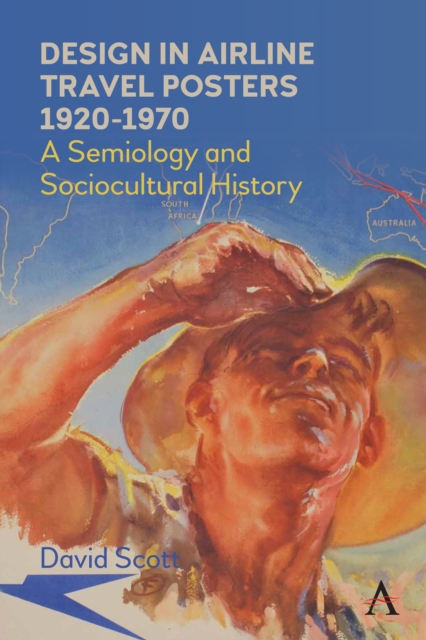
Design in Airline Travel Posters 1920-1970
This book studies design in airline travel posters of the 1920–1970: period. It is both a semiology and a sociocultural cultural history that explores the way advertising posters combine information and fantasy to create seductive images/texts. The book is lavishly illustrated in colour, the images constituting part of the overall argument. The field of poster studies is vast, but it is surprising how little work has been done till date on the fundamental structures – semiotic and semantic – that underpin the visual messages posters produce. Most studies of posters focus either on their history; on specific themes – politics, travel, sport, cinema; or on their status as collectable items. Though such approaches are valid, they hardly account for the specificity of the poster’s appeal or for the complex semiotic and cultural issues poster art raises. This book sets out to tackle these latter issues since they are fundamental both to the deeper significance and to the wider appeal of the poster as a cultural form. In doing so it focuses on the field of airline travel posters which developed precisely in the period of the twentieth century (1920–1970) that coincided with the onset of mass travel.
eBook

Karuzela plakatowa” jako technika rozwijania działań językowych
„Karuzela plakatowa” to ciekawa propozycja techniki nauczania. Jest to zadaniowa forma pracy inspirowana sesjami plakatowymi, czyli dyskusjami prowadzonymi przy rozwieszonych plakatach. Tony Lynch i Joan Maclean w artykule A case of exercising: Effects of immediate task repetition on learners’ performance (2001) wykazali związek między zastosowaniem techniki „karuzeli” a wzrostem poprawności produkcji językowej. Efekty ich pracy zachęciły autorkę artykułu do wykorzystania techniki „karuzeli” jako narzędzia wspierającego rozwijanie działań językowych na lekcji języka polskiego jako obcego na poziomie B2. W artykule odpowiemy na następujące pytania: Czy technika „karuzeli plakatowej” jest skutecznym narzędziem nauczania języka polskiego? Jakie korzyści wynikają z zastosowania tej techniki? Jak uczący się oceniają tę technikę? Postaramy się także pokazać, że „karuzela plakatowa” jest ciekawą techniką nauczania mówienia integrującą rozwijanie produktywnych, interakcyjnych i mediacyjnych działań językowych.
Journal Article

Caricatura, lirica și afișele electorale ca forme ale confruntărilor partizane în alegerile generale din 1937 din România
This study proposes an analysis of how the National Liberal Party (PNL), the National Peasant Party (PNT) and the National Christian Party (PNC) used caricatures, lyrics or electoral posters to build a more favorable image of their own party or compromise the opponent. Based in particular on the sources existing in the official party press and the so-called independent one, we proceeded to a description of the three elements, including the meanings and messages intended for the electorate. With a predominantly rural population (over 80%), poorly educated in regard to civic issues, caricature and electoral lyrics were used in particular by the PNT and the so-called independent press to attack the ruling party, as well as the formation of A. C. Cuza and Octavian Goga, and to target those with a nationalist-peasant affiliation. Through the three types of confrontation, the parties in our study have endeavored to transmit as effectively as possible the eccentric populist and manipulative messages aimed at attracting thousands of voters. Although both the national and the nationalist-peasant press used caricature and versification as a political weapon, there are immense differences between the contents of the two camps, the caricaturist Petrică Lazar and the anti-Semitic poet Vasile Militaru -known also under the pseudonym of Radu Barda -preferring the construction of satirical images and poems that contained huge doses of grotesque, beliefs and prejudices about the Jewish minority.
Journal Article

WPA Posters in an Aesthetic, Social, and Political Context
This book examines posters produced by the Works Progress Administration (WPA), a federal relief program designed to create jobs in the United States during the Great Depression.
Cory Pillen focuses on several issues addressed repeatedly in the roughly 2,200 extant WPA posters created between 1935 and 1943: recreation and leisure, conservation, health and disease, and public housing. As the book shows, the posters promote specific forms of knowledge and literacy as solutions to contemporary social concerns. The varied issues these works engage and the ideals they endorse, however, would have resonated in complex ways with the posters' diverse viewing public, working both for and against the rhetoric of consensus employed by New Deal agencies in defining and managing the relationship between self and society in modern America.
This book will be of interest to scholars in design history, art history, and American studies.
Cover image: Don (Chester) C. Powell. Washington D.C. WPA, Department of the Interior, National Park Service, c. 1938. Silkscreen Print. Digital Image courtesy of Library of Congress, Prints & Photographs Division, WPA Poster Collection, LC-DIG-ppmsca-13397.
eBook
