
Catalogue Search | MBRL


Are you sure you want to remove the book from the shelf?

{{itemTitle}}
25,149
result(s) for
"Planetary science"
Sort by:

Under desert skies : how Tucson mapped the way to the Moon and planets
\"The book tells the story of how an upstart planetary laboratory in Tucson, the Lunar and Planetary Laboratory (LPL), would help create the field of planetary science, breaking free from traditional astronomical techniques to embrace a wide range of disciplines necessary to study planets\"-- Provided by publisher.
Book

Revealing the Mysteries of Venus: The DAVINCI Mission
The Deep Atmosphere Venus Investigation of Noble gases, Chemistry, and Imaging (DAVINCI) mission described herein has been selected for flight to Venus as part of the NASA Discovery Program. DAVINCI will be the first mission to Venus to incorporate science-driven flybys and an instrumented descent sphere into a unified architecture. The anticipated scientific outcome will be a new understanding of the atmosphere, surface, and evolutionary path of Venus as a possibly once-habitable planet and analog to hot terrestrial exoplanets. The primary mission design for DAVINCI as selected features a preferred launch in summer/fall 2029, two flybys in 2030, and descent-sphere atmospheric entry by the end of 2031. The in situ atmospheric descent phase subsequently delivers definitive chemical and isotopic composition of the Venus atmosphere during an atmospheric transect above Alpha Regio. These in situ investigations of the atmosphere and near-infrared (NIR) descent imaging of the surface will complement remote flyby observations of the dynamic atmosphere, cloud deck, and surface NIR emissivity. The overall mission yield will be at least 60 Gbits (compressed) new data about the atmosphere and near surface, as well as the first unique characterization of the deep atmosphere environment and chemistry, including trace gases, key stable isotopes, oxygen fugacity, constraints on local rock compositions, and topography of a tessera.
Journal Article

Picture this! : grasping the dimensions of time and space
Astronomical concepts can be truly hard to comprehend, especially those of planetary sizes and distances from Earth and from each other. These concepts are made more comprehensible by the group of illustrations in this book, which put, in scale, side by side extraterrestrial objects with objects on Earth we can more easily relate to. For example, study the pictures of Earth floating above Jupiter's Great Red Spot and the asteroid Itokawa resting beside Toronto's CN Tower. These mind-bending images bring things better into perspective and will help you understand the size and scale of our Solar System. In later chapters, you will be told how close the visionaries of the past came to guessing what today's explorers would find. Astronomer/painter Lucien Rudaux's masterpieces of Mars dust storms anticipated Viking and Mars rover images by nearly a century. Space artist Ludek Pesek envisioned astronauts setting up camp on the lunar surface in scenes hauntingly similar to photos taken by Apollo astronauts decades later. But the real benefit of this work is in better grasping the nature of our universe -- how big it is, now large it is, and how we fit into it.
Book

Exoplanet secondary atmosphere loss and revival
The next step on the path toward another Earth is to find atmospheres similar to those of Earth and Venus—high–molecular-weight (secondary) atmospheres—on rocky exoplanets. Many rocky exoplanets are born with thick (>10 kbar) H₂-dominated atmospheres but subsequently lose their H₂; this process has no known Solar System analog. We study the consequences of early loss of a thick H₂ atmosphere for subsequent occurrence of a high–molecular-weight atmosphere using a simple model of atmosphere evolution (including atmosphere loss to space, magma ocean crystallization, and volcanic outgassing). We also calculate atmosphere survival for rocky worlds that start with no H₂. Our results imply that most rocky exoplanets orbiting closer to their star than the habitable zone that were formed with thick H₂-dominated atmospheres lack high–molecularweight atmospheres today. During early magma ocean crystallization, high–molecular-weight species usually do not form long-lived high–molecular-weight atmospheres; instead, they are lost to space alongside H₂. This early volatile depletion also makes it more difficult for later volcanic outgassing to revive the atmosphere. However, atmospheres should persist on worlds that start with abundant volatiles (for example, water worlds). Our results imply that in order to find high–molecular-weight atmospheres on warm exoplanets orbiting M-stars, we should target worlds that formed H₂-poor, that have anomalously large radii, or that orbit less active stars.
Journal Article

The asteroid hunter : a scientist's journey to the dawn of our solar system
\"On September 11, 1999, humanity made a monumental discovery in the vastness of space. Scientists uncovered an asteroid of immense scientific importance--a colossal celestial entity. As massive as an aircraft carrier and towering as high as the iconic Empire State Building, this cosmic titan was later named Bennu. Remarkable for much more than its size, Bennu belonged to a rare breed of asteroids capable of revealing the essence of life itself. But just as Bennu became a beacon of promise, researchers identified a grave danger. Hurtling through space, it threatens to collide with our planet on September 24, 2182. Leading the expedition was Dr. Dante Lauretta, the Principal Investigator of NASA's audacious OSIRIS-REx Asteroid Sample Return Mission. Tasked with unraveling Bennu's mysteries, his team embarked on a daring quest to retrieve a precious sample from the asteroid's surface - one that held the potential to not only unlock the secrets of life's origins but also to avert an unprecedented catastrophe. A tale of destiny and danger, The Asteroid Hunter chronicles the high-stakes mission firsthand, narrated by Dr. Lauretta. It offers readers an intimate glimpse into the riveting exploits of the mission and Dr. Lauretta's wild, winding personal journey to Bennu and back. Peeling back the curtain on the wonders of the cosmos, this enthralling account promises a rare glimpse into the tightly woven fabric of scientific exploration, where technical precision converges with humanity's profound curiosity and indominable spirit\"-- Provided by publisher.
Book
Pliocene and Eocene provide best analogs for near-future climates
As the world warms due to rising greenhouse gas concentrations, the Earth systemmoves toward climate states without societal precedent, challenging adaptation. Past Earth system states offer possible model systems for the warming world of the coming decades. These include the climate states of the Early Eocene (ca. 50 Ma), the Mid-Pliocene (3.3–3.0 Ma), the Last Interglacial (129–116 ka), the Mid-Holocene (6 ka), preindustrial (ca. 1850 CE), and the 20th century. Here, we quantitatively assess the similarity of future projected climate states to these six geohistorical benchmarks using simulations from the Hadley Centre Coupled Model Version 3 (HadCM3), the Goddard Institute for Space Studies Model E2-R (GISS), and the Community Climate System Model, Versions 3 and 4 (CCSM) Earth system models. Under the Representative Concentration Pathway 8.5 (RCP8.5) emission scenario, by 2030 CE, future climates most closely resemble Mid-Pliocene climates, and by 2150 CE, they most closely resemble Eocene climates. Under RCP4.5, climate stabilizes at Pliocene-like conditions by 2040 CE. Pliocene-like and Eocene-like climates emerge first in continental interiors and then expand outward. Geologically novel climates are uncommon in RCP4.5 (<1%) but reach 8.7% of the globe under RCP8.5, characterized by high temperatures and precipitation. Hence, RCP4.5 is roughly equivalent to stabilizing at Pliocene-like climates, while unmitigated emission trajectories, such as RCP8.5, are similar to reversing millions of years of long-term cooling on the scale of a few human generations. Both the emergence of geologically novel climates and the rapid reversion to Eocene-like climates may be outside the range of evolutionary adaptive capacity.
Journal Article
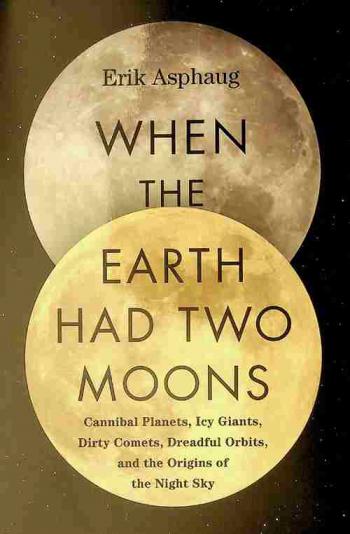
When the Earth had two moons
An astonishing exploration of planet formation and the origins of life by one of the world's most innovative planetary geologists. In 1959, the Soviet probe Luna 3 took the first photos of the far side of the moon. Even in their poor resolution, the images stunned scientists: the far side is an enormous mountainous expanse, not the vast lava-plains seen from Earth. Subsequent missions have confirmed this in much greater detail. How could this be, and what might it tell us about our own place in the universe? As it turns out, quite a lot. Fourteen billion years ago, the universe exploded into being, creating galaxies and stars. Planets formed out of the leftover dust and gas that coalesced into larger and larger bodies orbiting around each star. In a sort of heavenly survival of the fittest, planetary bodies smashed into each other until solar systems emerged. Curiously, instead of being relatively similar in terms of composition, the planets in our solar system, and the comets, asteroids, satellites and rings, are bewitchingly distinct. So, too, the halves of our moon. In When the Earth Had Two Moons, esteemed planetary geologist Erik Asphaug takes us on an exhilarating tour through the farthest reaches of time and our galaxy to find out why. Beautifully written and provocatively argued, When the Earth Had Two Moons is not only a mind-blowing astronomical tour but a profound inquiry into the nature of life here -- and billions of miles from home.
Predicting long-term dynamics of soil salinity and sodicity on a global scale
Knowledge of spatiotemporal distribution and likelihood of (re)occurrence of salt-affected soils is crucial to our understanding of land degradation and for planning effective remediation strategies in face of future climatic uncertainties. However, conventional methods used for tracking the variability of soil salinity/sodicity are extensively localized, making predictions on a global scale difficult. Here, we employ machine-learning techniques and a comprehensive set of climatic, topographic, soil, and remote sensing data to develop models capable of making predictions of soil salinity (expressed as electrical conductivity of saturated soil extract) and sodicity (measured as soil exchangeable sodium percentage) at different longitudes, latitudes, soil depths, and time periods. Using these predictive models, we provide a global-scale quantitative and gridded dataset characterizing different spatiotemporal facets of soil salinity and sodicity variability over the past four decades at a ∼1-km resolution. Analysis of this dataset reveals that a soil area of 11.73 Mkm² located in nonfrigid zones has been salt-affected with a frequency of reoccurrence in at least three-fourths of the years between 1980 and 2018, with 0.16 Mkm² of this area being croplands. Although the net changes in soil salinity/sodicity and the total area of salt-affected soils have been geographically highly variable, the continents with the highest salt-affected areas are Asia (particularly China, Kazakhstan, and Iran), Africa, and Australia. The proposed method can also be applied for quantifying the spatiotemporal variability of other dynamic soil properties, such as soil nutrients, organic carbon content, and pH.
Journal Article

Alien earths : the new science of planet hunting in the cosmos
\"Riveting and timely, a look at the research that is transforming our understanding of the cosmos in the quest to discover whether we are alone. For thousands of years, humans have wondered whether we're alone in the cosmos. Now, for the first time, we have the technology to investigate. But once you look for life elsewhere, you realize it is not so simple. How do you find it over cosmic distances? What actually is life? As founding director of Cornell University's Carl Sagan Institute, astrophysicist Lisa Kaltenegger has built a team of tenacious scientists from many disciplines to create a specialized toolkit to find life on faraway worlds. In Alien Earths, she demonstrates how we can use our homeworld as a Rosetta Stone, creatively analyzing Earth's history and its astonishing biosphere to inform this search. With infectious enthusiasm, she takes us on an eye-opening journey to the most unusual exoplanets that have shaken our worldview - planets covered in oceans of lava, lonely wanderers lost in space, and others with more than one sun in their sky! And the best contenders for Alien Earths. We also see the imagined worlds of science fiction and how close they come to reality. With the James Webb Space Telescope and Dr. Kaltenegger's pioneering work, she shows that we live in an incredible new epoch of exploration. As our witty and knowledgeable tour guide, Dr. Kaltenegger shows how we discover not merely new continents, like the explorers of old, but whole new worlds circling other stars and how we could spot life there. Worlds from where aliens may even be gazing back at us. What if we're not alone?\"-- Provided by publisher.
BOOK
African burned area and fire carbon emissions are strongly impacted by small fires undetected by coarse resolution satellite data
Fires are a major contributor to atmospheric budgets of greenhouse gases and aerosols, affect soils and vegetation properties, and are a key driver of land use change. Since the 1990s, global burned area (BA) estimates based on satellite observations have provided critical insights into patterns and trends of fire occurrence. However, these global BA products are based on coarse spatial-resolution sensors, which are unsuitable for detecting small fires that burn only a fraction of a satellite pixel. We estimated the relevance of those small fires by comparing a BA product generated from Sentinel-2 MSI (Multispectral Instrument) images (20-m spatial resolution) with a widely used global BA product based on Moderate Resolution Imaging Spectroradiometer (MODIS) images (500 m) focusing on sub-Saharan Africa. For the year 2016, we detected 80% more BA with Sentinel-2 images thanwith the MODIS product. This difference was predominately related to small fires: we observed that 2.02 Mkm² (out of a total of 4.89 Mkm²) was burned by fires smaller than 100 ha, whereas the MODIS product only detected 0.13 million km² BA in that fire-size class. This increase in BA subsequently resulted in increased estimates of fire emissions; we computed 31 to 101% more fire carbon emissions than current estimates based on MODIS products. We conclude that small fires are a critical driver of BA in sub-Saharan Africa and that including those small fires in emission estimates raises the contribution of biomass burning to global burdens of (greenhouse) gases and aerosols.
Journal Article