
Catalogue Search | MBRL


Are you sure you want to remove the book from the shelf?

{{itemTitle}}
851
result(s) for
"Planets -- Origin"
Sort by:


Planetary Crusts
Planetary Crusts explains how and why solid planets and satellites develop crusts. Extensively referenced and annotated, it presents a geochemical and geological survey of the crusts of the Moon, Mercury, Venus, Earth and Mars, the asteroid Vesta, and several satellites like Io, Europa, Ganymede, Titan and Callisto. After describing the nature and formation of solar system bodies, the book presents a comparative investigation of different planetary crusts and discusses many crustal controversies. The authors propose the theory of stochastic processes dominating crustal development, and debate the possibility of Earth-like planets existing elsewhere in the cosmos. Written by two leading authorities on the subject, this book presents an extensive survey of the scientific problems of crustal development, and is a key reference for researchers and students in geology, geochemistry, planetary science, astrobiology and astronomy.
eBook
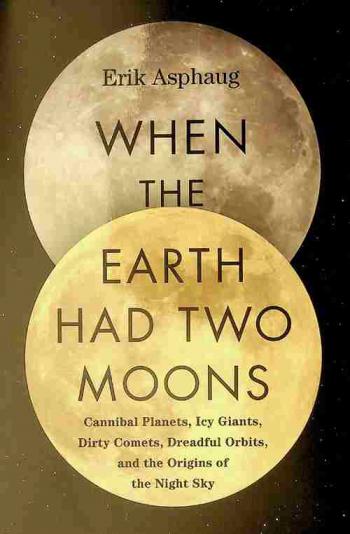
When the Earth had two moons
An astonishing exploration of planet formation and the origins of life by one of the world's most innovative planetary geologists. In 1959, the Soviet probe Luna 3 took the first photos of the far side of the moon. Even in their poor resolution, the images stunned scientists: the far side is an enormous mountainous expanse, not the vast lava-plains seen from Earth. Subsequent missions have confirmed this in much greater detail. How could this be, and what might it tell us about our own place in the universe? As it turns out, quite a lot. Fourteen billion years ago, the universe exploded into being, creating galaxies and stars. Planets formed out of the leftover dust and gas that coalesced into larger and larger bodies orbiting around each star. In a sort of heavenly survival of the fittest, planetary bodies smashed into each other until solar systems emerged. Curiously, instead of being relatively similar in terms of composition, the planets in our solar system, and the comets, asteroids, satellites and rings, are bewitchingly distinct. So, too, the halves of our moon. In When the Earth Had Two Moons, esteemed planetary geologist Erik Asphaug takes us on an exhilarating tour through the farthest reaches of time and our galaxy to find out why. Beautifully written and provocatively argued, When the Earth Had Two Moons is not only a mind-blowing astronomical tour but a profound inquiry into the nature of life here -- and billions of miles from home.


The living cosmos : our search for life in the universe
Astrobiology, the study of life in space, is one of today's fastest growing fields of science. In this accessible and elegantly reasoned book, scholar and researcher Impey explores the foundations of this rapidly developing discipline, where it's going, and what it's likely to find. If Earth is not the only planet, it is so far the only living one that we know of. Impey reveals the incredible proliferation and variety of life on Earth, paying special tribute to some of its hardiest life forms, extremophiles, a dizzying array of microscopic organisms that can survive extreme heat and cold, live deep within rocks, or thrive in pure acid. From there, Impey investigates the potential for life beyond our own world, providing portraits of the individuals who have devoted their lives to the search.--From publisher description.
Book

Early Earth systems
Early Earth Systems provides a complete history of the Earth from its beginnings to the end of the Archaean. This journey through the Earth's early history begins with the Earth's origin, then examines the evolution of the mantle, the origin of the continental crust, the origin and evolution of the Earth's atmosphere and oceans, and ends with the origin of life. - Looks at the evidence for the Earth's very early differentiation into core, mantle, crust, atmosphere and oceans and how this differentiation saw extreme interactions within the Earth system. - Discusses Archaean Earth processes within the framework of the Earth System Science paradigm, providing a qualitative assessment of the principal reservoirs and fluxes in the early Earth. “The book would be perfect for a graduate-level or upper level undergraduate course on the early Earth. It will also serve as a great starting point for researchers in solid-Earth geochemistry who want to know more about the Earth’s early atmosphere and biosphere, and vice versa for low temperature geochemists who want to get a modern overview of the Earth’s interior.” Geological Magazine, 2008
eBook

Why is there life on Earth?
Looks at what characteristics make Earth able to support life and determines that a wider range of conditions are survivable than once thought.
Book

Origin and Evolution of Earth
Questions about the origin and nature of Earth and the life on it have long preoccupied human thought and the scientific endeavor. Deciphering the planet's history and processes could improve the ability to predict catastrophes like earthquakes and volcanic eruptions, to manage Earth's resources, and to anticipate changes in climate and geologic processes. At the request of the U.S. Department of Energy, National Aeronautics and Space Administration, National Science Foundation, and U.S. Geological Survey, the National Research Council assembled a committee to propose and explore grand questions in geological and planetary science. This book captures, in a series of questions, the essential scientific challenges that constitute the frontier of Earth science at the start of the 21st century.
eBook

The life of super-Earths : how the hunt for alien worlds and artificial cells will revolutionize life on our planet
\"In the past year, we have witnessed unprecedented breakthroughs in the seemingly unrelated fields of synthetic biology and exoplanetary astronomy. Just recently, arsenic-based bacteria was discovered in a California lake-both puzzling and electrifying the scientific world. In The Life of Super-Earths, expert astronomer Dimitar Sasselov aims to highlight these groundbreaking findings and explain how what we learn in the laboratory informs our investigation of the universe, and vice versa. The discovery of a New Earth, or other world, may be in our future. But a truly 'alien' life form is more likely to emerge from our planet's natural environment or in a petri dish at a research lab. We may cross a milestone into the era of synthetic biology under the microscope. These breakthroughs will shed new light on our place in the universe and answer the age-old question: Are we alone in the universe? The Life of Super-Earths offers nothing short of a revolution in our understanding of life and its place in the cosmos\"-- Provided by publisher.
Book

Protostars and Planets VI
The revolutionary discovery of thousands of confirmed and candidate planets beyond the solar system brings forth the most fundamentalquestion: How do planets and their host stars form and evolve? Protostars and Planets VI brings together more than 250 contributing authors at the forefront of their field, conveying the latest results in this research area and establishing a new foundation for advancing our understanding of stellar and planetary formation.Continuing the tradition of the Protostars and Planets series, this latest volume uniquely integrates the cross-disciplinary aspects of this broad field. Covering an extremely wide range of scales, from the formation of large clouds in our Milky Way galaxy down to small chondrules in our solar system, Protostars and Planets VI takes an encompassing view with the goal of not only highlighting what we know but, most importantly, emphasizing the frontiers of what we do not know.As a vehicle for propelling forward new discoveries on stars, planets, and their origins, this latest volume in the Space Science Series is an indispensable resource for both current scientists and new students in astronomy, astrophysics, planetary science, and the study of meteorites.
eBook