
Catalogue Search | MBRL


Are you sure you want to remove the book from the shelf?

{{itemTitle}}
9,601
result(s) for
"Planets Exploration"
Sort by:

Worlds without end : exoplanets, habitability, and the future of humanity
\"WORLDS WITHOUT END: EXOPLANETS, HABITABILITY, AND THE FUTURE OF HUMANITY will present the scientific missions exploring exoplanets through the lens of habitability and our survival in the universe\"-- Provided by publisher.
Book
Working on Mars
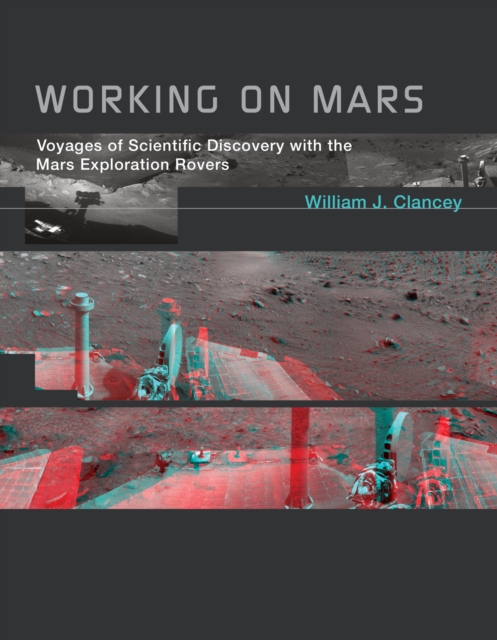
Geologists in the field climb hills and hang onto craggy outcrops; they put their fingers in sand and scratch, smell, and even taste rocks. Beginning in 2004, however, a team of geologists and other planetary scientists did field science in a dark room in Pasadena, exploring Mars from NASA's Jet Propulsion Laboratory (JPL) by means of the remotely operated Mars Exploration Rovers (MER). Clustered around monitors, living on Mars time, painstakingly plotting each movement of the rovers and their tools, sensors, and cameras, these scientists reported that they felt as if they were on Mars themselves, doing field science. The MER created a virtual experience of being on Mars. In this book, William Clancey examines how the MER has changed the nature of planetary field science. NASA cast the rovers, Spirit and Opportunity, as \"robotic geologists,\" and ascribed machine initiative (\"Spirit collected additional imagery...\") to remotely controlled actions. Clancey argues that the actual explorers were not the rovers but the scientists, who imaginatively projected themselves into the body of the machine to conduct the first overland expedition of another planet. The scientists have since left the darkened room and work from different home bases, but the rover-enabled exploration of Mars continues. Drawing on his extensive observations of scientists in the field and at the JPL, Clancey investigates how the design of the rover mission enables field science on Mars, explaining how the scientists and rover engineers manipulate the vehicle and why the programmable tools and analytic instruments work so well for them. He shows how the scientists felt not as if they were issuing commands to a machine but rather as if they were working on the red planet, riding together in the rover on a voyage of discovery. http://www.youtube.com/watch?v=oZQSWSZnTYs&feature=youtube_gdata
eBook

Earths of distant suns : how we find them, communicate with them, and maybe even travel there
Based on the latest missions results and supported by commissioned artwork, this book explores the possible lessons we may learn from exoplanets. As the number of known Earth-like objects grows significantly, the author explores what is known about the growing roster of \"pale blue dots\" far afield. Aided by an increased sensitivity of the existing observatories, recent discoveries by Keck, the Hubble Space Telescope, and Kepler are examined. These findings, once thought to be closer to the realm of science fiction, have fired the imaginations of the general public as well as scientists. All of us are mesmerized by the possibility of other Earth-like worlds out there. Author Michael Carroll asks the tough questions of what the expected gain is from identifying these Earth analogs spread across the Universe and the reasons for studying them. Potentially, they could teach us about our own climate and Solar System. Also explored are the more remote options of communication between or even travel to these distant yet perhaps not so dissimilar worlds.
Book

The Planning and Execution of Human Missions to the Moon and Mars
In The Planning and Execution of Human Missions to the Moon and Mars expert contributors from government, academia, and private enterprise explore the myriad challenges that must be overcome in order to conduct deep space travel. From spacecraft operation, mission architecture, and communications to interplanetary supply chains, in-space manufacturing, and beyond, this book is a must-read for everyone from industry professionals to those who dream of an off -world future.
eBook

Assessment of Planetary Protection Requirements for Spacecraft Missions to Icy Solar System Bodies
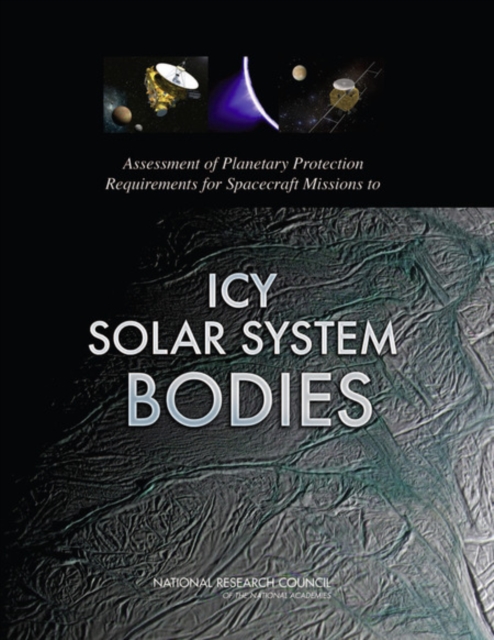
NASA's exploration of planets and satellites during the past 50 years has led to the discovery of traces of water ice throughout the solar system and prospects for large liquid water reservoirs beneath the frozen ICE shells of multiple satellites of the giant planets of the outer solar system. During the coming decades, NASA and other space agencies will send flybys, orbiters, subsurface probes, and, possibly, landers to these distant worlds in order to explore their geologic and chemical context. Because of their potential to harbor alien life, NASA will select missions that target the most habitable outer solar system objects. This strategy poses formidable challenges for mission planners who must balance the opportunity for exploration with the risk of contamination by Earth's microbes, which could confuse the interpretation of data obtained from these objects.
The 2000 NRC report Preventing the Forward Contamination of Europa provided a criterion that was adopted with prior recommendations from the Committee on Space Research of the International Council for Science. This current NRC report revisits and extends the findings and recommendations of the 2000 Europa report in light of recent advances in planetary and life sciences and, among other tasks, assesses the risk of contamination of icy bodies in the solar system.
eBook

Exploring the outer planets
In this visually spectacular tour of the outer reaches of our solar system, readers discover many intriguing facts. For example, the outer planets are separated from the inner planets by the asteroid belt. And, in addition to discovering Jupiter's moons, Galileo, in the early 17th century, observed the phases of Venus and made careful studies of sunspots. Readers also learn why humans could never live on one of the gas planets. The physical and chemical features and movement of the outer planets and their moons are detailed.
Book

Exploration and Engineering
Getting to Mars required engineering genius, scientific strategy, and the drive to persevere in the face of failure. Although the Jet Propulsion Laboratory in Pasadena, California, has become synonymous with the United States' planetary exploration during the past half century, its most recent focus has been on Mars. Beginning in the 1990s and continuing through the Mars Phoenix mission of 2007, JPL led the way in engineering an impressive, rapidly evolving succession of Mars orbiters and landers, including roving robotic vehicles whose successful deployment onto the Martian surface posed some of the most complicated technical problems in space flight history. In Exploration and Engineering, Erik M. Conway reveals how JPL engineers' creative technological feats led to major breakthroughs in Mars exploration. He takes readers into the heart of the lab's problem-solving approach and management structure, where talented scientists grappled with technical challenges while also coping, not always successfully, with funding shortfalls, unrealistic schedules, and managerial turmoil. Conway, JPL's historian, offers an insider's perspective into the changing goals of Mars exploration, the ways in which sophisticated computer simulations drove the design process, and the remarkable evolution of landing technologies over a thirty-year period.
eBook


Discovering Mars
For millenia humans have considered Mars the most fascinating
planet in our solar system. We've watched this Earth-like world
first with the naked eye, then using telescopes, and, most
recently, through robotic orbiters and landers and rovers on the
surface. Historian William Sheehan and astronomer and planetary
scientist Jim Bell combine their talents to tell a unique story of
what we've learned by studying Mars through evolving technologies.
What the eye sees as a mysterious red dot wandering through the sky
becomes a blurry mirage of apparent seas, continents, and canals as
viewed through Earth-based telescopes. Beginning with the Mariner
and Viking missions of the 1960s and 1970s, space-based instruments
and monitoring systems have flooded scientists with data on Mars's
meteorology and geology, and have even sought evidence of possible
existence of life-forms on or beneath the surface. This knowledge
has transformed our perception of the Red Planet and has provided
clues for better understanding our own blue world. Discovering
Mars vividly conveys the way our understanding of this other
planet has grown from earliest times to the present. The story is
epic in scope-an Iliad or Odyssey for our time, at least so far
largely without the folly, greed, lust, and tragedy of those
ancient stories. Instead, the narrative of our quest for the Red
Planet has showcased some of our species' most hopeful attributes:
curiosity, cooperation, exploration, and the restless drive to
understand our place in the larger universe. Sheehan and Bell have
written an ambitious first draft of that narrative even as the
latest chapters continue to be added both by researchers on Earth
and our robotic emissaries on and around Mars, including the
latest: the Perseverance rover and its Ingenuity helicopter drone,
which set down in Mars's Jezero Crater in February 2021.
eBook