
Catalogue Search | MBRL


Are you sure you want to remove the book from the shelf?

{{itemTitle}}
7,832
result(s) for
"Planets Models."
Sort by:

LEGO space : building the future
In LEGO Space, you'll explore an entire LEGO universe. Astounding spaceships, eye-popping aliens, and vast planets come to life in a series of truly impressive LEGO models. Step-by-step building instructions at the end of each chapter will have you recreating a piece of each LEGO world for your own collection. Marvel at page after page of out-of-this-world spaceships, rockets, astronauts, space-villains, and other amazing creations from a distant, future realm!
Book

Vortex dynamics, statistical mechanics, and planetary atmospheres
Vortex Dynamics, Statistical Mechanics, and Planetary Atmospheres introduces the reader with a background in either fluid mechanics or statistical mechanics to the modeling of planetary atmospheres by barotropic and shallow-water models. These potent models are introduced in both analytical and numerical treatments highlighting the ways both approaches inform and enlighten the other. This book builds on Vorticity, Statistical Mechanics, and Monte Carlo Simulations by Lim and Nebus in providing a rare introduction to this intersection of research fields. While the book reaches the cutting edge of atmospheric models, the exposition requires little more than an undergraduate familiarity with the relevant fields of study, and so this book is well suited to individuals hoping to swiftly learn an exciting new field of study. With inspiration drawn from the atmospheres of Venus and of Jupiter, the physical relevance of the work is never far from consideration, and the bounty of results shows a new and fruitful perspective with which to study planetary atmospheres.
eBook

Development of planetary ephemerides EPM and their applications
This paper outlines the progress in development of the numerical planet ephemerides EPM—Ephemerides of Planets and the Moon. EPM was first created in the 1970s in support of Russian space flight missions and constantly improved at IAA RAS. Comparison between various available EPM ephemerides (EPM2004, EPM2008, EPM2011) is shown. The first results of the updated EPM2013 version which takes into account the two-dimensional annulus of small asteroids are presented. Currently two main factors drive the progress of planet ephemerides: dynamical models of planet motion and observational data, with the crucial role of spacecraft ranging. EPM ephemerides are the basis for the Russian Astronomical and Nautical Astronomical Yearbooks, are planned to use in the GLONASS and LUNA-RESOURCE programs, and are being used for determination of physical parameters: masses of asteroids, planet rotation parameters and topography, the
G
M
⊙
and its secular variation, the PPN parameters, and the upper limit on the mass of dark matter in the Solar System. The files containing polynomial approximation for EPM ephemerides (EPM2004, EPM2008, EPM2011) along with
TT
–
TDB
and ephemerides of Ceres, Pallas, Vesta, Eris, Haumea, Makemake, and Sedna are available from
ftp://quasar.ipa.nw.ru/incoming/EPM/
. Files are provided in IAA’s binary and ASCII formats, as well as in the SPK format.
Journal Article

Modelos del planeta Tierra en escolares rurales de Chile / Planet Earth models about students in rural schools from Chile
RESUMEN El presente estudio tuvo como objetivo identificar los modelos del planeta Tierra en escolares mapuches y no mapuches de procedencia rural. Los participantes fueron 40 escolares distribuidos en dos grupos de edad, quienes respondieron a una tarea cognitiva que indaga la representación de la forma del planeta Tierra. En base al grado de acuerdo con la representación científica, cada participante fue categorizado en uno de cuatro modelos del planeta Tierra. El modelo 4, concordante con el conocimiento científico, no fue observado, pues la mayoría de los participantes se concentra en el modelo 3 en el que coexisten conocimientos previos con algunos elementos científicos. En los niños no mapuches se aprecia que el modelo del planeta Tierra se ajusta a los significados científicos a medida que aumenta el conocimiento escolar. Por el contrario, en los niños mapuches no se observa esta tendencia. Se discute el papel de la cultura y la enseñanza en el aprendizaje del modelo científico del planeta. ABSTRACT The aim of this study was to identify planet Earth models in mapuches and non mapuches students of rural origin. The participants were 40 students divided into two age groups who responded to a cognitive task which explores the representation of the shape of the planet Earth. Based on the degree of agreement with the scientific representation, each participant was categorized into one of four models of planet Earth. Model 4, consistent with the scientific knowledge was not observed because the majority of the participants were concentrated in Model 3. In non mapuche children, it is observed that the model of the planet Earth is adjusted to the scientific meaning in accordance with the increase of school knowledge. On the other hand, this trend is not observed in mapuche children. The role of culture and teaching is discussed in the learning of planet scientific model.
Journal Article

Inflection points of potential and polar moments of inertia of spherical celestial bodies
A simple existence criterion of inflection points of the potential in nonuniform spherical bodies is formulated. The criterion states that geometric loci of inflection points of the potential appear not only at density discontinuities but also at locations where the density ρ(
r
) is two-thirds of the average matter density
inside a sphere of a specified radius. The criterion is universal and is fulfilled as for bodies with a continuous density distribution, and for bodies consisting of layers of finite thickness, and also in mixed models. The method of separation of extreme points method of separation of inflection points is given. The criterion is tested on many models including isothermal, polytropic, and isochronous spheres. The family of models within which there are no inflection points is specified. Testing of the method on the Earth’s model confirms its adequacy. A lower limit for the axial (polar) moment of inertia of a spherical body
that separates planets and moons of the solar system into two groups is also obtained using the 3/2 criterion. The first and the largest group includes celestial bodies that have internal extreme points of the attraction force. The second group consists of planets and satellites that have no internal extreme points. These are the Moon, Io, Phobos, and, significantly, Mars.
Journal Article

Response of Tropical Cyclone Frequency to Sea Surface Temperatures Using Aqua-Planet Simulations
The present study investigates the effect of increasing sea surface temperatures (SSTs) on tropical cyclone (TC) frequency using the high-resolution Australian Community Climate and Earth-System Simulator (ACCESS) model. We examine environmental conditions leading to changes in TC frequency in aqua-planet global climate model simulations with globally uniform sea surface temperatures (SSTs). Two different TC tracking schemes are used. The Commonwealth Scientific and Industrial Research Organization (CSIRO) scheme (a resolution-dependent scheme) detects TCs that resemble observed storms, while the Okubo–Weiss zeta parameter (OWZP) tracking scheme (a resolution-independent scheme) detects the locations within “marsupial pouches” that are favorable for TC formation. Both schemes indicate a decrease in the global mean TC frequency with increased saturation deficit and static stability of the atmosphere. The OWZP scheme shows a poleward shift in the genesis locations with rising temperatures, due to lower vertical wind shear. We also observe an overall decrease in the formation of tropical depressions (TDs) with increased temperatures, both for those that develop into TCs and non-developing cases. The environmental variations at the time of TD genesis between the developing and the non-developing tropical depressions identify the Okubo–Weiss (OW) parameter and omega (vertical mass flux) as significant influencing variables. Initial vortices with lower vorticity or with weaker upward mass flux do not develop into TCs due to environments with higher saturation deficit and stronger static stability of the atmosphere. The latitudinal variations in the large-scale environmental conditions account for the latitudinal differences in the TC frequency in the OWZP scheme.
Journal Article
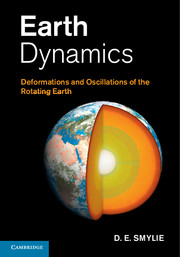
Earth Dynamics
The Earth is a dynamic system. Internal processes, together with external gravitational forces of the Sun, Moon and planets, displace the Earth's mass, impacting on its shape, rotation and gravitational field. Doug Smylie provides a rigorous overview of the dynamical behaviour of the solid Earth, explaining the theory and presenting methods for numerical implementation. Topics include advanced digital analysis, earthquake displacement fields, Free Core Nutations observed by the Very Long Baseline Interferometric technique, translational modes of the solid inner core observed by the superconducting gravimeters, and dynamics of the outer fluid core. This book is supported by freeware computer code, available online for students to implement the theory. Online materials also include a suite of graphics generated from the numerical analysis, combined with 100 graphic examples in the book to make this an ideal tool for researchers and graduate students in the fields of geodesy, seismology and solid earth geophysics. The book covers broadly applicable subjects such as the analysis of unequally spaced time series by Singular Value Decomposition, as well as specific topics on Earth Dynamics.
eBook

USING THE AUTOMATED SYSTEM ROBUST MODELING FOR STUDY THE SURFACES AND GRAVITY FIELDS PLANETS
Modern versions of the ASRM-2017 (Automated System for Robust Modeling) package provide a solution to a large range of problems associated with modeling surfaces and gravity fields of planets. However, their application requires creation of not only the global models but working models of the local surface areas as well. Currently, these regional geopotential models are in high demand in geology and oil exploration. To solve the problems of this kind, the special algorithms were created and implemented because the methods of developing global models are not always suitable for the development of the model in accordance with the limited surface area. The capability to create and analyze models of local parts of the surface is the main feature of the ASRM-2017. The required calculation accuracy of the model and output data are provided. Mathematical models developed on the basis of the ASRM-2017 may be applied in a wide range of density measurements from regular measuring networks with short distances between the points to irregular networks with the points located far from each other. With increasing distances between points, and irregularity of increasing the accuracy of prediction of constructed mathematical models increases, reaching and exceeding the accuracy of interpolation for some interpolation formulas. The capabilities of modern working version of the software package allow to carry out precise modeling of the planetary parameters distribution (topography, gravitational and magnetic fields, etc.) as on the whole planetary surface and on its local parts. The software can also be used in geology and oil exploration.
Conference Proceeding

Volatile-to-sulfur Ratios Can Recover a Gas Giant’s Accretion History
The newfound ability to detect SO2 in exoplanet atmospheres presents an opportunity to measure sulfur abundances and so directly test between competing modes of planet formation. In contrast to carbon and oxygen, whose dominant molecules are frequently observed, sulfur is much less volatile and resides almost exclusively in solid form in protoplanetary disks. This dichotomy leads different models of planet formation to predict different compositions of gas giant planets. Whereas planetesimal-based models predict roughly stellar C/S and O/S ratios, pebble-accretion models more often predict superstellar ratios. To explore the detectability of SO2 in transmission spectra and its ability to diagnose planet formation, we present a grid of atmospheric photochemical models and corresponding synthetic spectra for WASP-39b (where SO2 has been detected). Our 3D grid contains 113 models (spanning 1–100× the solar abundance ratio of C, O, and S) for thermal profiles corresponding to the morning and evening terminators, as well as mean terminator transmission spectra. Our models show that for a WASP-39b-like O/H and C/H enhancement of ∼10× solar, SO2 can only be seen for C/S and O/S ≲ 1.5× solar, and that WASP-39b’s reported SO2 abundance of 1–10 ppm may be more consistent with planetesimal accretion than with pebble-accretion models (although some pebble models also manage to predict similarly low ratios). More extreme C/S and O/S ratios may be detectable in higher-metallicity atmospheres, suggesting that smaller and more metal-rich gas and ice giants may be particularly interesting targets for testing planet formation models. Future studies should explore the dependence of SO2 on a wider array of planetary and stellar parameters, both for the prototypical SO2 planet WASP-39b, as well as for other hot Jupiters and smaller gas giants.
Journal Article

Terminator Habitability: The Case for Limited Water Availability on M-dwarf Planets
Rocky planets orbiting M-dwarf stars are among the most promising and abundant astronomical targets for detecting habitable climates. Planets in the M-dwarf habitable zone are likely synchronously rotating, such that we expect significant day–night temperature differences and potentially limited fractional habitability. Previous studies have focused on scenarios where fractional habitability is confined to the substellar or “eye” region, but in this paper we explore the possibility of planets with terminator habitability, defined by the existence of a habitable band at the transition between a scorching dayside and a glacial nightside. Using a global climate model, we show that for water-limited planets it is possible to have scorching temperatures in the “eye” and freezing temperatures on the nightside, while maintaining a temperate climate in the terminator region, due to reduced atmospheric energy transport. On water-rich planets, however, increasing the stellar flux leads to increased atmospheric energy transport and a reduction in day–night temperature differences, such that the terminator does not remain habitable once the dayside temperatures approach runaway or moist greenhouse limits. We also show that while water-abundant simulations may result in larger fractional habitability, they are vulnerable to water loss through cold trapping on the nightside surface or atmospheric water vapor escape, suggesting that even if planets were formed with abundant water, their climates could become water-limited and subject to terminator habitability.
Journal Article