
Catalogue Search | MBRL


Are you sure you want to remove the book from the shelf?

{{itemTitle}}
544
result(s) for
"Plantes Anatomie."
Sort by:

Do plants know math? : unwinding the story of plant spirals, from Leonardo da Vinci to now
\"Charles Darwin was driven to distraction by plant spirals, growing so exasperated that he once begged a friend to explain the mystery \"if you wish to save me from a miserable death.\" The legendary naturalist was hardly alone in feeling tormented by these patterns. Plant spirals captured the gaze of Leonardo da Vinci and became Alan Turing's final obsession. This book tells the stories of the physicists, mathematicians, and biologists who found themselves magnetically drawn to Fibonacci spirals in plants, seeking an answer to why these beautiful and seductive patterns occur in botanical forms as diverse as pine cones, cabbages, and sunflowers. Do Plants Know Math? takes you down through the centuries to explore how great minds have been captivated and mystified by Fibonacci patterns in nature. It presents a powerful new geometrical solution, little known outside of scientific circles, that sheds light on why regular and irregular spiral patterns occur. Along the way, the book discusses related plant geometries such as fractals and the fascinating way that leaves are folded inside of buds. Your neurons will crackle as you begin to see the connections. The book will inspire you to look at botanical patterns-and the natural world itself-with new eyes. Featuring hundreds of gorgeous color images, Do Plants Know Math? includes a dozen creative hands-on activities and even spiral-plant recipes, encouraging readers to explore and celebrate these beguiling patterns for themselves\"--Publisher's description.
BOOK

BAAD: a Biomass And Allometry Database for woody plants
Understanding how plants are constructed-i.e., how key size dimensions and the amount of mass invested in different tissues varies among individuals-is essential for modeling plant growth, carbon stocks, and energy fluxes in the terrestrial biosphere. Allocation patterns can differ through ontogeny, but also among coexisting species and among species adapted to different environments. While a variety of models dealing with biomass allocation exist, we lack a synthetic understanding of the underlying processes. This is partly due to the lack of suitable data sets for validating and parameterizing models. To that end, we present the Biomass And Allometry Database (BAAD) for woody plants. The BAAD contains 259 634 measurements collected in 176 different studies, from 21 084 individuals across 678 species. Most of these data come from existing publications. However, raw data were rarely made public at the time of publication. Thus, the BAAD contains data from different studies, transformed into standard units and variable names. The transformations were achieved using a common workflow for all raw data files. Other features that distinguish the BAAD are: (i) measurements were for individual plants rather than stand averages; (ii) individuals spanning a range of sizes were measured; (iii) plants from 0.01-100 m in height were included; and (iv) biomass was estimated directly, i.e., not indirectly via allometric equations (except in very large trees where biomass was estimated from detailed sub-sampling). We included both wild and artificially grown plants. The data set contains the following size metrics: total leaf area; area of stem cross-section including sapwood, heartwood, and bark; height of plant and crown base, crown area, and surface area; and the dry mass of leaf, stem, branches, sapwood, heartwood, bark, coarse roots, and fine root tissues. We also report other properties of individuals (age, leaf size, leaf mass per area, wood density, nitrogen content of leaves and wood), as well as information about the growing environment (location, light, experimental treatment, vegetation type) where available. It is our hope that making these data available will improve our ability to understand plant growth, ecosystem dynamics, and carbon cycling in the world's vegetation.
Journal Article

Root cone angle is enlarged in docs1 LRR-RLK mutants in rice
The DEFECTIVE IN OUTER CELL LAYER SPECIFICATION 1 (DOCS1) gene belongs to the Leucine-Rich Repeat Receptor-Like Kinase (LRR-RLK) subfamily. It has been discovered few years ago in Oryza sativa (rice) in a screen to isolate mutants with defects in sensitivity to aluminum. The c68 (docs1-1) mutant possessed a nonsense mutation in the C-terminal part of the DOCS1 kinase domain. We have generated a new loss-of-function mutation in the DOCS1 gene (docs1-2) using the CRISPR-Cas9 technology. This new loss-of-function mutant and docs1-1 present similar phenotypes suggesting the original docs1-1 was a null allele. Besides the aluminum sensitivity phenotype, both docs1 mutants shared also several root phenotypes described previously: less root hairs and mixed identities of the outer cell layers. Moreover, our new results suggest that DOCS1 could also play a role in root cap development. We hypothesized these docs1 root phenotypes may affect gravity responses. As expected, in seedlings, the early gravitropic response was delayed. Furthermore, at adult stage, the root gravitropic set angle of docs1 mutants was also affected since docs1 mutant plants displayed larger root cone angles. All these observations add new insights into the DOCS1 gene function in gravitropic responses at several stages of plant development.
Journal Article

Variations in physical and mechanical properties between tension and opposite wood from three tropical rainforest species
Growth strains were measured in situ in nine trees of three species from a French Guiana tropical rainforest in a clearly active verticality restoration process. The aim was to detect tension wood within the samples. Wood specimens were cut in the vicinity of the growth strain measurements in order to determine the microfibril angle and some mechanical and physical properties. As suspected, tensile growth strain was much higher in tension wood zones, as shown by the slightly higher longitudinal modulus of elasticity. Conversely, tension wood showed reduced compression strength. Longitudinal shrinkage was much higher in tension wood than in opposite wood. Clear relationships between the microfibril angle and longitudinal properties were noted in comparison (i) with those observed in gymnosperm compression wood and (ii) with expected relationships from the organization of wood fibres cell wall structure.
Journal Article
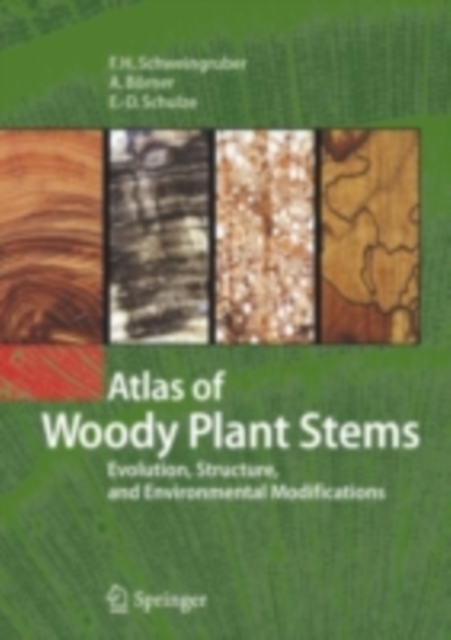
Atlas of woody plant stems
This atlas gives a unique assemblage of microscopic slides of wood anatomy and and demonstrates the reaction of stem anatomy to environments in which plants form woody stems. Presented in color throughout it has over 700 beautiful and instructive illustrations.
eBook

Peculiar tension wood structure in Laetia procera (Poepp.) Eichl. (Flacourtiaceae)
Tension wood of Laetia procera (Poepp.) Eichl. (Flacourtiaceae), a neo-tropical forest species, shows a peculiar secondary wall structure, with an alternance of thick and thin layers, while opposite wood of this species has a typical secondary wall structure (S1 + S2 + S3). Samples for the study of microstructural properties were collected upon the estimation of growth stresses in the living tree, in order to analyze the correlation of the former with the latter. Investigation using optical microscopy, scanning electron microscopy and UV microspectrophotometry allowed the description of the anatomy, ultra-structure and chemistry of this peculiar polylaminate secondary wall. In the thick layers, cellulose microfibril angle is very low (i.e., microfibril orientation is close to fibre axis) and cellulose microfibrils are well organized and parallel to each other. In the thin layers, microfibrils (only observable in the inner layer) are less organized and are oriented with a large angle relative to the axis of the cell. Thick layers are lightly lignified although thin layers show a higher content of lignin, close to that of opposite wood secondary wall. The more the wood was under tensile stress, the less the secondary wall was lignified, and lower the syringyl on guaiacyl lignin units' ratio was. The innermost layer of the secondary wall looks like a typical S3 layer with large microfibril angle and lignin occurrence. The interest of this kind of structure for the understanding of stress generation is discussed.
Journal Article

Characterization of the morphological, physical, and mechanical properties of seven nonwood plant fiber bundles
The morphological, physical, and mechanical properties of the nonwood plant fiber bundles of ramie, pineapple, sansevieria, kenaf, abaca, sisal, and coconut fiber bundles were investigated. All fibers except those of coconut fiber had noncircular cross-sectional shapes. The crosssectional area of the fiber bundles was evaluated by an improved method using scanning electron microscope images. The coefficient factor defined as the ratio of the cross-sectional area determined by diameter measurement, to the cross-sectional area determined by image analysis was between 0.92 and 0.96 for all fibers. This indicated that the area determined by diameter measurement was available. The densities of the fiber bundles decreased with increasing diameters. The diameters of each fiber species had small variation of around 3.4%-9.8% within a specimen. The tensile strength and Young’s modulus of ramie, pineapple, and sansevieria fiber bundles showed excellent values in comparison with the other fibers. The tensile strength and Young’s modulus showed a decreasing trend with increasing diameter of fiber bundles.
Journal Article

The relationships among root and leaf traits of 76 grassland species and relative abundance along fertility and disturbance gradients
For 76 annual, biennial, and perennial species common in the grasslands of central Minnesota, USA, we determined the patterns of correlations among seven organ-level traits (specific leaf area, leaf thickness, leaf tissue density, leaf angle, specific root length, average fine root diameter, and fine root tissue density) and their relationships with two traits relating to growth form (whether species existed for part of the growing season in basal, non-caulescent form and whether species were rhizomatous or not). The first correlation of traits showed that grasses had thin, dense leaves and thin roots while forbs had thick, low-density leaves and thick roots without any significant differences in growth form or life history. The second correlation of traits showed a gradient of species from those with high-density roots and high-density erect leaves to species with low-density roots and low-density leaves that were held parallel to the ground. High tissue density species were more likely to exist as a basal rosette for part of the season, were less likely to be rhizomatous, and less likely to be annuals. We examined the relationships between the two axes that represent the correlations of traits and previously collected data on the relative abundance of species across gradients of nitrogen addition and disturbance. Grasses were generally more abundant than forbs and the relative abundance of grasses and forbs did not change with increasing nitrogen addition or soil disturbance. High tissue density species became less common as fertility and disturbance increased.
Journal Article
An Introduction to Plant Structure and Development
A plant anatomy textbook unlike any other on the market today. Carol A. Peterson described the first edition as 'the best book on the subject of plant anatomy since the texts of Esau'. Traditional plant anatomy texts include primarily descriptive aspects of structure, this book not only provides a comprehensive coverage of plant structure, but also introduces aspects of the mechanisms of development, especially the genetic and hormonal controls, and the roles of plasmodesmata and the cytoskeleton. The evolution of plant structure and the relationship between structure and function are also discussed throughout. Includes extensive bibliographies at the end of each chapter. It provides students with an introduction to many of the exciting, contemporary areas at the forefront of research in the development of plant structure and prepares them for future roles in teaching and research in plant anatomy.
eBook