
Catalogue Search | MBRL


Are you sure you want to remove the book from the shelf?

{{itemTitle}}
5,154
result(s) for
"Plants Nomenclature"
Sort by:


Dictionary of plant lore
Knowledge of plant names can give insight into largely forgotten beliefs. For example, the common red poppy is known as \"Blind Man\" due to an old superstitious belief that if the poppy were put to the eyes it would cause blindness. Many plant names derived from superstition, folk lore, or primal beliefs. Other names are purely descriptive and can serve to explain the meaning of the botanical name. For example, Beauty-Berry is the name given to the American shrub that belongs to the genus Callicarpa. Callicarpa is Greek for beautiful fruit. Still other names come from literary sources providing rich detail of the transmission of words through the ages.Conceived as part of the author's wider interest in plant and tree lore and ethnobotanical studies, this fully revised edition of Elsevier's Dictionary of Plant Names and Their Origins contains over 30,000 vernacular and literary English names of plants. Wild and cultivated plants alike are identified by the botanical name. Further detail provides a brief account of the meaning of the name and detailed commentary on common usage. * Includes color images * Inclusive of all Latin terms with vernacular derivatives * The most comprehensive guide for plant scientists, linguists, botanists, and historians
eBook


Gods and Goddesses in the Garden
Zeus, Medusa, Hercules, Aphrodite. Did you know that these and other dynamic deities, heroes, and monsters of Greek and Roman mythology live on in the names of trees and flowers? Some grow in your local woodlands or right in your own backyard garden.
In this delightful book, botanist Peter Bernhardt reveals the rich history and mythology that underlie the origins of many scientific plant names. Unlike other books about botanical taxonomy that take the form of heavy and intimidating lexicons, Bernhardt's account comes together in a series of interlocking stories. Each chapter opens with a short version of a classical myth, then links the tale to plant names, showing how each plant \"resembles\" its mythological counterpart with regard to its history, anatomy, life cycle, and conservation. You will learn, for example, that as our garden acanthus wears nasty spines along its leaf margins, it is named for the nymph who scratched the face of Apollo. The shape-shifting god, Proteus, gives his name to a whole family of shrubs and trees that produce colorful flowering branches in an astonishing number of sizes and shapes.
Amateur and professional gardeners, high school teachers and professors of biology, botanists and conservationists alike will appreciate this book's entertaining and informative entry to the otherwise daunting field of botanical names. Engaging, witty, and memorable, Gods and Goddesses in the Garden transcends the genre of natural history and makes taxonomy a topic equally at home in the classroom and at cocktail parties.
eBook
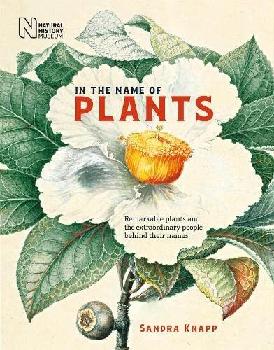
In the name of plants : from Attenborough to Washington, the people behind plants' names
The names of plants that are so familiar to us - magnolia, bougainvillea, sequioa - may just be names, but behind the names lie stories of espionage and heroism, rivalry and mystery and inspiration. 'In the Name of Plants' relates the stories of these people and the plants that were named after them. Each chapter tells the story of the person for which each plant is named, many of whom were pioneering explorers, collectors and botanists. Subjects range from Charles Darwin (Darwinia) and legendary French botanist Pierre Magnol (Magnolia), to US founding fathers George Washington (Washingtonia) and Benjamin Franklin (Franklinia). Each entry is accompanied by artworks from the Library of the Natural History Museum, as well as photography of specimens and wild plants and the essential taxonomic details and geographic spread for each species.
Book


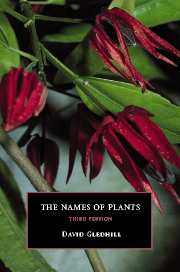
The Names of Plants
The Names of Plants is a handy two-part reference for the botanist and amateur gardener. The book begins by documenting the historical problems associated with an ever-increasing number of common names of plants and the resolution of these problems through the introduction of International Codes for both botanical and horticultural nomenclature. It also outlines the rules to be followed when plant breeders name a new species or cultivar of plant. The second part of the book comprises an alphabetical glossary of generic and specific plant names, and components of these, from which the reader may interpret the existing names of plants and construct new names. For the third edition, the book has been updated to include explanations of the International Codes for both Botanical Nomenclature (2000) and Nomenclature for Cultivated Plants (1995). The glossary has similarly been expanded to incorporate many more commemorative names.
eBook


Plant names in vegetation databases – a neglected source of bias
Problem: The increasing availability of large vegetation databases holds great potential in ecological research and biodiversity informatics, However, inconsistent application of plant names compromises the usefulness of these databases. This problem has been acknowledged in recent years, and solutions have been proposed, such as the concept of “potential taxa” or “taxon views”. Unfortunately, awareness of the problem remains low among vegetation scientists. Methods: We demonstrate how misleading interpretations caused by inconsistent use of plant names might occur through the course of vegetation analysis, from relevés upward through databases, and then to the final analyses. We discuss how these problems might be minimized. Results: We highlight the importance of taxonomic reference lists for standardizing plant names and outline standards they should fulfill to be useful for vegetation databases. Additionally, we present the R package vegdata, which is designed to solve name-related problems that arise when analysing vegetation databases. Conclusions: We conclude that by giving more consideration to the appropriate application of plant names, vegetation scientists might enhance the reliability of analyses obtained from large vegetation databases.
Journal Article