
Catalogue Search | MBRL


Are you sure you want to remove the book from the shelf?

{{itemTitle}}
87,003
result(s) for
"Plants Variation."
Sort by:

Plant variation and classification
Explains how our plant classification system works and looks at how scientists use it to identify and group plant species. The book also examines the variation between and within plants species and discusses how and why such variations have occurred.
Book

Continuous within-plant variation as a source of intraspecific functional diversity: Patterns, magnitude, and genetic correlates of leaf variability in Helleborus foetidus (Ranunculaceae)
• Premise of the study: Continuous within-plant variation in quantitative traits of reiterated, homologous structures is a component of intraspecific variation, but its contribution to functional diversity remains largely unexplored. For the perennial Helleborus foetidus, we measured functional leaf traits to quantify the contribution of within-plant variation to intraspecific functional variance and evaluate whether within-plant variability itself deserves separate consideration. • Methods: Within-individual variation in eight leaf traits was quantified for 138 plants sampled from 10 widely spaced locations in the Sierra de Cazorla, southeastern Spain. An amplified fragment length polymorphism (AFLP) technique was used to look for associations between within-plant variability and specific AFLP markers. • Key resulrs: Leaflets from basal positions in ramets were longer, heavier, had greater surface area and larger stomata, and lower specific area, stomatal index, and stomatal density than those from distal positions. Continuous variation between leaves from the same ramet was the main source of population-wide variance for most traits. Within-plant variability differed among populations. Individuals differed in within-plant variability, which was largely independent of trait means and associated with genetic characteristics. Up to four AFLP markers were associated with the within-plant variability level of a given leaf trait. • Conclusions: Subindividual variability in continuous leaf traits was independent of plant means and related to genetic features. The within-individual component generally exceeded the between-individual component of intraspecific variance. Withinplant variation may broaden the ecological breadth and enhance stability and persistence of plant populations and communities and may provide novel insights when incorporated in trait-based community ecology models.
Journal Article


Correlations among morphological and biochemical traits in high‐cannabidiol hemp (Cannabis sativa L.)
Cannabis sativa is cultivated for multiple uses including the production of cannabinoids. In developing improved production systems for high‐cannabinoid cultivars, scientists and cultivators must consider the optimization of complex and interacting sets of morphological, phenological, and biochemical traits, which have historically been shaped by natural and anthropogenic selection. Determining factors that modulate cannabinoid variation within and among genotypes is fundamental to developing efficient production systems and understanding the ecological significance of cannabinoids. Thirty‐two high‐cannabinoid hemp cultivars were characterized for traits including flowering date and shoot‐tip cannabinoid concentration. Additionally, a set of plant architecture traits, as well as wet, dry, and stripped inflorescence biomass were measured at harvest. One plant per plot was partitioned post‐harvest to quantify intra‐plant variation in inflorescence biomass production and cannabinoid concentration. Some cultivars showed intra‐plant variation in cannabinoid concentration, while many had a consistent concentration regardless of canopy position. There was both intra‐ and inter‐cultivar variation in architecture that correlated with intra‐plant distribution of inflorescence biomass, and concentration of cannabinoids sampled from various positions within a plant. These relationships among morphological and biochemical traits will inform future decisions by cultivators, regulators, and plant breeders.
Journal Article

Socioeconomic plants conservation strategy for the Sultanate of Oman
The Socioeconomic Plant Conservation Strategy for the Sultanate of Oman aims to provide a blueprint for the conservation of the genetic diversity of our plant genetic resources. It emphasizes in particular crop landraces, crop wild relatives, medicinal plants and wild harvested species that are of socioeconomic importance at national and regional level.
Book

Landscape scale variation in nectar amino acid and sugar composition in a Lepidoptera pollinated orchid species and its relation with fruit set
1. Understanding landscape scale variation in reproductive and pollination success is a major aim of plant population biology. A potential determinant of reproductive success that has received surprisingly little attention so far is variation in nectar chemical composition across plant individuals and populations. Using the Lepidoptera pollinated fragrant orchid (Gymnadenia conopsea) as a model species, we aimed at providing a first account of landscape scale variation in nectar amino acid and sugar composition, its environmental drivers, and how it may affect plant fruit set. 2. Nectar was sampled from 986 flowers from 296 individuals across eleven discrete populations of the G. conopsea. The proportions of sugars and amino acids were determined using high-performance anion-exchange chromatography. Nectar composition was related to soil characteristics of the populations, and to fruit set, using linear mixed models. 3. Approximately, 20% of the variance in nectar traits was situated between populations, whereas the highest proportion of variance (c. 45%) was found among flowers within individuals. Soil carbon and nitrogen content affected both nectar concentration and composition. Furthermore, fruit set of G. conopsea individuals was found to be significantly related to nectar amino acid and sugar composition. 4. Synthesis. These results show that landscape scale variation in nectar amino acid and sugar composition should be taken into account in future studies of plant reproductive success. Furthermore, there is also high within-plant variation in both nectar amino acid and sugar composition. This variation may reduce geitonogamous pollination, but it may also limit rapid pollinator-mediated selection on nectar composition.
Journal Article
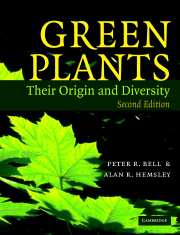
Green Plants
The central theme of Green Plants, first published in 2000, is the astonishing diversity of forms found in the plant kingdom, from the simplicity of prokaryotic algae to the myriad complexities of flowering plants. The book is arranged according to generally accepted classification schemes, beginning with algae (prokaryotic and eukaryotic) and moving through mosses, liverworts, fern allies, ferns and gymnosperms to flowering plants. Copiously illustrated throughout, it provides a concise account of all algae and land plants, with information on topics from cellular structure to life cycles and reproduction. The authors maintain a refreshingly cautious approach in discussions of possible phylogenetic relationships and include newly emerging information on features of plants known only as fossils. This edition has been completely updated to reflect current views on the origin of the major groups of plants, providing a resource for students of botany, and for researchers needing a comprehensive reference to the plant kingdom.
eBook

Consequences of interplant trait variation for canopy light absorption and photosynthesis
Plant-to-plant variation (interplant variation) may play an important role in determining individual plant and whole canopy performance, where interplant variation in architecture and photosynthesis traits has direct effects on light absorption and photosynthesis. We aimed to quantify the importance of observed interplant variation on both whole-plant and canopy light absorption and photosynthesis. Plant architecture was measured in two experiments with fruiting tomato crops ( Solanum lycopersicum ) grown in glasshouses in the Netherlands, in week 16 (Exp. 1) or week 19 (Exp. 2) after transplanting. Experiment 1 included four cultivars grown under three supplementary lighting treatments, and Experiment 2 included two different row orientations. Measured interplant variations of the architectural traits, namely, internode length, leaf area, petiole angle, and leaflet angle, as well as literature data on the interplant variation of the photosynthesis traits alpha, J max28 , and V cmax28 , were incorporated in a static functional–structural plant model (FSPM). The FSPM was used to analyze light absorption and net photosynthesis of whole plants in response to interplant variation in architectural and photosynthesis traits. Depending on the trait, introducing interplant variation in architecture and photosynthesis traits in a functional–structural plant model did not affect or negatively affected canopy light absorption and net photosynthesis compared with the reference model without interplant variation. Introducing interplant variation of architectural and photosynthesis traits in FSPM results in a more realistic simulation of variation of plants within a canopy. Furthermore, it can improve the accuracy of simulation of canopy light interception and photosynthesis although these effects at the canopy level are relatively small ( < 4% for light absorption and<7% for net photosynthesis).
Journal Article
Extreme intraplant variation in nectar sugar composition in an insect-pollinated perennial herb
Variation in nectar chemistry among plants, flowers, or individual nectaries of a given species has been only rarely explored, yet it is an essential aspect to our understanding of how pollinator-mediated selection might act on nectar traits. This paper describes variation in nectar sugar composition in a population of the perennial herb Helleborus foetidus (Ranunculaceae) and dissects it into components due to variation among plants, flowers of the same plant, and nectaries of the same flower. The proportions of sucrose, glucose, and fructose in single-nectary nectar samples collected at two times in the flowering season were determined using high performance liquid chromatography (HPLC). Sugar composition varied extensively among nectaries, and nearly all combinations of individual sugars were recorded. Population-wide variance was mainly accounted for by variation among flowers of the same plant (56% of total), nectaries of the same flower (30%), and only minimally by differences among plants (14%). In absolute terms, intraplant variation was similar to or greater than that ordinarily reported in interspecific comparisons. Results suggest that the prevailing notion of intraspecific constancy in nectar sugar composition may be unwarranted for some species and that more elaborate nectar sampling designs are required to detect and appropriately account for extensive within-plant variance. Within-plant variation in nectar sugar composition will limit the ability of pollinators to exert selection on nectar chemistry in H. foetidus and may be advantageous to plants by reducing the number of flowers visited per foraging bout by variance-sensitive, risk-averse pollinators.
Journal Article
The effect of phenological variation in sex expression on female reproductive success in Saxifraga granulata
PREMISE OF THE STUDY: Differences in timing of flowering within and among protandrous plants shift the floral sex ratio from male to female dominance during the flowering season. Hence, the number of seeds produced by a single flower depends on traits of the flower itself (e.g., allocation to male and female function, position within an inflorescence, and flower size), as well as plant traits (e.g., timing of flowering, number of flowers, and plant height). Although it is clear that characteristics of individual flowers and whole plants can affect the number of seeds produced per flower, their relative importance for plant fitness remains largely unknown. METHODS: We examined how phenological sex expression affected seed number per flower in two populations of the protandrous grassland herb Saxífraga granulata. Seed number was assessed for >1200 flowers and related to their position within an inflorescence, male and female phase duration, timing of flowering, number of flowers per plant, and plant height. KEY RESULTS: Seed number within and among plants decreased significantly over time. Early lateral flowers were larger and produced more seeds in comparison to late lateral flowers, indicating that flower position significantly affected seed number through its combined effect on sex allocation, timing of flowering, and attractiveness. CONCLUSIONS: Our results showed that female reproductive success of a single flower was best explained by its position within an inflorescence and that plant traits such as first flowering date and number of flowers per plant had a smaller impact on seed number per flower.
Journal Article