
Catalogue Search | MBRL


Are you sure you want to remove the book from the shelf?

{{itemTitle}}
209
result(s) for
"Plaskow, Judith"
Sort by:
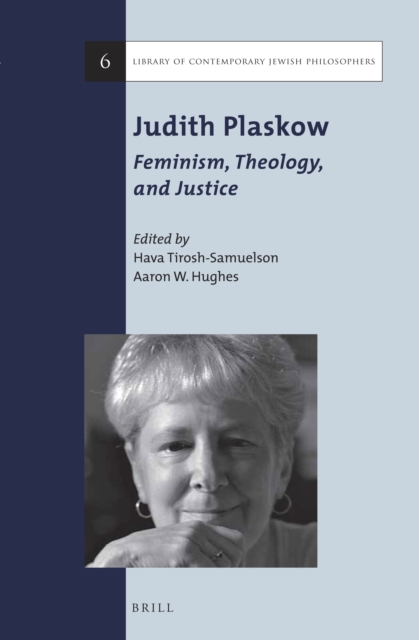
Judith Plaskow : feminism, theology, and justice
Judith Plaskow, Professor of Religious Studies Emerita at Manhattan College, is a leading Jewish feminist theologian. Plaskow's feminist reading of traditional sources is a critical reading of Judaism that calls Jews to end oppression, exclusion, and marginalization of individuals and groups.
eBook

On Making the Silence Loud
Townes been a member of the American Academy of Religion (AAR) since 1984. The words she began her presentation with are the opening words of Judith Plaskow's 1998 presidential address. She was sitting next to Katie Cannon, who, just moments before Judith began her address, said to her that this is historic. As she listened to Judith's opening words to an Academy that seemed to her to be mired in minutia and esoterica as the only truly scholarly activities that should go on in their sessions, her words hit her like a lightning bolt. Her talk was deeply grounded in the events of their times through the lens of women and religion and a call to all the membership to take what they do much more seriously as work that has, or should have, concrete effects on the worlds around them and the worlds within them selves.
Journal Article
Envisioning a New Sinai
Most people make one meaningful contribution to their field, although their one contribution may be small. Standing Again at Sinai is a monumental achievement, and there is no feminist work in religion that does not owe something to Judith Plaskow's foundational scholarship. It is a field-shaping book, and alongside a handful of other works created a whole new set of questions. While Jewish feminist thought is central to all of Judith's endeavors, she has not just written the quintessential manifesto on the feminist transformation of Judaism. Judith's contributions on a variety of topics have been invaluable to the field. Her work on Christian anti-Judaism, for example, is a vital resource for analyzing how supersessionism shapes Christian feminist spaces. In these articles Judith confronts scholars who argue that early Christianity is feminist by contrasting it with a negative portrayal of Judaism. Judith asks to consider what it means to build their liberation on the backs of others.
Journal Article
Special Panel Honoring Judith Plaskow: Introductory Remarks
A special panel honoring Dr. Judith Plaskow's induction into the National Women's Hall of Fame was held at the annual meeting of the American Academy of Religion (AAR) on Nov 24, 2024. Dr. Plaskow was the first scholar of religion to be inducted into this prestigious society. The induction ceremony took place in Mar 024 in New York, and Park had the privilege of attending the ceremony as the president of the American Academy of Religion, alongside two other AAR members, Drs. Rita Brock and Su Yon Pak. The panel began with a video segment from the induction ceremony, in which Brock introduces Judith Plaskow succinctly and \"humorously,\" followed by a brief talk from Plaskow herself. After the video, five scholars familiar with Plaskow's work gave presentations, and Plaskow responded to each of them. The five panelists include Emilie M. Townes, Max Strassfeld and Michal Raucher.
Journal Article
Shaping a Field, Creating a Home through the Journal of Feminist Studies in Religion
Raucher is not sure whether Judith Plaskow and Elisabeth Schüssler Fiorenza imagined what Feminist Studies in Religion (FSR) or JFSR would become when they wrote that first editors' introduction, but they thought of the journal as just one piece of a broader movement. This movement included the establishment of a Women and Religion Working Group at the American Academy of Religion (AAR) in 1971, and the rise of feminist religious experimentation around the world. Additionally, they hoped that the journal would change, adapt, and evolve with the movement. Although they were creating a permanent home for feminist studies in religion, Judith and Elisabeth built movable walls and open doors so that the journal would be a home where all could find a room.
Journal Article
GLOBAL RACISM AND INTERNATIONAL PUBLISHING
The Journal of Feminist Studies in Religion was founded in 1985, at a time when feminist and womanist religious scholarship gathered momentum globally. Asian feminist theology began in the late 1970s and the journal In God's Image launched in 1982. The Womanist Approach to Religion and Society group at the American Academy of Religion (AAR) was formed in 1985. The AAR's Native Traditions in the Americas group was formed in 1987. In Africa and Latin America, feminist religious networks also began. Here, Pui-lan reflects on the challenges of global racism in knowledge production and publishing and why it is difficult to publish more articles by female scholars from the global South.
Journal Article
EMBRACING CONFLICT
West argues that to address the proliferation of white supremacist habits in the \"white space\" of Feminist Studies in Religion (FSR) through a genuinely transformative process, we need more conflict. We ought to intensify conflicts that also bring discomfort to the familiar patterns of white entitlement and supremacist logics embedded in our existing academic practices. We need conflicts that fuel more disruption of our tolerance for the continual reiteration of those familiar, lived patterns. A feminist and womanist gender justice approach to antiracism in religious studies intentionally promotes rupturing conflict with traditions of repression and our communal investments in them. Therefore, it ought not be surprising that deeply uncomfortable conflict arises if we, racially, ethnically, nationally, and religiously diverse gender justice scholars of religion, choose to seriously engage issues of white supremacy. Proceeding with this engagement should be understood as a deliberate commitment to immerse ourselves in tense, high-stakes struggle with one another. But many are unprepared for it or do not share this assumption. Perhaps this is partly because we disagree on the extent to which the presence of racially and ethnically diverse perspectives constitutes a primary goal of antiracism.
Journal Article
Monumental Support: Judith Plaskow as Mentor, Bridge, and Lighthouse for Feminist Theologians
Judith Plaskow deserves to be in the Women's Hall of Fame, alongside Serena Williams and Kimberlé Crenshaw and all the inspiring women who are represented there. She has never surrendered any part of her identity, and she has not stopped pushing, standing up, challenging to do the same in the name of what matters: liberation. She continues to hold out hope that religion will make space for women's voices, or that women's voices will be heard, one way or another in revolutionary ways, beyond, as Sandra Schneiders wrote, mere patching. But what Imperatori-Lee learned after the induction ceremony that they all watched a bit of earlier, is that Judith also wants theological voices, the voices of feminists who wrestle with religion, to be heard in secular feminist spaces. And that is work that lies ahead for many. She's heartened that Judith's work, like a lighthouse beacon, calls into the breach, warns of the craggy, unwelcoming shores, and pulls forth anyway.
Journal Article