
Catalogue Search | MBRL


Are you sure you want to remove the book from the shelf?

{{itemTitle}}
190
result(s) for
"Platonists."
Sort by:

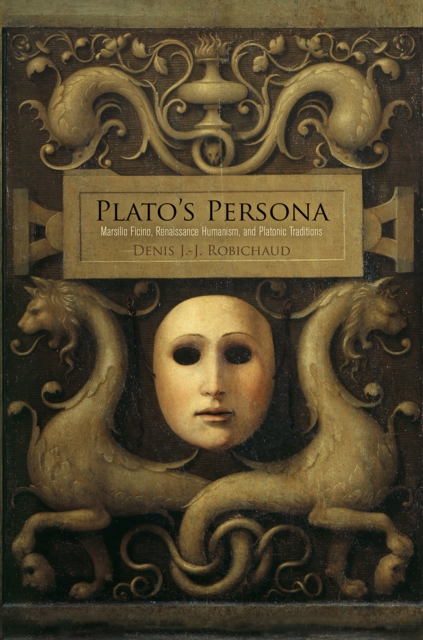
Plato's Persona
In 1484, humanist philosopher and theologian Marsilio Ficino
published the first complete Latin translation of Plato's extant
works. Students of Plato now had access to the entire range of the
dialogues, which revealed to Renaissance audiences the rich ancient
landscape of myths, allegories, philosophical arguments,
etymologies, fragments of poetry, other works of philosophy,
aspects of ancient pagan religious practices, concepts of
mathematics and natural philosophy, and the dialogic nature of the
Platonic corpus's interlocutors. By and large, Renaissance readers
in the Latin West encountered Plato's text through Ficino's
translations and interpretation.
In Plato's Persona , Denis J.-J. Robichaud provides the
first synthetic study of Ficino's interpretation of the Platonic
corpus. Robichaud analyzes Plato's works in their original Greek
and in Ficino's Latin translations, as well as Ficino's
non-Platonic writings and correspondence, in the process uncovering
new aspects of Ficino's intellectual work habits. In his letters
and works, Ficino self-consciously imitated a Platonic style of
prose, in effect devising a persona for himself as a Platonic
philosopher. Plato's dialogues are populated with a wealth of
literary characters with whom Plato interacts and against whom
Plato refines his own philosophies. Reading through Ficino's
translations, Robichaud finds that the Renaissance philosopher
seeks an understanding of Plato's persona(e) among all the
dialogues' interlocutors. In effect, Ficino assumed the role of
Plato's Latin spokesperson in the Renaissance.
Plato's Persona is grounded in an extensive study of
scholarship in Renaissance humanism, classics, philosophy, and
intellectual history, and contextualizes Ficino's intellectual
achievements within the contemporary Christian orthodox view of
Platonism. Ficino was an influential figure in the early Italian
Renaissance: the key intermediary between Greek and Latin, and
between manuscript and print, giving voice to Plato and access to
the ancient frameworks needed to interpret his dialogues.
eBook

Plato as critical theorist
Is there any point in thinking about the best possible society? Over the last decade or so, a number of political philosophers have argued that such \"ideal theory\" is a dangerous distraction from the concrete power struggles that make up \"real politics.\" Jonny Thakkar takes a different view, arguing that each and every one of us has a duty to engage in ideal theory. To make that case he turns to Plato's Republic, which depicts an ideal society within which ideal theory itself plays a vital role, thanks to the institution of philosopher-kings. The first half of the book offers a careful but creative reading of the notion of rule by philosophers. The second half of the book argues that in today's liberal democracies what we need is not philosopher-kings but philosopher-citizens--citizens who reflect, both individually and together, on how they could work together to produce an environment conducive to flourishing. Plato as Critical Theorist argues that the notion of philosopher-citizens is not only compatible with Rawlsian political liberalism, but an advance on it.-- Provided by publisher
Book

Women and the Female in Neoplatonism
This book explores the various ways, ranging over psychology, political philosophy and metaphysics, that both historical women and various conceptualizations of the female help shape Neoplatonism, one of the most influential philosophical schools of late antiquity, at various levels.
eBook

Name-Glorification, Hesychasm, and Palamism in Alexei Losev’s “Onomatodoxy” and “Essays on Ancient Symbolism and Mythology”
This article considers how early Alexei Losev dealt with the concepts of hesychasm, Palamism, and Name-Glorification. It reveals a range of important sources that Losev employed in his essay “Onomatodoxy” while developing his formulas of hesychasm and Name-Glorification, elaborating on the concept of absolute symbolism and touching on his teaching about universals. These sources include “Synodikon of Orthodoxy,” “Philokalia,” and Pavel Florensky’s essay “Onomathodoxy as a Philosophical Premise.” Although Losev follows the main framework of Florensky’s project in his “Onomatodoxy” (1921–1922)—treating Palamism and Name-Glorification as derivatives of Platonism and comprehending the nature of applying the notion “God” to the divine essence and energies—he differs from Florensky in his interpretation of the structure of symbol. In Losev’s later work, “Essays on Ancient Symbolism and Mythology” (1930), he exchanges his understanding of the correlation between Palamism and Name-Glorification with Platonism, which directly correlates with Losev’s changed attitude toward Florensky. However, in the “Essays,” the specific interpretation of the application of the notion “God” to the essence and energies, dating back to Florensky, is preserved.
Journal Article

Speaking Truth to ‘Platonism’? Some Thoughts on Alcibiades and Erôs
This article reads Alcibiades’ speech in Plato’s Symposium in terms of the later Foucault’s examination of ‘parrhēsia’, or ‘frank spokenness’. It contends that, in part, Alcibiades’ stress on the sheer particularity and individuality of erotic attraction—in his case, attraction to Socrates himself—acts as a kind of rejoinder to the ‘impersonal’ aspect of erôs highlighted in the famous speech of Socrates/Diotima.
Journal Article

Samuel Taylor Coleridge (1772–1834) and Nature’s Divine Participation: Reverence for the One and the Many in the Scientific and Poetic Imagination
This paper considers the influence of Platonism and Neoplatonism on the British Romantic poet and theologian Samuel Taylor Coleridge (1772–1834) and how they informed his reverence for nature. Coleridge did not see this reverence as merely personal but sought to call an increasingly materialist and industrializing England back to a Platonic social imagination that would better revere the created world. First, I will establish the influence of Platonic and Neoplatonic thought on his philosophical system. Second, I will show how the relationship between Platonic philosophy and scientific pursuit is worked out in Coleridge’s “Essays on Method”, wherein he attempts to synthesize Plato with Frances Bacon and poetry with science and proposes a scientific method that reverences all of creation in its individuality and participation within a spiritual whole. Third, I will briefly explore two of Coleridge’s most famous poems, The Rime of the Ancient Mariner and Christabel, as both show the destructive potential of a lack of reverence for the mysterious natural order. These poems may be read as case studies, experimental worlds where refusal to recognize nature’s order and participation with the divine results in the coming apart of those worlds and the self’s relation to them.
Journal Article

Platonism : Ficino to Foucault
Platonism, Ficino to Foucault explores some key chapters in the history Platonic philosophy from the revival of Plato in the fifteenth century to the new reading of Platonic dialogues promoted by the so-called 'Critique of Modernity'.
eBook
Goethe’s Platonic Natural Philosophy: How Goethean Science Provides an Alternative Conception of the Cosmos
While popularly known for his works of literature and poetry, Johann Wolfgang von Goethe viewed his lesser-known scientific pieces as his most enduring achievement. I will argue that Goethe’s unique scientific methodology is informed by a metaphysical commitment to a form of Platonism and that Goethe provides an intriguing alternative paradigm that unifies science, philosophy, theology, and ethics. I begin by demonstrating how Goethe’s concept of the Urphänomen offers a Platonic conception of natural beings. I then briefly outline how this alternative scientific approach ultimately derives from his Platonic commitments. Next, I demonstrate the ethical and spiritual implications of Goethean science, establishing that Goethe’s approach bridges the divide between our scientific endeavors and spiritual formation. There is, then, a continued relevance for Goethe in conversations regarding ecological ethics and our perception of nature.
Journal Article

Idols that Have Mouths but Do Not Speak: Levinas's Critique of Art between Platonism and Jewish Aniconism
In Levinas’s production, the text most openly discussing the value of art is certainly “Reality and its Shadow”, published for the first time in 1948 in the journal Les Temps Modernes, directed by Jean-Paul Sartre. At the time of its publication, the article and its author received harsh criticism due to the allegedly simplistic and anachronistic nature of the accusations addressed against art. As Richard A. Cohen explains, this judgement is also shared by several contemporary scholars,1 who describe Levinas’s critique of art “as both narrow-minded and denunciatory, both false and hostile” (152). In this essay, Levinas openly complains about the hypertrophy that aesthetics had acquired in the post-war French cultural background. More generally, he blames Western thought, especially in its Heideggerian tendencies, for seeing art as the place for the eminent manifestation of truth. In recent times, he states, art has ended up assuming the status of “metaphysical intuition” par excellence (“Reality and its Shadow” 1), and artists have been acknowledged as eminent mediums for the knowledge of the absolute. In other words, Western thought gave the work of art a sort of ontological priority concerning Being itself. In this way, it became “more real than reality”: in contemporary Western thought, Levinas observes, surrealism is not something alternative to realism but a form that represents its superlative degree. These considerations are brought forward through a comparison between the Western experience and that of the Jewish spiritual world, which proclaims the prohibition of representation. As several scholars point out, however, Levinas does not start his analysis by immediately contrasting between Jerusalem and Athens. Rather, he believes that, at the beginning of their philosophical development, they express an original agreement on the subject of art. In particular, authoritative scholars as Aaron Rosen (371) and Jacques Rolland describe Levinas’s judgment on art and aesthetics as remarkably similar to the critique expressed by Plato, the eminent founder of Western thought. In this respect, Jacques Rolland even says that Levinas’s Platonism is very “strict, if not intransigent” (233). The fundamental contention of this paper is that this concordance is merely apparent or at least partial. Levinas indeed finds useful arguments for his refusal of art in Plato but considers this Platonic criticism completely insufficient. Even more paradoxically, he judges Platonism and the seeds that it sowed in the Western philosophical tradition as responsible for the hyper-valuation that art has gained among his contemporaries.
Journal Article