
Catalogue Search | MBRL


Are you sure you want to remove the book from the shelf?

{{itemTitle}}
98
result(s) for
"Pockets History."
Sort by:

Pockets : an intimate history of how we keep things close
\"A social and design history of the sewn-in pocket, from the mid-1500s up to today, that uncovers what pockets reveal about us, our place in society, and how we move through the world\"-- Provided by publisher.
Book

Growing Up the Hard Way
A POCKET HISTORY OF SEX IN THE TWENTIETH CENTURY By Jane Vandenburgh Counterpoint. 374 pp. $25This memoir is basically two different books. The aunt in particular, so strict and respectable, forever whiling away her time by embroidering priestly vestments, is cordially loathed by some of her children and assiduously avoided by her husband.
Newspaper Article


A Woman's Life So Far: Kissing and Telling Without Blush or Reservation
[...] Jane Vandenburgh obviously thinks the answer is yes, and in her new memoir, \"A Pocket History of Sex in the Twentieth Century,\" she goes on a jagged little tear on the topic. Ms. Vandenburgh's beautiful, wild and self-destructive parents came from wealthy old families, and their little beach house in Redondo, Calif., is \"full of big, heavy, old-fashioned furniture that our parents inherited from Various Dead Rich Relatives Who Never Gave a Damn About Us When They Were Alive.\"
Newspaper Article

Scenes From a Family
Alison Bechdel reviews the memoir told in graphic novel form \"A Pocket History of Sex in the Twentieth Century: A Memoir\" by Jane Vandenburgh.
Book Review

COMPARISON FRICTION: EXPERIMENTAL EVIDENCE FROM MEDICARE DRUG PLANS
Consumers need information to compare alternatives for markets to function efficiently. Recognizing this, public policies often pair competition with easy access to comparative information. The implicit assumption is that comparison friction—the wedge between the availability of comparative information and consumers' use of it—is inconsequential because when information is readily available, consumers will access this information and make effective choices. We examine the extent of comparison friction in the market for Medicare Part D prescription drug plans in the United States. In a randomized field experiment, an intervention group received a letter with personalized cost information. That information was readily available for free and widely advertised. However, this additional step—providing the information rather than having consumers actively access it—had an impact. Plan switching was 28% in the intervention group, versus 17% in the comparison group, and the intervention caused an average decline in predicted consumer cost of about $100 a year among letter recipients—roughly 5% of the cost in the comparison group. Our results suggest that comparison friction can be large even when the cost of acquiring information is small and may be relevant for a wide range of public policies that incorporate consumer choice.
Journal Article

Animal origin of 13th-century uterine vellum revealed using noninvasive peptide fingerprinting
Tissue-thin parchment made it possible to produce the first pocket Bibles: Thousands were made in the 13th century. The source of this parchment, often called “uterine vellum,” has been a long-standing controversy in codicology. Use of the Latin termabortivumin many sources has led some scholars to suggest that the skin of fetal calves or sheep was used. Others have argued that it would not be possible to sustain herds if so many pocket Bibles were produced from fetal skins, arguing instead for unexpected alternatives, such as rabbit. Here, we report a simple and objective technique using standard conservation treatments to identify the animal origin of parchment. The noninvasive method is a variant on zooarchaeology by mass spectrometry (ZooMS) peptide mass fingerprinting but extracts protein from the parchment surface by using an electrostatic charge generated by gentle rubbing of a PVC eraser on the membrane surface. Using this method, we analyzed 72 pocket Bibles originating in France, England, and Italy and 293 additional parchment samples that bracket this period. We found no evidence for the use of unexpected animals; however, we did identify the use of more than one mammal species in a single manuscript, consistent with the local availability of hides. These results suggest that ultrafine vellum does not necessarily derive from the use of abortive or newborn animals with ultrathin hides, but could equally well reflect a production process that allowed the skins of maturing animals of several species to be rendered into vellum of equal quality and fineness.
Journal Article

Oral hygiene status, gingival status, periodontal status, and treatment needs among pregnant and nonpregnant women: A comparative study
Objectives: The gingival and periodontal changes during pregnancy are well known. Gingivitis is the most prevalent oral manifestations associated with pregnancy. The hormonal and vascular changes that accompany pregnancy are known to exaggerate the inflammatory response to the local irritants. Hence, a study was designed to assess oral hygiene status, gingival status, periodontal status, and treatment needs (TNs) among pregnant and nonpregnant women. Materials and Methods: A cross-sectional study was conducted among 120 pregnant and 120 nonpregnant women of 18-44 years age attending the Outpatient Department of Gynaecology and Obstetrics in Government Hospital of Belgaum city, Karnataka, India. The study consisted of an interview and oral examination. Type 3 examination was followed. Simplified Oral Hygiene Index (OHI-S), Gingival Index, and Community Periodontal Index and TNs Index were used to assess \"oral hygiene status,\" \"gingival status,\" and \"periodontal status and TNs,\" respectively. Results: The pregnant women showed poor oral hygiene with the mean OHI-S score as 2.68. Gingivitis was prevalent in almost all the pregnant and nonpregnant women. However, it was found more severe in pregnant women with mean gingival score as 1.25. A definite increase in gingivitis was found from Trimester II to Trimester III. The mean number of sextants showing healthy gingiva was significantly (P < 0.01) lower among pregnant women. Conclusions: Pregnant women showed poor oral hygiene, more gingival inflammation, and more periodontal disease as compared to nonpregnant women. The severity of gingivitis increased in Trimester III. Proper oral hygiene practice can prevent these diseases and further complications.
Journal Article
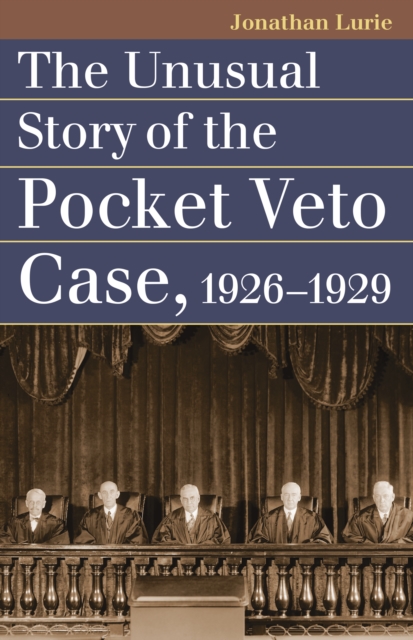
The Unusual Story of the Pocket Veto Case, 1926-1929
According to the US Constitution, if a bill is not returned to
Congress by the president within ten days of receiving it and
Congress has adjourned, the bill is effectively vetoed. The
so-called pocket veto dates at least as far back as the presidency
of James Madison (1808â€\"1816), but the constitutionality of its
use had not been considered by the Supreme Court until Okanogan
et al. v. United States was decided in 1929, during the last
year of Chief Justice Taft's tenure. Despite responding to a
situation in American Indian law, the Pocket Veto Case is notable
for the fact that its final decision had nothing whatsoever to do
with Indian law. The Okanogan Tribe is barely mentioned at all in
the Court's unanimous opinion, delivered by Justice Edward Sanford,
which ultimately concluded that the pocket veto is a constitutional
exercise of presidential authority. The Unusual Story of the
Pocket Veto Case explores the underlying tension between
congressional authority and the executive prerogative. Especially
today, with such tension very much in evidence, it becomes all the
more important to understand how and why the Constitution actually
appears to encourage it. Studying Okanogan et al. v. United
States and use of the pocket veto provides an excellent
example of the tension between Congress and the president.
eBook

Preferences for public health insurance coverage of new anticancer drugs: a discrete choice experiment among non-small cell lung cancer patients in China
Background
Ensuring equal access to affordable, high-quality, and satisfied healthcare for cancer patients is a challenge worldwide. Our study aimed to investigate preferences for public health insurance coverage of new anticancer drugs among non-small cell lung cancer (NSCLC) patients in China.
Methods
We identified six attributes of new anticancer drugs and adopted a Bayesian-efficient design to generate choice scenarios for a discrete choice experiment (DCE). The one-on-one, face-to-face DCE was conducted in four cities in Jiangsu Province. The mixed logit regression model was used to estimate patient-reported preferences for each attribute. The interaction model was used to investigate preference heterogeneity.
Results
Data from 486 patients were available for analysis. The most valuable attribute was the out-of-pocket cost if reimbursed (RI = 32.25%), followed by extension of overall survival (RI = 15.99%), and low incidence of serious side effects (RI = 14.45%). Patients had the highest willingness to pay for the comparative 9-month’ extension of overall survival. Patients with advanced NSCLC were more likely to expect new anticancer drugs could improve HRQoL (
p
< 0.01) and require fewer out-of-pocket costs (
p
< 0.01). Older patients and patients with low income cared more about the out-of-pocket costs (
p
< 0.001).
Conclusion
Health insurance policymakers need to consider the affordability, comparative survival benefits, comparative safety, and comparative patient-reported outcomes of new anticancer drugs. The findings also highlight the need to ensure affordability for older patients, low-income patients, and patients with advanced cancer.
Journal Article