
Catalogue Search | MBRL


Are you sure you want to remove the book from the shelf?

{{itemTitle}}
103
result(s) for
"Poetry Explication."
Sort by:


Reading the Difficulties
The bold essays that make up
Reading the Difficulties offer case studies in and
strategies for reading innovative poetry. Definitions of what
constitutes innovative poetry are innumerable and are offered
from every quarter. Some critics and poets argue that innovative
poetry concerns free association (John Ashbery), others that
experimental poetry is a “re-staging” of language
(Bruce Andrews) or a syntactic and cognitive break with the past
(Ron Silliman and Lyn Hejinian). The tenets of new poetry abound.
But what of the new reading that such poetry demands? Essays in
Reading the Difficulties ask what kinds of stances allow
readers to interact with verse that deliberately removes many of
the comfortable cues to comprehension—poetry that is
frequently nonnarrative, nonrepresentational, and indeterminate
in subject, theme, or message. Some essays in Thomas Fink and
Judith Halden-Sullivan’s collection address issues of
reader reception and the way specific stances toward reading
support or complement the aesthetic of each poet. Others suggest
how we can be open readers, how innovative poetic texts change
the very nature of reader and reading, and how critical language
can capture this metamorphosis. Some contributors consider how
the reader changes innovative poetry, what language reveals about
this interaction, which new reading strategies unfold for the
audiences of innovative verse, and what questions readers should
ask of innovative verse and of events and experiences that we
might bring to reading it. CONTRIBUTORS Charles Bernstein /
Carrie Conners / Thomas Fink / Kristen Gallagher / Judith
Halden-Sullivan / Paolo Javier / Burt Kimmelman / Hank Lazer /
Jessica Lewis Luck / Stephen Paul Miller / Sheila E. Murphy /
Elizabeth Robinson / Christopher Schmidt / Eileen R.
Tabios
eBook

Reading modernist poetry
This essential guide to modernist poetry enables readers to make sense of a literary movement often regarded as difficult and intimidating. Provides close examinations of key poems by T. S. Eliot, Ezra Pound, W. B. Yeats, and others Considers key techniques employed to orient and disorient the reader, such as diction, rhythm, and allusion Explores the ideological implications of subject matter and the literary forms and structures of modernist poetry Places modernist poetry in relation to its Victorian and Romantic predecessors Encourages readers to engage with the texts and make their own interpretations, moving away from the question of what the poem says in favour of considering the effect of the poem on its reader.
eBook

The Poetry Handbook
The Poetry Handbook is a lucid and entertaining guide to the poet's craft, and an invaluable introduction to practical criticism for students. Chapters on each element of poetry offer a wide-ranging general account and end by looking at different poems, to build up sustained analytical readings. The second edition - fully revised, expanded,.
eBook

Don't read poetry : a book about how to read poems
\"In Don't Read Poetry, award-winning poet and literary critic Stephanie Burt offers an accessible introduction to the seemingly daunting task of reading, understanding, and appreciating poetry. Burt dispels preconceptions about poetry and explains how poems speak to one another--and how they can speak to our lives. She shows readers how to find more poems once they have some poems they like, and how to connect the poetry of the past to the poetry of the present. Burt moves seamlessly from Shakespeare and other classics to the contemporary poetry circulated on Tumblr and Twitter. She challenges the assumptions that many of us make about \"poetry,\" whether we think we like it or think we don't, in order to help us cherish--and distinguish among--individual poems. A masterful guide to a sometimes confounding genre, Don't Read Poetry will instruct and delight ingénues and cognoscenti alike\"-- Provided by publisher.
Book
Reading visual poetry
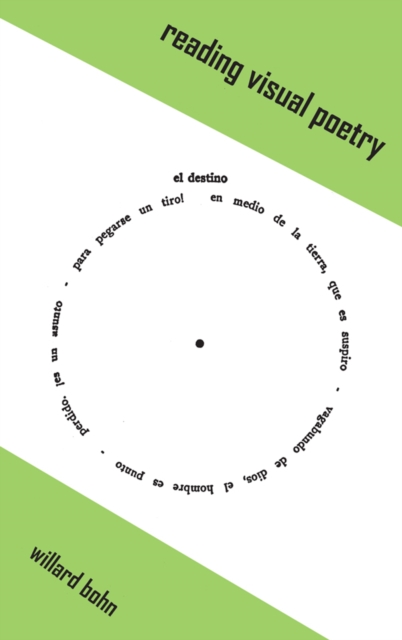
Visual poetry can be defined as poetry that is meant to be seen. Combining painting and poetry, it attempts to synthesize the principles underlying each discipline. Visual poems are immediately recognizable by their refusal to adhere to a rectilinear grid and by their tendency to flout their plasticity. In contrast to traditional poetry, they are conceived not only as literary works but also as works of art. Although they continue to provide visual cues that aid in deciphering the text, they function simultaneously as visual compositions. Whether the visual elements form a rudimentary pattern or whether they constitute a highly sophisticated design, they transform the poem into a picture. Reading Visual Poetry examines works created in Spain, Latin America, France, Italy, Brazil, and the United States. While it attempts to recreate the historical and cultural context surrounding each of the works in question, it is conceived primarily as a series of readings-or rather as a series of readings about reading. This book seeks to interpret a number of poems, which, despite their apparent simplicity, can be difficult to decipher. It explores the process of interpretation itself, which, like the compositions, can be surprisingly complex.
eBook

The lyric in the age of the brain
\"Exploration of our inner life--perception, thought, memory, feeling--once seemed a privileged domain of lyric poetry. Scientific discoveries, however, have recently supplied physiological explanations for what was once believed to be transcendental; the past sixty years have brought wide recognition that the euphoria of love is both a felt condition and a chemical phenomenon, that memories are both representations of lived experience and dynamic networks of activation in the brain. Caught between a powerful but reductive scientific view of the mind and traditional literary metaphors for consciousness that have come to seem ever more naive, American poets since World War II have struggled to articulate a vision of human consciousness that is both scientifically informed and poetically truthful. The Lyric in the Age of the Brain examines several contemporary poets--Robert Lowell, A. R. Ammons, Robert Creeley, James Merrill, John Ashbery, Jorie Graham, and experimentalists such as Harryette Mullen and Tan Lin--to discern what new language, poetic forms, and depictions of selfhood this perplexity forces into being. Nikki Skillman shows that under the sway of physiological conceptions of mind, poets ascribe ever less agency to the self, ever less transformative potential to the imagination. But in readings that unravel factional oppositions in contemporary American poetry, Skillman argues that the lyric--a genre accustomed to revealing expansive aesthetic possibilities within narrow formal limits--proves uniquely positioned to register and redeem the dispersals of human mystery that loom in the age of the brain.\"--Provided by publisher.
Book

Reading postwar British and Irish poetry
Combining detailed explorations of both mainstream and experimental poets with a clear historical and literary overview, Reading Postwar British and Irish Poetry offers readers at all levels an ideal guide to the rich body of poetic works published in Britain and Ireland over the last half-century.
* Features detailed discussions of individual poems that are widely available in anthologies and selected poems volumes
* Pays explicit attention to how to read the poems, focusing on language and form and the institutional conditions of literary possibility in which poets worked
* Includes poets of all types and styles from throughout the post-war period, including canonical and mainstream poets alongside experimental poets, women, and poets of color
eBook