
Catalogue Search | MBRL


Are you sure you want to remove the book from the shelf?

{{itemTitle}}
908
result(s) for
"Poetry Psychological aspects."
Sort by:

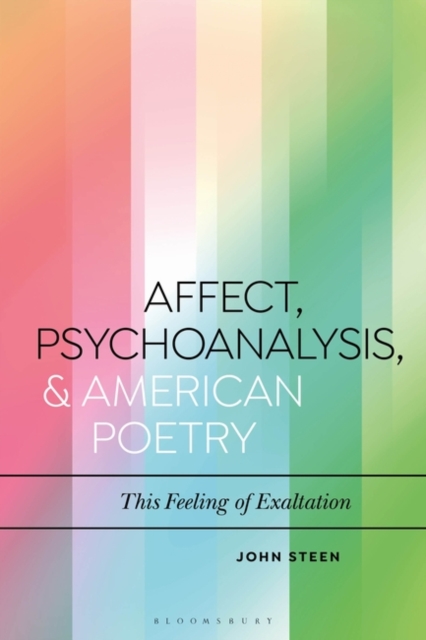
Affect, Psychoanalysis, and American Poetry
Poetry has often been defined by its closure, its condensation of meaning and value into discrete, self-referential textual objects. Affect, Psychoanalysis and American Poetry challenges the dominant metaphor of poetic containers by turning to recent poetic texts that represent the contagious and uncontainable feelings of anxiety, grief, shame, and rage. From modernists Wallace Stevens to mid-century poets Randall Jarrell, Robert Creeley and Ted Berrigan, and finally to contemporary practitioners Aaron Kunin and Claudia Rankine, John Steen argues that new poetic techniques arise from the poetic productivity of negative affects, and that a new model of poetic value can be found in poems that are–instead of containers–permeable, social spaces of intimacy, attachment, and withdrawal. Drawing from object relations, psychoanalysis, queer theory, and affect theory, Affect, Psychoanalysis, and American Poetry finds poetry’s singularity in its unique capacity to represent anew the transmissible, relational, and uncontainable valences of feeling that structure and destabilize social life.
eBook


American Scream
Written as a cultural weapon and a call to arms,Howltouched a raw nerve in Cold War America and has been controversial from the day it was first read aloud nearly fifty years ago. This first full critical and historical study ofHowlbrilliantly elucidates the nexus of politics and literature in which it was written and gives striking new portraits of Allen Ginsberg, Jack Kerouac, and William Burroughs. Drawing from newly released psychiatric reports on Ginsberg, from interviews with his psychiatrist, Dr. Philip Hicks, and from the poet's journals,American Screamshows howHowlbrought Ginsberg and the world out of the closet of a repressive society. It also gives the first full accounting of the literary figures-Eliot, Rimbaud, and Whitman-who influencedHowl,definitively placing it in the tradition of twentieth-century American poetry for the first time. As he follows the genesis and the evolution ofHowl,Jonah Raskin constructs a vivid picture of a poet and an era. He illuminates the development of Beat poetry in New York and San Francisco in the 1950s--focusing on historic occasions such as the first reading ofHowlat Six Gallery in San Francisco in 1955 and the obscenity trial over the poem's publication. He looks closely at Ginsberg's life, including his relationships with his parents, friends, and mentors, while he was writing the poem and uses this material to illuminate the themes of madness, nakedness, and secrecy that pervadeHowl.A captivating look at the cultural climate of the Cold War and at a great American poet,American Screamfinally tells the full story ofHowl-a rousing manifesto for a generation and a classic of twentieth-century literature.
eBook

Dickinson's nerves, Frost's woods : poetry in the shadow of the past
William Logan reconciles history and poetry to provide new ways of reading poets ranging from Shakespeare and Shelley to Lowell and Heaney. In these striking essays, Logan presents the poetry of the past through the lens of the past, attempting to bring poems back to the world in which they were made.
Book

The Motive For Metaphor
This book is a small anthology: each chapter a kind of meditation-on poetry and psychoanalysis; on a poem, sometimes two; on poetry in general; on thought itself. The poems are beautiful, some are contemporary, some are classical and well worth a reader's attention. \"The motive for metaphor\" is the title of a short poem of Wallace Stevens in which he says he is \"happy\" with the subtleties of experience. He likes what he calls the \"half colours of quarter things,\" as opposed to the certainties, the hard primary \"reds\" and \"blues.\" To grasp and make sense of what is elusive (and beautiful), that is, for the essential and puzzling condition of poetry, we are obliged to make metaphors. The same is perhaps true of psychoanalysis-this is the essential argument of the book. The chapters were originally poetry columns that the author wrote for Psychologist-Psychoanalyst and Division/Review (both journals of the Division of Psychoanalysis of the American Psychological Association).
eBook

He held radical light : the art of faith, the faith of art
\"New nonfiction work about death and fame, poetry and Poetry, heaven and oblivion, an accidental theology involving interactions with other poets: Heaney, C.K. Williams, Ammons, Levertov, Mary Oliver\" -- Provided by publisher.
Book

Disguise and recognition in the Odyssey
Disguise and Recognition in the Odyssey reveals the significance of the Odyssey's plot, in particular the many scenes of recognition that make up the hero's homecoming and dramatize the cardinal values of Homeric society, an aristocratic culture organized around recognition in the broader senses of honor, privilege, status, and fame. Odysseus' identity is seen to be rooted in his family relations, geographical origins, control of property, participation in the social institutions of hospitality and marriage, past actions, and ongoing reputation. At the same time, Odysseus' dependence on the acknowledgement of others ensures attention to multiple viewpoints, which makes the Odyssey more than a simple celebration of one man's preeminence and accounts in part for the poem's vigorous afterlife. The theme of disguise, which relies on plausible lies, highlights the nature of belief and the power of falsehood and creates the mixture of realism and fantasy that gives the Odyssey its distinctive texture. The book contains a pioneering analysis of the role of Penelope and the questions of female agency and human limitation raised by the critical debate about when exactly she recognizes that Odysseus has come home.
eBook


Sacrifice Your Love
Sacrifice Your Love develops the idea that sacrifice is a mode of enjoyment—that our willingness to sacrifice our desire is actually a way of pursuing it. Fradenburg considers the implications of this idea for various problems important in medieval studies today and beyond. Medieval Cultures Series, volume 31
eBook